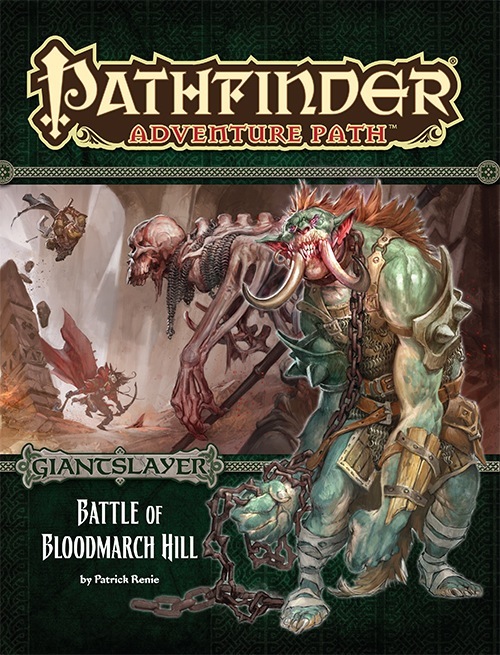
The Giantslayer Adventure Path begins! In the human town of Trunau, a beleaguered settlement surrounded by the brutal orcs of the Hold of Belkzen, the heroes must investigate a mysterious death. Before they uncover the truth, however, Trunau comes under attack by an orc army, and the heroes must help defend it—only to discover that the situation is worse than anyone realizes. For even the fearsome orc raid is just a distraction allowing a giant chieftain to recover the relics of an ancient giant hero from a tomb long forgotten beneath the town.

The adventurers now have their own island and port, but they’ll need more than one ship to defend it. When a past rival sends a fleet to attack them, they’re forced to pull out all the stops to defend their island home, scouring the harbors and docks of the Shackles in order to recruit more ships and crews to their flag. Yet when they sail to the attacker’s own island to get their revenge, the adventurers discover a traitor—one whose betrayal threatens not only their own fleet, but the very islands of the Shackles themselves. This volume of Pathfinder Adventure Path includes: • “The Price of Infamy,” a Pathfinder RPG adventure for 11th-level characters, by Tim Hitchcock. • Fleet battle rules that allow players to stand as admirals and commodores directing their own armadas against enemy fleets in large-scale naval warfare, by James Jacobs. • A glimpse behind the gray veil of Norgorber, Golarion’s most secretive deity, by Sean K Reynolds. • Lock-breakers and sea-devils in the Pathfinder’s Journal, by Robin D. Laws. • Four new monsters, by Savannah Broadway, Ryan Costello, Mark Moreland, and Sean K Reynolds.

Thail Donnodol, an eleven scholar, has been imprisoned for crimes he did not commit. The law is no refuge. Only by breaking into the fortress prison of Granite’s End can the player character save Thail from a lifetime of misery. There’s only one problem: Thail Donnodol does not want to be saved. At least not until he finds the Vengeance of Olindor. Part 3 of the Olindor Trilogy.
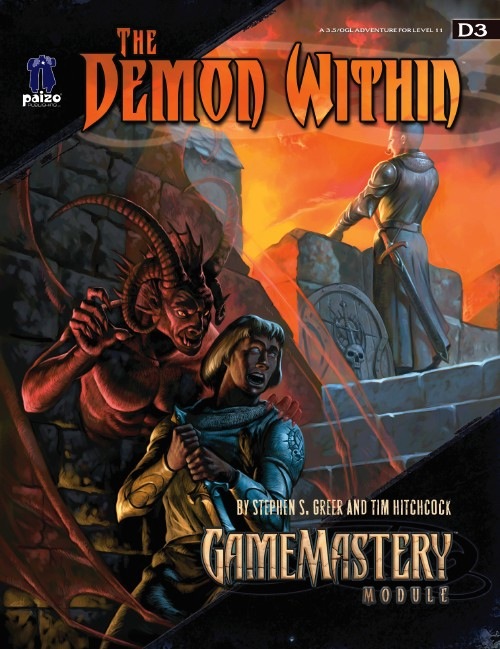
For years, the knights of Mendev have held back the evil locked inside the Worldwound, a vast, demon-tainted landscape. Every few years, they anoint a new protector, a sacred guardian charged with pitting his will against the teeming hordes bent on devouring the very souls of the living. This year, something has gone horribly wrong, and now a bloodthirsty demonic army has overrun the ancient fortress, and threatens to pour into the surrounding countryside.

In Westcrown, darkness brings fear and death, the night haunted by the spawn of a terrible curse. Striving to free the city from its decades-old blight, the PCs must reveal a long-buried secret and a treasure locked away for ages. Their journey will set them against the scum of Westcrown’s underworld, denizens of the haunted night, and the very forces of Hell itself, all in an attempt to rekindle the memories of long-dead spirits with stories still to tell. Yet what those souls reveal might prove even deadlier than the city’s midnight curse. This volume of Pathfinder Adventure Path includes: ► “What Lies in Dust,” a Pathfinder RPG adventure for 5th-level characters, by Michael Kortes. ► Revelations on and rules for joining Golarion’s most feared law bringers, the infamous Hellknights, by F. Wesley Schneider. ► Diverse and exotic treasures recovered from across Golarion by the Pathfinder Society, by Craig Shackleton. ► The unfortunate return of Radovan’s gangster past in the latest chapter of the Pathfinder’s Journal by Dave Gross. ► Seven new monsters by David Eitelbach, F. Wesley Schneider, and Hank Woon.
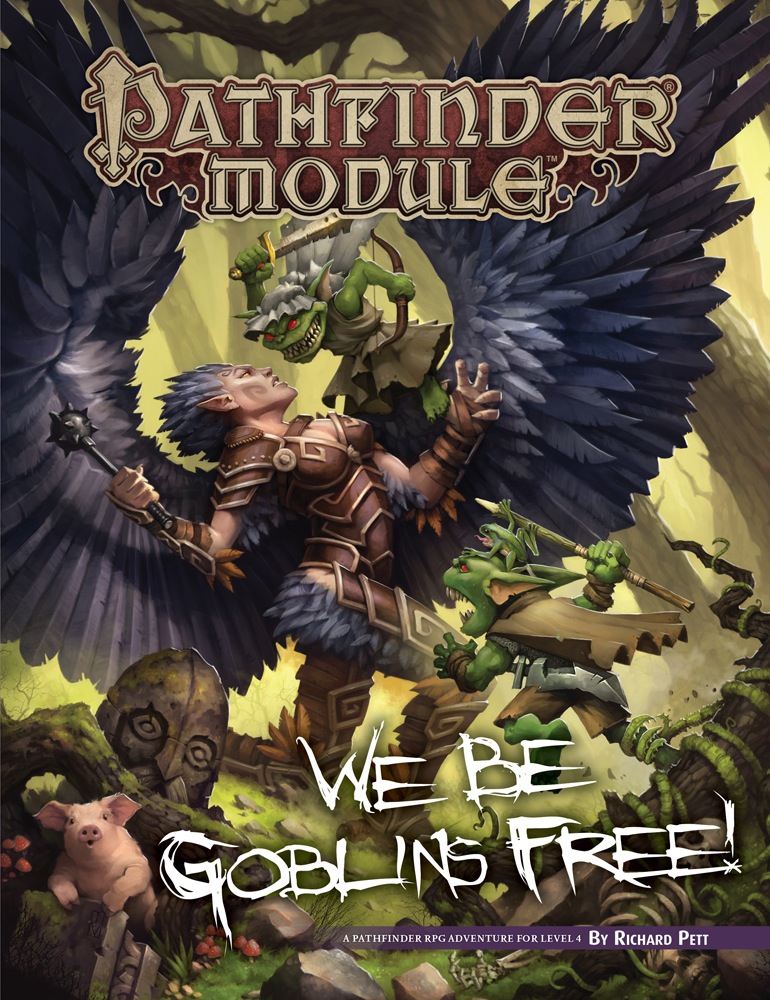
After losing chieftain after chieftain, the Birdcruncher goblin tribe finally found competent leadership in its four goblin "heroes". But it turns out leading a tribe of goblins isn't much fun, and the newest Birdcruncher chieftains are bored. In order to cure their doldrums, the chieftains have issued a new demand—find them some adventure, or else! Eager to please their great chieftains, the Birdcruncher goblins frantically try to whip up all sorts of amusements, including goblin games, feats of skill, and a grand feast. But trouble arises in the midst of the goblins' feast for their mighty leaders—the goblins who went to harvest truffles for the feast got beat up by some stinky humans! Part 3 of the We Be Goblins series.
Book 6, and the conclusion, of the Iron Gods campaign: More than treasure waits within the alien chambers of Silver Mount - here, the greatest of the Iron Gods dwells, preparing for its triumphant emergence after eons of preparation. Having recruited allies from across the land and cowed the brutal rulership of Numeria’s capital city for the time being, the heroes are ready for an expedition into Silver Mount’s mysterious interior. What strange perils from beyond the stars await the PCs within the metal walls of one of Golarion’s most legendary dungeons? In trying to save Numeria, could the heroes be walking right into a trap?
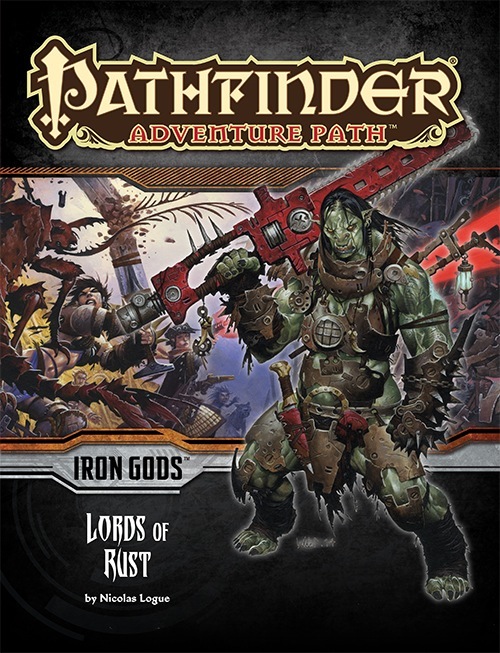
The heroes of the town of Torch follow a trail of clues to the sprawling junkyard known as Scrapwall, where bands of desperate and violent brigands vie for control of the technological remnants found within. The Lords of Rust dominate Scrapwall, and their swiftly rising power threatens more than just the town of Torch, for this gang has the support of one of the terrifying Gods of Numeria. What slumbers fitfully beneath the wreckage of Scrapwall could catapult the Lords of Rust into a new level of power if they're not stopped!
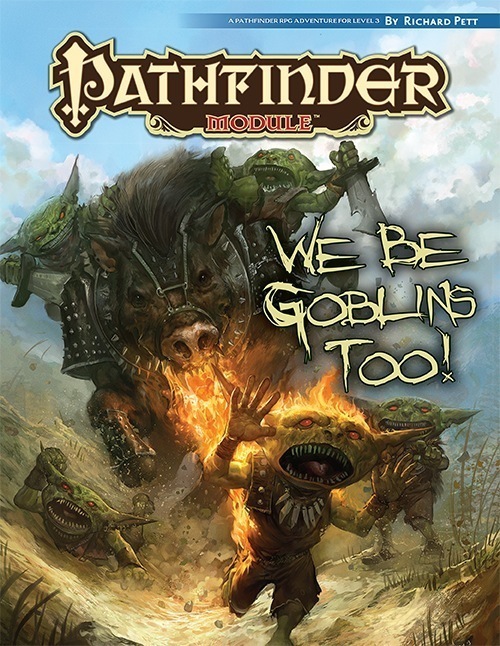
The Licktoads, once the great and fierce goblin tribe in Brinestump Marsh, were defeated by human adventurers! All that remains of the tribe are its four goblin "heroes". Homeless and bored, they left their swampy homeland to join the neighboring goblin tribe, the Birdcrunchers. The good news is that the Birdcrunchers are willing to let the goblin heroes join their tribe. The better news is that the Birdcrunchers have heard of these four, and want one of them to become their new chieftain. The bad news is that before the goblins can join, they'll need to endure a series of dangerous and humiliating tests. Very dangerous. Very humiliating. The worse news is that lately Birdcruncher chieftains have had really short lifespans—they're being killed by the pet fire-breathing boar of a local ogre who wants the Birdcruncher land as his own. Part 2 of the We Be Goblins series.

557 pages - five adventures! The first act of the critically acclaimed ZEITGEIST: The Gears of Revolution Adventure Path now compiled into a gorgeous hardcover book! These five adventures are the first act of a steam & spell campaign for the Pathfinder RPG (also available for Dungeons & Dragons 4th edition). Steam and soot darken the skies above the city of Flint, and the choking products of its industrial forges sweep from the majestic harbor to the fey rainforests that dot its knife-toothed mountains. The Unseen Court, the Great Hunt, and the many spirits of the land no longer receive tribute, but they cannot enter these new domains of steam and steel to demand their tithe. The impoverished workers who huddle in factory slums fear monsters of a different breed, shadowy children of this bleak urban labyrinth. Times are turning. The skyseers – Risurs folk prophets since their homeland’s birth – witness omens in the starry wheels of heaven, and they warn that a new era is nigh. But what they cannot foresee, hidden beyond the smog of the night sky, is the face of this coming era, the spirit of the age. The zeitgeist. This tome contains Act One of ZEITGEIST: The Gears of Revolution, a cinematic adventure path designed for experienced Game Masters. These five 'steam and spell' adventures will take your party - members of the Royal Homeland Constabulary - from 1st to 8th level as they solve murders, engage in magical spycraft, and unearth villainous conspiracies. Take a step away from traditional fantasy, and play a part in shaping the coming age!
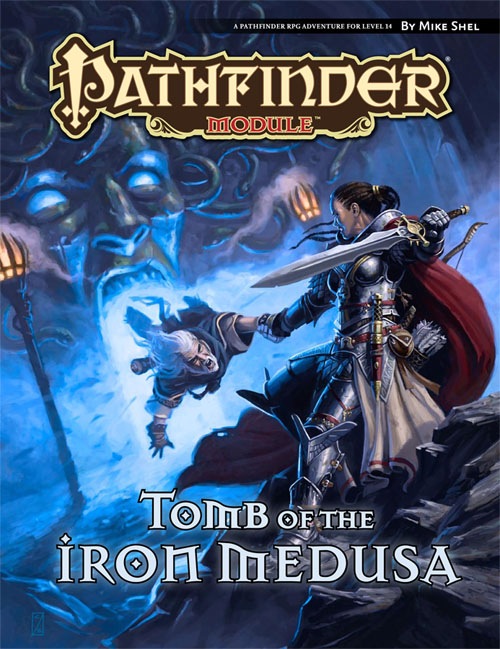
Hidden in the remote southern range of the World’s Edge Mountains lies a mysterious necropolis known in legend as the Tomb of the Iron Medusa. When the last heir of the dungeon’s long-dead noble builders hires the PCs to explore the forlorn and deadly site in search of evidence that may clear his family name, the intrepid heroes soon find themselves in over their heads. For the Tomb of the Iron Medusa does not give up its secrets lightly, and the dangerous truths that lie within its ancient, trap-laden crypts may have been hidden for very good reasons indeed.
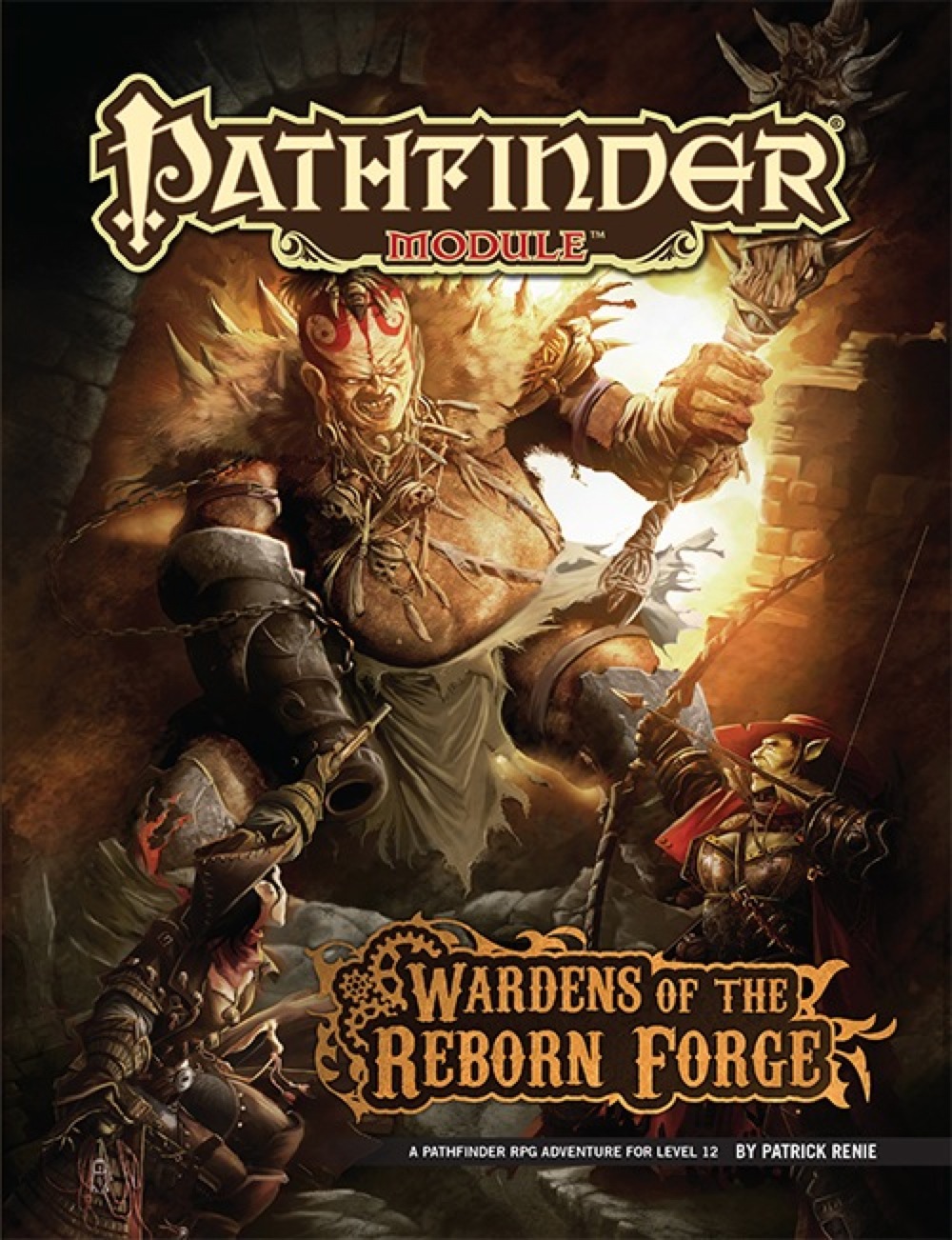
Alkenstar, City of Smog, is a bastion of civilization in the magic-warped region known as the Mana Wastes. Its ingenious citizens survive in the treacherous Spellscar Desert with the help of canny inventions like guns and clockwork automatons, but now their construct protectors have begun to run amok within the city. It falls to the PCs to venture beyond the city walls to find the source of their strange behavior.

What makes Heroes into Villains? Damien Anthilas has fallen from ally to adversary, but something desperate in him has struck a chord with you. Why would he risk everything to steal the memories of the citizens of Anduria? Left with only a cryptic clue, the characters seek answers from the burned out remnants of his former home. Anthilas Manor is a place of dark magic and even darker history, where the ghosts of the past hold sway and the influence of the mad god is still felt to this day
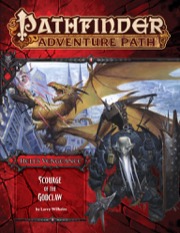
Now bound to Queen Abrogail by infernal contracts, the villainous adventurers are tasked with destroying the Glorious Reclamation's headquarters in the former citadel of the Hellknight Order of the Godclaw, where they face a gold dragon ally of Iomedae herself! Only if they can survive the terrible onslaught of this fearsome foe and secure the citadel from the revolutionaries can the vile characters succeed at their quest—to perform an evil ritual, using the dragon's head to craft a legendary weapon capable of defeating the Glorious Reclamation's army of valorous knights once and for all.
A free adventure for the Pathfinder RPG, focusing upon a city ravaged by a natural disaster and besieged on all sides. Party levels 4-5 will face off against a half-dragon, half-demon overlord known as Ymial, a demonic seductress, goblin warbands, and drow slavers beneath the ground all while trying to discover the secrets of the city of Fairhaven. Works well for players who are looking to visit a large town and face off in a high-stakes conflict even at low levels. Includes lots of details on the town, from rumors to residents.
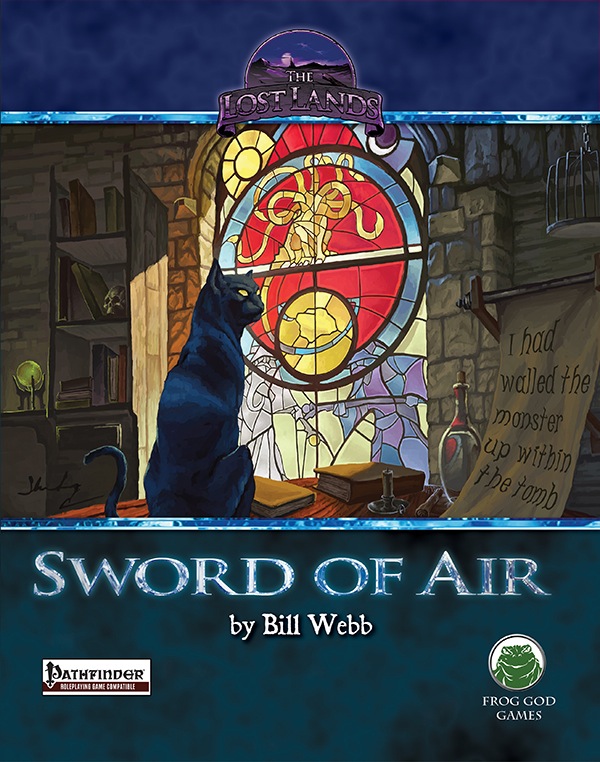
What is the Lost Lands? The Lost Lands is the home campaign world of Necromancer Game's and Frog God Game's own Bill Webb. This campaign has been continuously running since 1977. Many of the adventures published by Necromancer Games and Frog God Games are directly inspired by this campaign. They have evolved over the decades, and more material continues to flow from it as the dice keep rolling. Sages and wizards of legend speak of the Lost Lands—many of the players who have lived and died in Bill's campaign over the years now have a place in history (in the books). Frac Cher the dwarf, Flail the Great, Bannor the Paladin, Speigle the Mage, and Helman the Halfling are well known to the fans of Bill's work. This is the game world, and these are the adventures in which the players of these famous characters lived and died. Hundreds of players over the past 35 years have experienced the thrills and terrors of this world. The Sword of Air is the centerpiece of the Lost Lands. Currently, this epic tome consists of several parts: 1. The Hel’s Temple Dungeon—kind of like Tomb of Horrors on crack. This six-level, trap-and-puzzle infested dungeon formed the basis of Bill's game through his high school and college years. Clark Peterson’s very own Bannor the Paladin spent several real life months in the place, and, sadly, finished the objective. This is where the fragments of the fabled Sword of Air can be found…perhaps. 2. The Wilderness of the Lost Lands extending to the humanoid-infested Deepfells Mountains and providing detail about the nearby Wizard’s Wall. This so-called “wall” was raised by the archmages Margon and Alycthron harnessing the Spirit of the Stoneheart Mountains to raise the land itself, creating a massive escarpment to block invaders from the Haunted Steppes. These archmages are actual player characters from the early 1980s who live on in the legends of the Lost Lands. Over 70 unique encounter areas are detailed, and each one is a mini-adventure in itself. New wilderness areas may be added based on bonus goals described below! 3. The Ruined City of Tsen. Legend has it the city was destroyed by a falling meteor. This place forms an aboveground dungeon area the size of a city, with over 100 detailed encounter areas. It’s a very dark place…even at noon. 4. The Wizard’s Feud—This campaign-style adventure pits the players in a long-running series of intrigues and battles between two archmages. Which side will they take? Their actions all play into the overall quest, and could well determine which side wins. Law and Chaos are not always what they seem, and if the wrong decisions are made, the entire ordeal could fail. Remember, one of the wizards WANTS Tsathogga to win. 5. New monsters, new demons, new spells, and new rules for various aspects of play. 6. The Tower of Bells. This dungeon is the result of the workshop Bill ran at PaizoCon 2013, where the participants assisted him in building an old-school dungeon. Visit the tower and discover the secrets of the “artist” within. Beware: those entering may never come out!

Something is amiss in the remote mountain town of Zuria. The head priest has not filed a report in months, and traders following the winding road into the high-altitude valley do not find their way back home. The Church of Palnor, benefactor and watchers of the Tomb of Kings, are greatly concerned. Can the PC discover what has happened in this isolated mountain town before events turn disastrous?
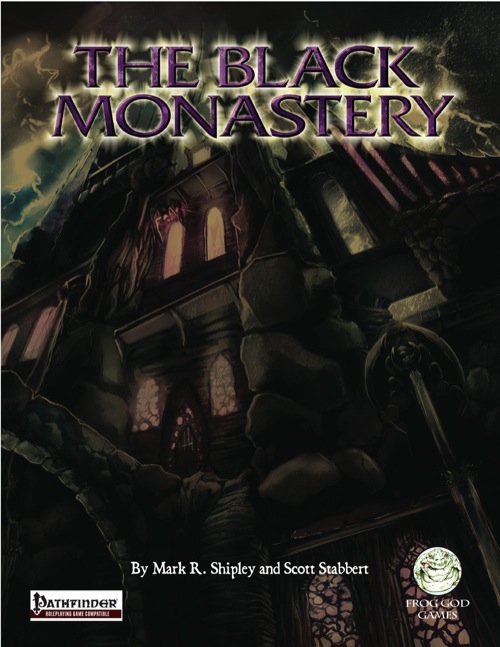
The Legend of the Black Monastery Two centuries have passed since the terrible events associated with the hideous cult known as the Black Brotherhood. Only scholars and story-tellers remember now how the kingdom was nearly laid to waste and the Black Monastery rose to grandeur and fell into haunted ruins. The Brothers first appeared as an order of benevolent priests and humble monks in black robes who followed a creed of kindness to the poor and service to the kingdom. Their rules called for humility and self denial. Other religious orders had no quarrel with their theology or their behavior. Their ranks grew as many commoners and nobles were drawn to the order by its good reputation. The first headquarters for the order was a campsite, located in a forest near the edge of the realm. The Brothers said that their poverty and dedication to service allowed them no resources for more grand accommodations. Members of the Black Brotherhood built chapels in caves or constructed small temples on common land near villages. They said that these rustic shrines allowed them to be near the people they served. Services held by the Brothers at these locations attracted large numbers of common people, who supported the Black Brotherhood with alms. Within 50 years of their first appearance, the Black Brotherhood had a number of larger temples and abbeys around the kingdom. Wealthy patrons endowed them with lands and buildings in order to buy favor and further the work of the Brothers. The lands they gained were slowly expanded as the order’s influence grew. Many merchants willed part of their fortunes to the Black Brotherhood, allowing the order to expand their work even further. The Brothers became bankers, loaning money and becoming partners in trade throughout the kingdom. Within 200 years of their founding, the order was wealthy and influential, with chapters throughout the kingdom and spreading into nearby realms. With their order well-established, the Black Brotherhood received royal permission to build a grand monastery in the hill country north of the kingdom’s center. Their abbot, a cousin of the king, asked for the royal grant of a specific hilltop called the Hill of Mornay. This hill was already crowned by ancient ruins that the monks proposed to clear away. Because it was land not wanted for agriculture, the king was happy to grant the request. He even donated money to build the monastery and encouraged others to contribute. With funds from around the realm, the Brothers completed their new monastery within a decade. It was a grand, sprawling edifice built of black stone and called the Black Monastery. From the very beginning, there were some who said that the Black Brotherhood was not what it seemed. There were always hints of corruption and moral lapses among the Brothers, but no more than any other religious order. There were some who told stories of greed, gluttony and depravity among the monks, but these tales did not weaken the order’s reputation during their early years. All of that changed with the construction of the Black Monastery. Within two decades of the Black Monastery’s completion, locals began to speak of troubling events there. Sometimes, Brothers made strange demands. They began to cheat farmers of their crops. They loaned money at ruinous rates, taking the property of anyone who could not pay. They pressured or even threatened wealthy patrons, extorting money in larger and larger amounts. Everywhere, the Black Brotherhood grew stronger, prouder and more aggressive. And there was more… People began to disappear. The farmers who worked the monastery lands reported that some people who went out at night, or who went off by themselves, did not return. It started with individuals…people without influential families…but soon the terror and loss spread to even to noble households. Some said that the people who disappeared had been taken into the Black Monastery, and the place slowly gained an evil reputation. Tenant farmers began moving away from the region, seeking safety at the loss of their fields. Slowly, even the king began to sense that the night was full of new terrors. Across the kingdom, reports began to come in telling of hauntings and the depredations of monsters. Flocks of dead birds fell from clear skies, onto villages and city streets. Fish died by thousands in their streams. Citizens reported stillborn babies and monstrous births. Crops failed. Fields were full of stunted plants. Crimes of all types grew common as incidents of madness spread everywhere. Word spread that the center of these dark portents was the Black Monastery, where many said the brothers practiced necromancy and human sacrifice. It was feared that the Black Brotherhood no longer worshipped gods of light and had turned to the service of the Dark God. These terrors came to a head when the Black Brotherhood dared to threaten the king himself. Realizing his peril, the king moved to dispossess and disband the Black Brother hood. He ordered their shrines, abbeys and lands seized. He had Brothers arrested for real and imagined crimes. He also ordered investigations into the Black Monastery and the order’s highest ranking members. The Black Brotherhood did not go quietly. Conflict between the order and the crown broke into violence when the Brothers incited their followers to riot across the kingdom. There were disturbances everywhere, including several attempts to assassinate the king by blades and by dark sorcery. It became clear to everyone that the Black Brotherhood was far more than just another religious order. Once knives were drawn, the conflict grew into open war between the crown and the Brothers. The Black Brotherhood had exceeded their grasp. Their followers were crushed in the streets by mounted knights. Brothers were rounded up and arrested. Many of them were executed. Armed supporters of the Black Brotherhood, backed by arcane and divine magic, were defeated and slaughtered. The Brothers were driven back to their final hilltop fortress – the Black Monastery. They were besieged by the king’s army, trapped and waiting for the king’s forces to break in and end the war. The final assault on the Black Monastery ended in victory and disaster. The king’s army took the hilltop, driving the last of the black-robed monks into the monastery itself. The soldiers were met by more than just men. There were monsters and fiends defending the monastery. There was a terrible slaughter on both sides. In many places the dead rose up to fight again. The battle continued from afternoon into night, lit by flames and magical energy. The Black Monastery was never actually taken. The king’s forces drove the last of their foul enemies back inside the monastery gates. Battering rams and war machines were hauled up the hill to crush their way inside. But before the king’s men could take the final stronghold, the Black Brotherhood immolated themselves in magical fire. Green flames roared up from the monastery, engulfing many of the king’s men as well. As survivors watched, the Black Monastery burned away, stones, gates, towers and all. There was a lurid green flare that lit the countryside. There was a scream of torment from a thousand human voices. There was a roar of falling masonry and splitting wood. Smoke and dust obscured the hilltop. The Black Monastery collapsed in upon itself and disappeared. Only ashes drifted down where the great structure had stood. All that was left of the Black Monastery was its foundations and debris-choked dungeons cut into the stones beneath. The war was over. The Black Brotherhood was destroyed. But the Black Monastery was not gone forever. Over nearly two centuries since its destruction, the Black Monastery has returned from time to time to haunt the Hill of Mornay. Impossible as it seems, there have been at least five incidents in which witnesses have reported finding the Hill of Mornay once again crowned with black walls and slate-roofed towers. In every case, the manifestation of this revenant of the Black Monastery has been accompanied by widespread reports of madness, crime and social unrest in the kingdom. Sometimes, the monastery has appeared only for a night. The last two times, the monastery reappeared atop the hill for as long as three months…each appearance longer than the first. There are tales of adventurers daring to enter the Black Monastery. Some went to look for treasure. Others went to battle whatever evil still lived inside. There are stories of lucky and brave explorers who have survived the horrors, returning with riches from the fabled hordes of the Black Brotherhood. It is enough to drive men mad with greed – enough to lure more each time to dare to enter the Black Monastery.
When strange reports of misty undead spread through Absalom, you and your fellow Pathfinders are dispatched to the half-drowned district of Puddles. Notoriously rough, the drooling addicts, flesh panderers, and quick-handed knifers of Puddles are the least of your worries. The night's tide brings with it an ancient armada of some long-forgotten war and you are the only thing between their mist-shrouded ghost fleet and Absalom's utter oblivion.
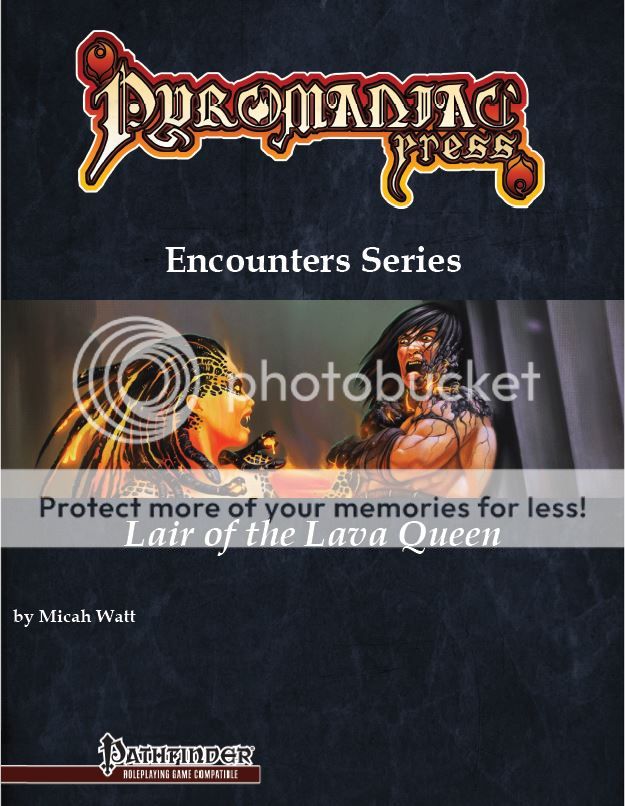
Rumours tell of a secluded cave where a powerful cleansing artifact resides, guarded by a mythical creature that no one has seen and lived to tell the tale. Heat boils forth from this cave, and tortured shrieks echo on the wind. Do you have what it takes to brave the Lair of the Lava Queen?