Nothing stirs in St. Anton. Through the alleys and streets, along castle walls, the town lies in a dreamlike lull. Moonlight shines upon the cobblestone paths winding lazily up and down the small hills. Sagging balconies and arching trees bow idly over the quiet streets. Evils is Afoot The Baron has descended into insanity, an eldritch creature stalks the streets, and clouds of despair gather over the townspeople. St. Anton needs brave heroes to unravel its mystery, and restore her fire.
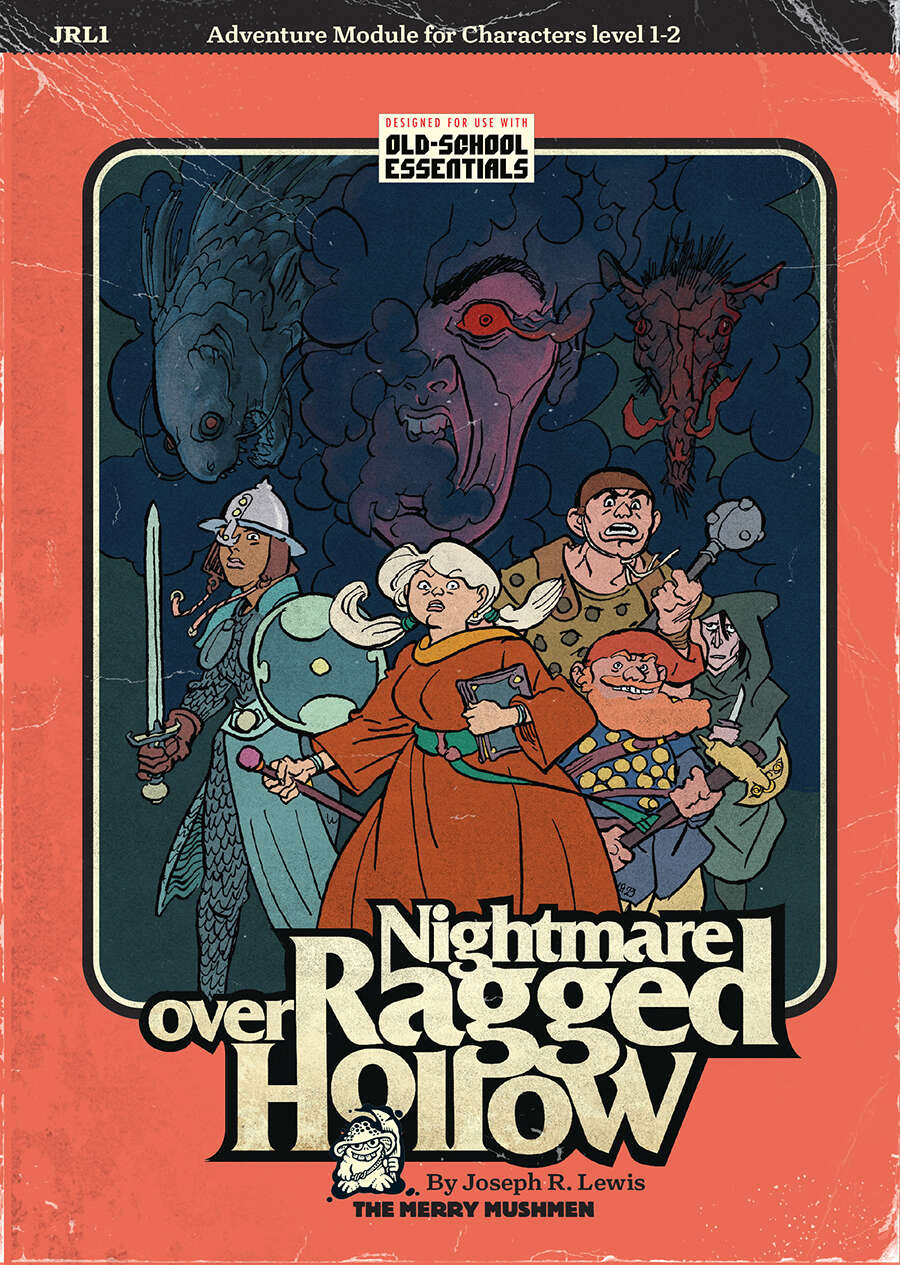
A new, expanded, OSR-ised, prettified edition of Joseph R. Lewis’ Ragged Hollow Nightmare which was rated among The Best by Tenfootpole. Joseph Lewis hit a perfect balance between the classics of dungeonverse fantasy and the whimsy of the folk tales we love so much (as testified by our Folklore Bestiary. we released last year), adding a dash of dreamworld strangeness and a pinch of body horror to spice up his brew. We did our best to respect his recipe when adding our extra material (about 30 pages of it). We worked with Joe and Li-An (the perfect artist to give life to spooky Ragged Hollow and its strange surroundings) to make the best module we could: a solid introduction to old-school gaming for both players and gamemasters. And for the veterans among us, it also makes an excellent, full-fledged campaign starter. Nightmare over Ragged Hollow is a sandbox adventure centred around a quaint town at the edge of the kingdom. But however quiet life in Ragged Hollow is, the town lies between places where you shouldn’t be traveling alone. Places like Gloam Wood (“A witch or two lurk there!”), the Bleak Mountains (“I’m told there are bugbears…”) and their infamous Mount Mourn (“Home, they say, to cursed Dwarven ruins”), not to forget the Wailing Hills (“Bandits on every road!”). There’s even a haunted house by the river (“That mad inventor riddled it with traps!”). But only when an impenetrable dome of golden light materialises around the Temple of Halcyon (“Hey, my kids go to school there!”) do things really get out of hand. Some selfless heroes (or, failing that, a bunch of greedy ne’er-do-wells) should really get involved. One town with three adventure mini-sites Three small dungeons One 50-room dungeon Three hexes with 16 detailed locations Two groups of potential allies or rivals Sixteen pre-generated characters One deadly countdown! Written for the Old-School Essentials (OSE) rule system

“Rats in the Walls”: A dockside tavern in Khromarium is plagued by rats of a most unusual breed. These abominable rodents have ruined the tavern keeper’s business and his life. The man is desperate, and he offers a substantial reward for the elimination of his horrific problem.

The Children of the Harvest is a stand-alone adventure set in The Blight for 4—6 7th- to 8th level characters. The Blight is a dark place. Children disappear all the time, especially those of poor. The Harvester of Cribs, one of the city's strange local gods, is blamed for many of these disappearances. Typically , these disappearances arc random, isolated instances, and in many cases, Harvester has nothing to do with it all, merely being a convenient explanation or alibi for some other nefarious activity. This time, however, 36 children have disappeared from their homes— all in a single night—and many of them were not from the houses of the poor. Not even jaded folk of City-State of Castorhage will stand for this (especially not a prominent Justice and a guild leader who have each lost a child in this rash of disappearance). Now is the time for a call to action. Now is the time for heroes.
A ten-part, fourthcore megadungeon designed to take a party of 4-6 players from level 1 to level 10. The Voice of All spoke three times before falling into silence. The first time to give shape to the Ancients. The second to give them the world as their domain. The third to build the TOWER for the war that was to come. And war did come. The Ancients, primordial warriors charged with protecting the world, were subverted by three great crusaders, vindictive and powerful. The Ancients were stripped of immortality and cast from the heavens to serve and suffer with the rest of humanity. The crusaders claimed new bodies for themselves, and became the Triumvirate, god-tyrants of all realms. The long line of descendants of the Ancients is dwindling, along with humanity’s last hope. What few remain have gathered to enter the TOWER OF THE ASCENDANTS. Crumbling stone tablets of ages forgotten say that a mortal who ascends the TOWER that pierces the heavens and slays the gods who dwell in its highest bower will reclaim lost immortality.
England, 1620. To strike a blow against the Patriarchy, six women perform a dangerous rite in an abandoned priory. Through dance, they commune with Terpsichore, Greek muse and patroness of dancers. Starving demons slither across the moors; monstrous nuns shriek in the infirmary; and within the Attic, a great unraveling awaits. The fate of the world rests in the hands of the players. Will they bring about an egalitarian utopia? Will they skulk away in the night, pockets bulging with treasure? Will they bring about the destruction of all things? Will they find the Tract of Teratology, a randomly-generated creature-summoning ritual with 3.6 quadrillion combinations? After this adventure, nothing will be the same. An adventure for Lamentations of the Flame Princess Weird Fantasy Role-Playing and other traditional role-playing games. Writing by Rafael Chandler Cover Art by Jason Rainville Interior Art by Jason Rainville and Ian MacLean Cartography by Ian MacLean Layout and Design by Sarah Richardson

To Kill A King Death to King Ovar the tyrant! Life to law and order! Four characters are charged with a mission so insane, so daring, that terming it an assassination does not do it justice. Are the four volunteers who would lay low King Ovar killers or heroes? If murderers, how are they better than the madman theyre assigned to kill? And even if they are mere assassins, are they determined enough to overcome the Maze of Zayene? Snared in the Wizards Web

Sometimes sneaking into the dungeon, avoiding traps and slaying monsters is the easy part. The hard part is getting back out alive. This is a dungeon crawl adventure with a twist, the adventure starts at the end of the dungeon with the party trying to find their way back to safety.
Two Days to Live! Welcome to Om Amarna, and the annual Horse Festival. It is a time of celebration, drinking, haggling, and thanksgiving. Celebrate while you can, because soon the peace will be shattered. And in its wake will come danger, suspicion, and tragedy. In this first adventure in the cursed land of Tieros, beginning characters will be forced to work together in a race against time to find critical answers in a crowded, diverse, and paranoid city. Answers that will satisfy the Dark Guard and the Cult of Justice. Answers that will save their own necks from the gallows. The Sword of Justice introduces Tieros, a land cursed by the acts of an ancient hero, bound by common fate, and diverse in culture and belief. In this adventure characters will become familiar with an exotic new PC race, the dangers of practicing magic in Tieros, the fanatical Cult of Justice who worships Law itself, and the ubiquitous Dark Guard, the military power that protects and enforces peace. Will you survive your first adventure in Tieros, or will it claim your life? Published by MonkeyGod Enterprises

For decades, Theatre Infernalis offered shocking and frightful entertainment to customers who entered its gaping demonic facade and saw a frightful portrait of the eternal torments that await all sinners. Now rumours tell of the aging and supposedly-cursed proprietor's deteriorating health and the theatre's impending sale, and the Artist's Quarter has been abuzz with those seeking one final fright with a walk through the crucible-licked walls of the infernal house of the macabre before its final curtain call. But are the theatre's smoke-and-mirrors and cheap scares hiding a truly wicked secret? What is the nature of the curse and illness that afflict the owner? And did foul and profane rites once take place between its walls that outside forces now seek to exploit? What happens when the spookshow's fun and games transform into a terrifying reality, threatening to spill forth an infernal malevolence onto the streets of the Blight?

The Eaves of Mirkwood: a 32-page adventure that makes a perfect introduction to Adventures in Middle-earth for new players, or a handy episode to drop into your existing campaign. The Company finds themselves setting out from Woodmen-town to travel through the Eaves of Mirkwood towards Lake-town. When the Journey goes awry they must draw swords in aid of a village beleaguered by the dreaded Greymuzzle Hob. Using cut down rules and offering lots of advice, Eaves of Mirkwood is a great starting point for your Adventures in Middle-earth. Published by Cubicle 7 Entertainment.
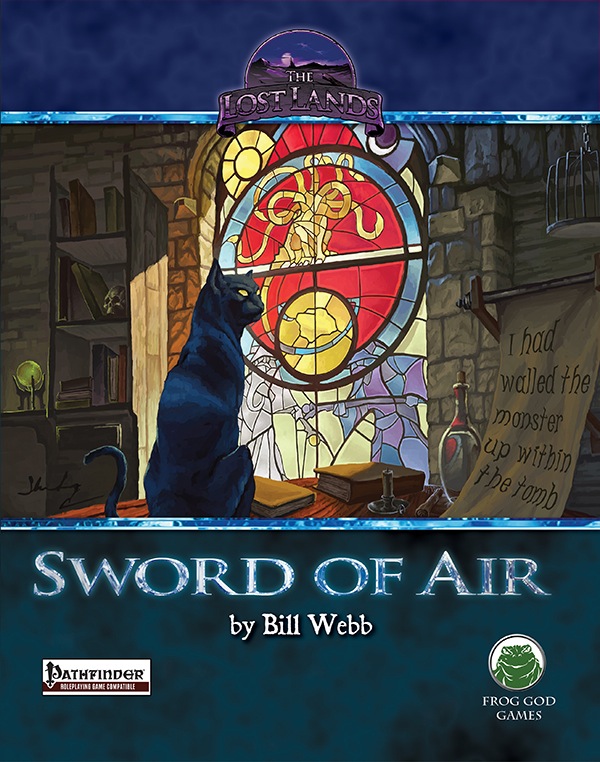
What is the Lost Lands? The Lost Lands is the home campaign world of Necromancer Game's and Frog God Game's own Bill Webb. This campaign has been continuously running since 1977. Many of the adventures published by Necromancer Games and Frog God Games are directly inspired by this campaign. They have evolved over the decades, and more material continues to flow from it as the dice keep rolling. Sages and wizards of legend speak of the Lost Lands—many of the players who have lived and died in Bill's campaign over the years now have a place in history (in the books). Frac Cher the dwarf, Flail the Great, Bannor the Paladin, Speigle the Mage, and Helman the Halfling are well known to the fans of Bill's work. This is the game world, and these are the adventures in which the players of these famous characters lived and died. Hundreds of players over the past 35 years have experienced the thrills and terrors of this world. The Sword of Air is the centerpiece of the Lost Lands. Currently, this epic tome consists of several parts: 1. The Hel’s Temple Dungeon—kind of like Tomb of Horrors on crack. This six-level, trap-and-puzzle infested dungeon formed the basis of Bill's game through his high school and college years. Clark Peterson’s very own Bannor the Paladin spent several real life months in the place, and, sadly, finished the objective. This is where the fragments of the fabled Sword of Air can be found…perhaps. 2. The Wilderness of the Lost Lands extending to the humanoid-infested Deepfells Mountains and providing detail about the nearby Wizard’s Wall. This so-called “wall” was raised by the archmages Margon and Alycthron harnessing the Spirit of the Stoneheart Mountains to raise the land itself, creating a massive escarpment to block invaders from the Haunted Steppes. These archmages are actual player characters from the early 1980s who live on in the legends of the Lost Lands. Over 70 unique encounter areas are detailed, and each one is a mini-adventure in itself. New wilderness areas may be added based on bonus goals described below! 3. The Ruined City of Tsen. Legend has it the city was destroyed by a falling meteor. This place forms an aboveground dungeon area the size of a city, with over 100 detailed encounter areas. It’s a very dark place…even at noon. 4. The Wizard’s Feud—This campaign-style adventure pits the players in a long-running series of intrigues and battles between two archmages. Which side will they take? Their actions all play into the overall quest, and could well determine which side wins. Law and Chaos are not always what they seem, and if the wrong decisions are made, the entire ordeal could fail. Remember, one of the wizards WANTS Tsathogga to win. 5. New monsters, new demons, new spells, and new rules for various aspects of play. 6. The Tower of Bells. This dungeon is the result of the workshop Bill ran at PaizoCon 2013, where the participants assisted him in building an old-school dungeon. Visit the tower and discover the secrets of the “artist” within. Beware: those entering may never come out!
The insurgent agent Adan, a spy in Alvedara, came across plans for an upcoming assault on Bodrun, the largest remaining dwarven clanhold in the South. Though the dwarves were unknown to him, this Sarcosan rebel decided that he must do his best to get word to these allies in the mountains. He stole the plans and abandoned his cover identity, fleeing east along the Eren and hoping to find succor in the Forest of the Sahi before his trek into the Kaladruns. He didn’t make it that far. A legate spyhunter was on his tail within hours of his departure, and with his stronger mount and divinatory magic, was sure to run him to ground on the Horse Plains of Erenhead. Adan hoped to throw off the scent of his tracker in the town of Malima, where he had contacts and might be able to wait out the legate in a safehouse. Unfortunately, the situation in Malima had worsened since Adan had last been there, and it had become a place of exile for Alvedarans with the plague. It was a question of choosing the lesser of two evils: plague and possible death in Malima, or torture, betrayal, and certain death at the hands of the legate. Adan chose to hide in Malima, but contracted the plague while hiding from his pursuers. Though unable to contact the outside world, Adan sent his familiar, a raven, eastward in the hopes that it would reach a dwarven settlement that could send agents to aid him. The raven made it to the Hagaran Observatory in the Forest of the Sahi, where the PCs have been assisting the sages of the observatory. Midnight Runner Up - Gen Con 2005

Ages ago, a religious order known as the Druun practiced rituals from inside sacred oak groves, ceremonial pools, and stone henges. In time, the Church of Law and Order suppressed the Druunic teachings, and the ancient holy sites were lost, forgotten, or converted to other uses. One such former site is located in the capital city of Dolmvay in the center of a small neighborhood known as Whiteoak Square. This neighborhood has recently been experiencing a strange phenomenon: At night, small dancing lights have been seen floating throughout the neighborhood. The residents were afraid of this sorcery at first, however, the lights seem to exude a feeling of peace and contentment, and the locals have grown used to them. How it Started: A few weeks ago, a butcher named Walton Brand was clearing out his cellar when he stumbled upon a secret underground passage that led to an ancient Druun hall. This hall was filled with lost relics, arcane lore, and forgotten treasures of the Druun. Walton told his friends, Loomis the Baker and the chandler Stefan of Walsbury, and the three men began sneaking away from their wives at night to dress in Druun finery and pretend to be men of wealth. A harlot named Red Kirsten was hired to attend them as they drank, feasted, and cavorted in the sacred hall. Unbeknownst to the revelers, the Druun hall still retained some of its magical powers and their merriment awakened the ancient guardian spirits of the grove. These creatures, known as faerlings, are the lights that have been seen dancing throughout the neighborhood. The faerlings were given life by the revelers' glee, and they project that joy and happiness onto the other residents of the neighborhood. This glee, however, is about to turn to horror. . . Oak Grove Whispers is a Labyrinth Lord™ adventure designed for 3-6 characters of 1st-3rd levels (about 10 levels total). The adventure is broken up into three chapters that take place in a small neighborhood located in the capital city of Dolmvay (the Labyrinth Lord is free to substitute any medium- to large-sized city from his own campaign world). Oak Grove Whispers involves a mixture of roleplaying, investigation, and dungeon crawling, so a diverse range of classes is recommended. As the adventure is set in a civilized city, the characters must also be careful their interaction with NPCs does not land them on the wrong side of the law. Published by Small Niche Games

The Notorious Goblin crime boss Krenko has escaped confinement in the Udzeo prison under suspicious circumstances. Now he plots to reestablish control over his criminal enterprise, raising the spector of a goblin gang war that could jeapordize the tenuous peace among the guilds. You must find Krenko and secure him before all-out war ensues! An introductory adventure.
The road to the remote village of Swordfall is a long and winding one. It takes pilgrims who wish to visit the holy site from the main trade road, through the hills, and into the mountains where once, thousands of years ago, two gods engaged in an epic battle. Now, all that remains of the battlefield is a lone sword, several hundred feet tall, embedded in the ground at the center of a massive crater. Over the years, a large temple to Thuul, god of battle, sprung up around the site. Now, warriors and fighters from across the land travel to Swordfall to pay their respects once in their lifetime. Recently, however, pilgrims have begun going missing. Somewhere between the main road and Swordfall itself, something, or someone, has been waylaying travelers. Unbeknownst to most, a cult to Ghenna has taken over one of the lone inns along the route and has begun using it to capture and sacrifice pilgrims to their own dark god. Unless a group of adventurers can stop them, the sacrifices won't stop.
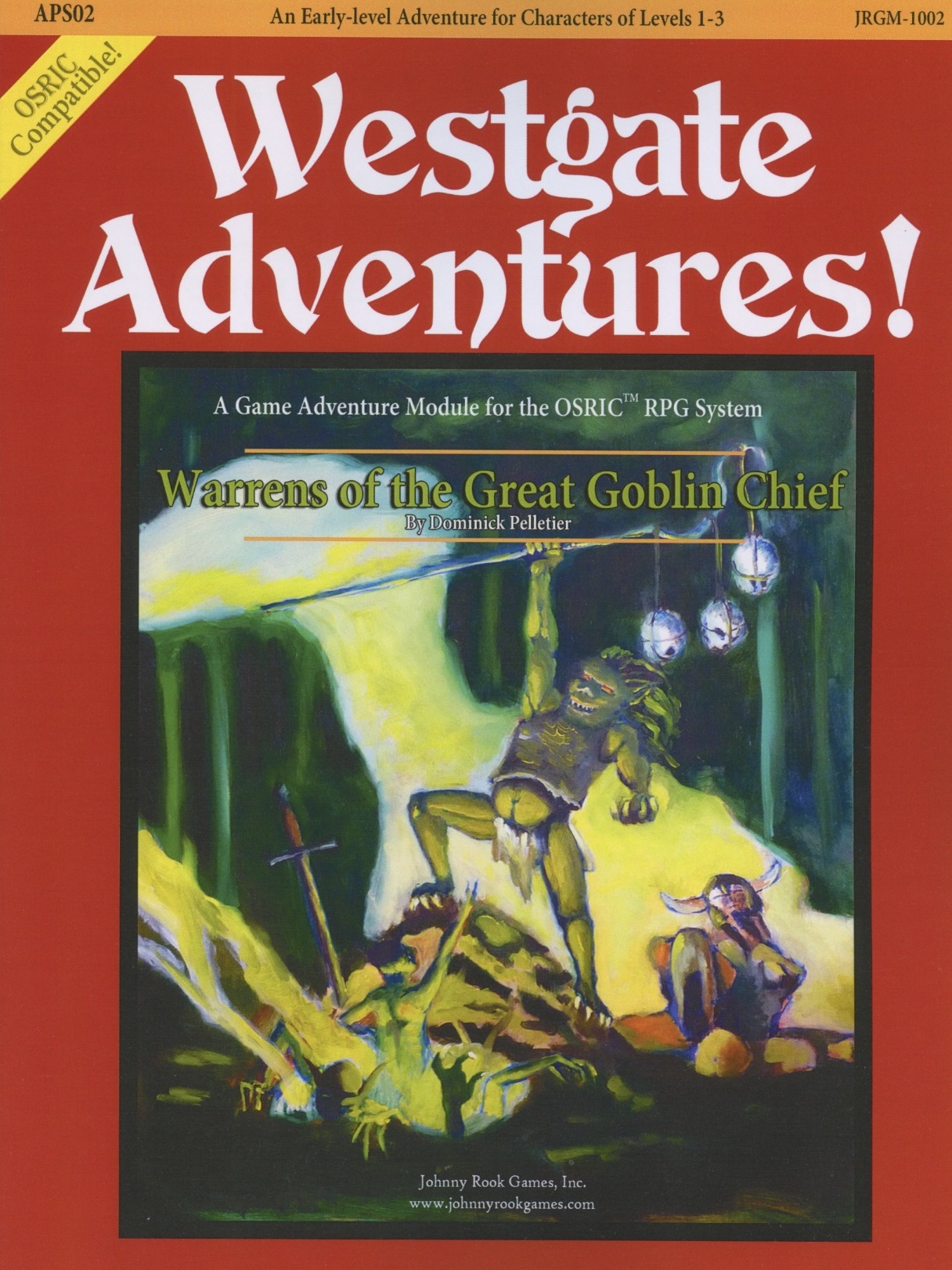
Goblins have returned to the area of Westgate, seeking an ancient magical item constructed for their foul kind. In their search, the goblins attack an imperial convoy secretly disguised as a merchant’s wagon. The knowledge that goblins are near must be kept quiet from the public, thus a small band of adventurers is required to seek out the creatures and the stolen magic item, deep inside the warrens of the great goblin chief! But the adventure does not end there...
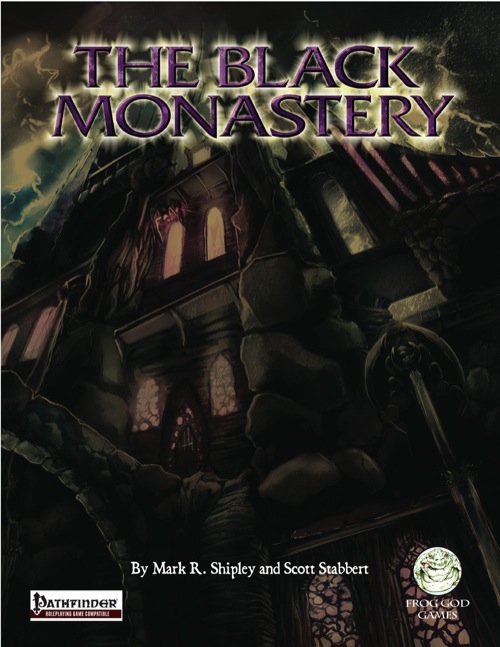
The Legend of the Black Monastery Two centuries have passed since the terrible events associated with the hideous cult known as the Black Brotherhood. Only scholars and story-tellers remember now how the kingdom was nearly laid to waste and the Black Monastery rose to grandeur and fell into haunted ruins. The Brothers first appeared as an order of benevolent priests and humble monks in black robes who followed a creed of kindness to the poor and service to the kingdom. Their rules called for humility and self denial. Other religious orders had no quarrel with their theology or their behavior. Their ranks grew as many commoners and nobles were drawn to the order by its good reputation. The first headquarters for the order was a campsite, located in a forest near the edge of the realm. The Brothers said that their poverty and dedication to service allowed them no resources for more grand accommodations. Members of the Black Brotherhood built chapels in caves or constructed small temples on common land near villages. They said that these rustic shrines allowed them to be near the people they served. Services held by the Brothers at these locations attracted large numbers of common people, who supported the Black Brotherhood with alms. Within 50 years of their first appearance, the Black Brotherhood had a number of larger temples and abbeys around the kingdom. Wealthy patrons endowed them with lands and buildings in order to buy favor and further the work of the Brothers. The lands they gained were slowly expanded as the order’s influence grew. Many merchants willed part of their fortunes to the Black Brotherhood, allowing the order to expand their work even further. The Brothers became bankers, loaning money and becoming partners in trade throughout the kingdom. Within 200 years of their founding, the order was wealthy and influential, with chapters throughout the kingdom and spreading into nearby realms. With their order well-established, the Black Brotherhood received royal permission to build a grand monastery in the hill country north of the kingdom’s center. Their abbot, a cousin of the king, asked for the royal grant of a specific hilltop called the Hill of Mornay. This hill was already crowned by ancient ruins that the monks proposed to clear away. Because it was land not wanted for agriculture, the king was happy to grant the request. He even donated money to build the monastery and encouraged others to contribute. With funds from around the realm, the Brothers completed their new monastery within a decade. It was a grand, sprawling edifice built of black stone and called the Black Monastery. From the very beginning, there were some who said that the Black Brotherhood was not what it seemed. There were always hints of corruption and moral lapses among the Brothers, but no more than any other religious order. There were some who told stories of greed, gluttony and depravity among the monks, but these tales did not weaken the order’s reputation during their early years. All of that changed with the construction of the Black Monastery. Within two decades of the Black Monastery’s completion, locals began to speak of troubling events there. Sometimes, Brothers made strange demands. They began to cheat farmers of their crops. They loaned money at ruinous rates, taking the property of anyone who could not pay. They pressured or even threatened wealthy patrons, extorting money in larger and larger amounts. Everywhere, the Black Brotherhood grew stronger, prouder and more aggressive. And there was more… People began to disappear. The farmers who worked the monastery lands reported that some people who went out at night, or who went off by themselves, did not return. It started with individuals…people without influential families…but soon the terror and loss spread to even to noble households. Some said that the people who disappeared had been taken into the Black Monastery, and the place slowly gained an evil reputation. Tenant farmers began moving away from the region, seeking safety at the loss of their fields. Slowly, even the king began to sense that the night was full of new terrors. Across the kingdom, reports began to come in telling of hauntings and the depredations of monsters. Flocks of dead birds fell from clear skies, onto villages and city streets. Fish died by thousands in their streams. Citizens reported stillborn babies and monstrous births. Crops failed. Fields were full of stunted plants. Crimes of all types grew common as incidents of madness spread everywhere. Word spread that the center of these dark portents was the Black Monastery, where many said the brothers practiced necromancy and human sacrifice. It was feared that the Black Brotherhood no longer worshipped gods of light and had turned to the service of the Dark God. These terrors came to a head when the Black Brotherhood dared to threaten the king himself. Realizing his peril, the king moved to dispossess and disband the Black Brother hood. He ordered their shrines, abbeys and lands seized. He had Brothers arrested for real and imagined crimes. He also ordered investigations into the Black Monastery and the order’s highest ranking members. The Black Brotherhood did not go quietly. Conflict between the order and the crown broke into violence when the Brothers incited their followers to riot across the kingdom. There were disturbances everywhere, including several attempts to assassinate the king by blades and by dark sorcery. It became clear to everyone that the Black Brotherhood was far more than just another religious order. Once knives were drawn, the conflict grew into open war between the crown and the Brothers. The Black Brotherhood had exceeded their grasp. Their followers were crushed in the streets by mounted knights. Brothers were rounded up and arrested. Many of them were executed. Armed supporters of the Black Brotherhood, backed by arcane and divine magic, were defeated and slaughtered. The Brothers were driven back to their final hilltop fortress – the Black Monastery. They were besieged by the king’s army, trapped and waiting for the king’s forces to break in and end the war. The final assault on the Black Monastery ended in victory and disaster. The king’s army took the hilltop, driving the last of the black-robed monks into the monastery itself. The soldiers were met by more than just men. There were monsters and fiends defending the monastery. There was a terrible slaughter on both sides. In many places the dead rose up to fight again. The battle continued from afternoon into night, lit by flames and magical energy. The Black Monastery was never actually taken. The king’s forces drove the last of their foul enemies back inside the monastery gates. Battering rams and war machines were hauled up the hill to crush their way inside. But before the king’s men could take the final stronghold, the Black Brotherhood immolated themselves in magical fire. Green flames roared up from the monastery, engulfing many of the king’s men as well. As survivors watched, the Black Monastery burned away, stones, gates, towers and all. There was a lurid green flare that lit the countryside. There was a scream of torment from a thousand human voices. There was a roar of falling masonry and splitting wood. Smoke and dust obscured the hilltop. The Black Monastery collapsed in upon itself and disappeared. Only ashes drifted down where the great structure had stood. All that was left of the Black Monastery was its foundations and debris-choked dungeons cut into the stones beneath. The war was over. The Black Brotherhood was destroyed. But the Black Monastery was not gone forever. Over nearly two centuries since its destruction, the Black Monastery has returned from time to time to haunt the Hill of Mornay. Impossible as it seems, there have been at least five incidents in which witnesses have reported finding the Hill of Mornay once again crowned with black walls and slate-roofed towers. In every case, the manifestation of this revenant of the Black Monastery has been accompanied by widespread reports of madness, crime and social unrest in the kingdom. Sometimes, the monastery has appeared only for a night. The last two times, the monastery reappeared atop the hill for as long as three months…each appearance longer than the first. There are tales of adventurers daring to enter the Black Monastery. Some went to look for treasure. Others went to battle whatever evil still lived inside. There are stories of lucky and brave explorers who have survived the horrors, returning with riches from the fabled hordes of the Black Brotherhood. It is enough to drive men mad with greed – enough to lure more each time to dare to enter the Black Monastery.

In this adventure the heroes must brave the perils of the Innenotdar, whose trees and other vegetation has burned with an undying flame for 40 years. They do this to throw off the dogged pursuit of the Ragesian Empire, who seek to stop them from delivering information crucial to the war effort. Along the way the heroes will face monsters that have been afflicted with this undying flame, a demon that has made a contract with the Ragesian Empire, and potentially solve the mystery surrounding this burning forest. This is the second adventure of the War of the Burning Sky adventure path from E.N. Publishing.

The ancestral swords of a powerful lord have been stolen! In the dark of night, on the eve of battle, a shadowy figure crept into Lord Kunemura's chamber and made off with the most potent symbols of his power and lineage. Worse, Lord Kunemura had declared war on his old enemy, Lord Shotokami. The imminent battle will be decisive, and the future of Lord Kunemura's lands and family hang in the balance.