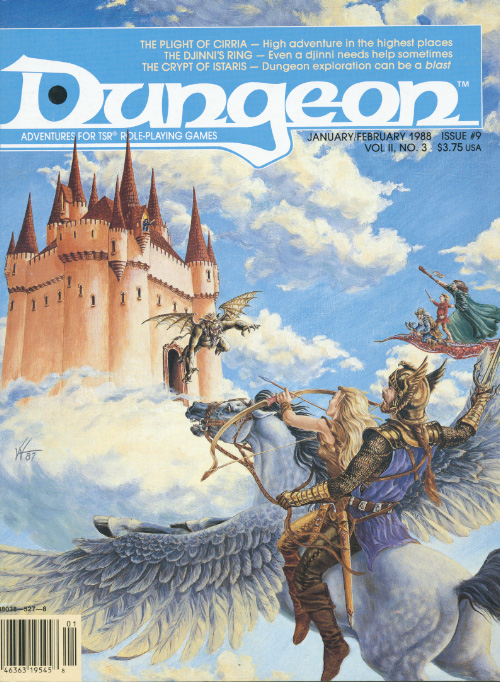
What angers the spirits? You don't have long to find out. An angry spirit can even steal the rain. The characters must appease a spirit that has brought drought to the area. Before they can summon him, however, they'll need to collect magical water from three shrines. Pgs. 35-43

Old-School Essentials Adventure A hole in an old oak tree leads characters down to a maze of twisting, root-riddled passageways, the chambers of an ancient wizard-complex, and the banks of an underground river where once a reptile cult built their temples. A classic expedition into the Mythic Underworld for characters of 1st to 2nd level. 60 keyed areas, rumour table, loot summary, dungeon background info, suggestions for expanding the dungeon. Keyed in a quick-reference, bullet point format. Unlabelled map included for VTT use. The Hole in the Oak can be linked with The Incandescent Grottoes to form a large, 3 level dungeon with over 115 keyed encounter areas!

Things are not right at Du Sharid Manor. Months ago, a deranged parish priest and his most devout followers formed a heretical cult. These self-proclaimed “Seekers of the White Heart” chose the desolate Wild Hills to practice their secret rites; but the strange goings on at the Wild Hills did not escape the prying eyes of the more pious villagers who set out to confront the cultists. Once there, the villagers witnessed something terrifying and unexpected. Since the events of that night, the cultists have vanished, but the remaining serfs of Du Sharid now live in constant paranoia. Your party has been hired by the local bishop to to learn the truth about what happened at Du Sharid Manor. For use with Swords & Wizardry (or the like) and designed for the experienced Referee, Jewel of the Lunar Rift is a first-level campaign-starter and an introduction to the Messoria setting. Included as a bonus are campaign journals from the author's own sessions.
When an injured child collapses in the street, will you venture into the cellar he fled from to discover what hides, creaking in the dark? Published by Nord Games

In the deep desert lies the dead city of Yumar, the source of countless bizarre rumors. Was it destroyed by a demonic metal sphere? Did it sink into a pit of acid? Were its people transformed into cursed beasts? Is it ruled by vicious thieves or mad nuns? In fact, the only thing stranger than what happened to Yumar a century ago is what will happen a few days from now... ADVENTURE TYPE: Medium Sandbox City / Ruin DESIGN NOTES: This adventure is intended for characters levels 5 to 8. It includes a ruined city, shrine, wizard tower, menagerie, several factions, and the surrounding wilderness. Each area contains various encounters and unique items. There are many opportunities for combat, but it is possible for players to explore most areas and complete many interactions without any combat at all, depending on their choices. INCLUDES: Story hooks, dialogue prompts, random encounters, factions, illustrations, stat blocks, original creatures and treasures, and overview maps. KEYWORDS: city, ruin, celestial, angel, dwarf, dwarves, miner, thief, thieves, cleric, nun, shrine, adamant, adamantine, lycanthropy, mind control, nightmare, mutation, mutant, wizard tower, menagerie, body horror
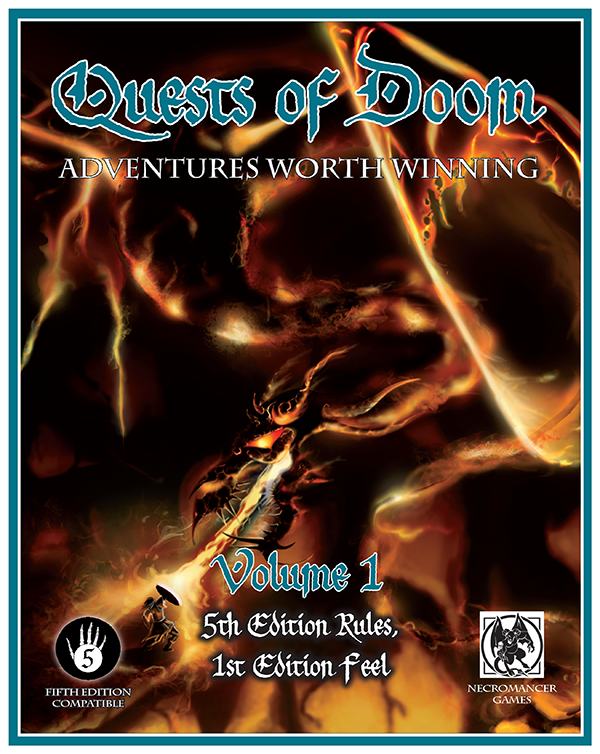
The Noble Rot is a location-based adventure for characters of 5th to 8th level. This adventure can be played in one or two sessions of reasonable length. It is a straightforward, haunted house-style adventure. The story revolves around Le Chateau Gluant, a vineyard and winery of repute. Vintages of its famous white (chardonnay) and red blend (cabernet sauvignon) are sought throughout the land. Some vintages can bring up to 200 gp per bottle from the right buyer. A case (twelve bottles) of the wine in pristine condition can fetch up to 1,500 gp. Unfortunately, the winery fell upon dark days and the prized wine has not flowed from its cellars for a few years. Approximately five years ago, the head winemaker, Malcolm Roth, hired Tobias Suey as an apprentice. Unfortunately for Roth, Suey was a member of the Cultus Limus (Cult of the Ooze). The Cultus Limus makes sacrifices to its demonic master Lumaszu in her faceless form. Lumaszu or “she who erases” is an ancient demoness who preys upon travelers by drinking their blood. She is the cause of nightmares, pestilence, infestation of pure water, and a bringer of disease, sickness, and death. Her worshipped form in Cultus Limus is that of a gigantic ooze. Suey turned the field hands who tended the vines against the winemaker. Then the new cult turned its attention to the Gluant family. Eventually the cult members started preying on each other. With each sacrifice to the ooze, Suey’s power grew—until there was no one left but Suey. The whim of demons is fickle. Suey was blighted and corrupted for his work. Now he deep in the cellars under the chateau as a minor ooze demon. His handiwork, however, remains. The chateau is now the abode of its former residents and workers, in undead form. Also slimes, molds, fungi, and other foulness fester in the fields, buildings, and cellars. The riches of the Gluant family remain undisturbed; would-be thieves and robbers quickly fall prey to the current residents. Besides normal valuables, cases of wine remain undisturbed and waiting to be plundered. The title The Noble Rot refers to a few factors in this adventure. The first is the rot that befell the Gluant family in the form of the Cultus Limus. Another is actual noble rot disease that may aid the PCs in overcoming the challenges posed. The phrase also refers to a real-world gray fungus, Botrytis cinerea, which in the right conditions creates world-class dessert wines such as French sauternes. In the wrong conditions, it destroys grapes and is known as gray rot.
A short adventure for the Midnight campaign setting from Fantasy Flight Games. The adventurers must contact a recently-captured resistance fighter to uncover the identity of a traitor.
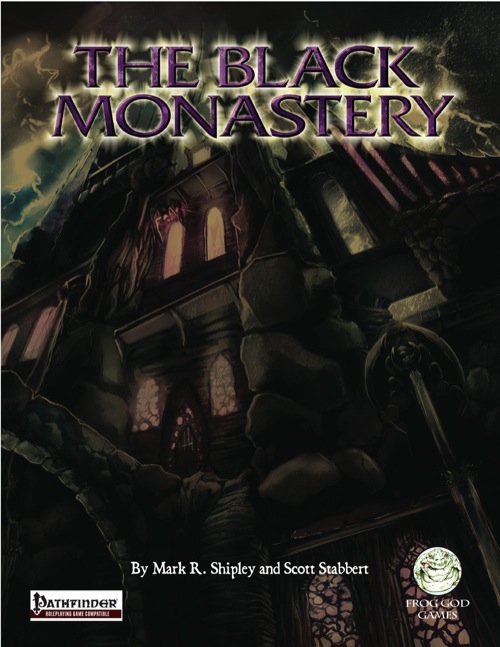
The Legend of the Black Monastery Two centuries have passed since the terrible events associated with the hideous cult known as the Black Brotherhood. Only scholars and story-tellers remember now how the kingdom was nearly laid to waste and the Black Monastery rose to grandeur and fell into haunted ruins. The Brothers first appeared as an order of benevolent priests and humble monks in black robes who followed a creed of kindness to the poor and service to the kingdom. Their rules called for humility and self denial. Other religious orders had no quarrel with their theology or their behavior. Their ranks grew as many commoners and nobles were drawn to the order by its good reputation. The first headquarters for the order was a campsite, located in a forest near the edge of the realm. The Brothers said that their poverty and dedication to service allowed them no resources for more grand accommodations. Members of the Black Brotherhood built chapels in caves or constructed small temples on common land near villages. They said that these rustic shrines allowed them to be near the people they served. Services held by the Brothers at these locations attracted large numbers of common people, who supported the Black Brotherhood with alms. Within 50 years of their first appearance, the Black Brotherhood had a number of larger temples and abbeys around the kingdom. Wealthy patrons endowed them with lands and buildings in order to buy favor and further the work of the Brothers. The lands they gained were slowly expanded as the order’s influence grew. Many merchants willed part of their fortunes to the Black Brotherhood, allowing the order to expand their work even further. The Brothers became bankers, loaning money and becoming partners in trade throughout the kingdom. Within 200 years of their founding, the order was wealthy and influential, with chapters throughout the kingdom and spreading into nearby realms. With their order well-established, the Black Brotherhood received royal permission to build a grand monastery in the hill country north of the kingdom’s center. Their abbot, a cousin of the king, asked for the royal grant of a specific hilltop called the Hill of Mornay. This hill was already crowned by ancient ruins that the monks proposed to clear away. Because it was land not wanted for agriculture, the king was happy to grant the request. He even donated money to build the monastery and encouraged others to contribute. With funds from around the realm, the Brothers completed their new monastery within a decade. It was a grand, sprawling edifice built of black stone and called the Black Monastery. From the very beginning, there were some who said that the Black Brotherhood was not what it seemed. There were always hints of corruption and moral lapses among the Brothers, but no more than any other religious order. There were some who told stories of greed, gluttony and depravity among the monks, but these tales did not weaken the order’s reputation during their early years. All of that changed with the construction of the Black Monastery. Within two decades of the Black Monastery’s completion, locals began to speak of troubling events there. Sometimes, Brothers made strange demands. They began to cheat farmers of their crops. They loaned money at ruinous rates, taking the property of anyone who could not pay. They pressured or even threatened wealthy patrons, extorting money in larger and larger amounts. Everywhere, the Black Brotherhood grew stronger, prouder and more aggressive. And there was more… People began to disappear. The farmers who worked the monastery lands reported that some people who went out at night, or who went off by themselves, did not return. It started with individuals…people without influential families…but soon the terror and loss spread to even to noble households. Some said that the people who disappeared had been taken into the Black Monastery, and the place slowly gained an evil reputation. Tenant farmers began moving away from the region, seeking safety at the loss of their fields. Slowly, even the king began to sense that the night was full of new terrors. Across the kingdom, reports began to come in telling of hauntings and the depredations of monsters. Flocks of dead birds fell from clear skies, onto villages and city streets. Fish died by thousands in their streams. Citizens reported stillborn babies and monstrous births. Crops failed. Fields were full of stunted plants. Crimes of all types grew common as incidents of madness spread everywhere. Word spread that the center of these dark portents was the Black Monastery, where many said the brothers practiced necromancy and human sacrifice. It was feared that the Black Brotherhood no longer worshipped gods of light and had turned to the service of the Dark God. These terrors came to a head when the Black Brotherhood dared to threaten the king himself. Realizing his peril, the king moved to dispossess and disband the Black Brother hood. He ordered their shrines, abbeys and lands seized. He had Brothers arrested for real and imagined crimes. He also ordered investigations into the Black Monastery and the order’s highest ranking members. The Black Brotherhood did not go quietly. Conflict between the order and the crown broke into violence when the Brothers incited their followers to riot across the kingdom. There were disturbances everywhere, including several attempts to assassinate the king by blades and by dark sorcery. It became clear to everyone that the Black Brotherhood was far more than just another religious order. Once knives were drawn, the conflict grew into open war between the crown and the Brothers. The Black Brotherhood had exceeded their grasp. Their followers were crushed in the streets by mounted knights. Brothers were rounded up and arrested. Many of them were executed. Armed supporters of the Black Brotherhood, backed by arcane and divine magic, were defeated and slaughtered. The Brothers were driven back to their final hilltop fortress – the Black Monastery. They were besieged by the king’s army, trapped and waiting for the king’s forces to break in and end the war. The final assault on the Black Monastery ended in victory and disaster. The king’s army took the hilltop, driving the last of the black-robed monks into the monastery itself. The soldiers were met by more than just men. There were monsters and fiends defending the monastery. There was a terrible slaughter on both sides. In many places the dead rose up to fight again. The battle continued from afternoon into night, lit by flames and magical energy. The Black Monastery was never actually taken. The king’s forces drove the last of their foul enemies back inside the monastery gates. Battering rams and war machines were hauled up the hill to crush their way inside. But before the king’s men could take the final stronghold, the Black Brotherhood immolated themselves in magical fire. Green flames roared up from the monastery, engulfing many of the king’s men as well. As survivors watched, the Black Monastery burned away, stones, gates, towers and all. There was a lurid green flare that lit the countryside. There was a scream of torment from a thousand human voices. There was a roar of falling masonry and splitting wood. Smoke and dust obscured the hilltop. The Black Monastery collapsed in upon itself and disappeared. Only ashes drifted down where the great structure had stood. All that was left of the Black Monastery was its foundations and debris-choked dungeons cut into the stones beneath. The war was over. The Black Brotherhood was destroyed. But the Black Monastery was not gone forever. Over nearly two centuries since its destruction, the Black Monastery has returned from time to time to haunt the Hill of Mornay. Impossible as it seems, there have been at least five incidents in which witnesses have reported finding the Hill of Mornay once again crowned with black walls and slate-roofed towers. In every case, the manifestation of this revenant of the Black Monastery has been accompanied by widespread reports of madness, crime and social unrest in the kingdom. Sometimes, the monastery has appeared only for a night. The last two times, the monastery reappeared atop the hill for as long as three months…each appearance longer than the first. There are tales of adventurers daring to enter the Black Monastery. Some went to look for treasure. Others went to battle whatever evil still lived inside. There are stories of lucky and brave explorers who have survived the horrors, returning with riches from the fabled hordes of the Black Brotherhood. It is enough to drive men mad with greed – enough to lure more each time to dare to enter the Black Monastery.

All the children of the Blight know the nursery rhymes about Bloody Jack Carver, cautionary tales for naughty or overly inquisitive children to mind their manners and obey their parents. However, their parents know the true horror of those times 30 years ago when the lunatic serial killer known as Bloody Jack Carver stalked the fog-shrouded streets of the Blight and abducted children. The killing spree finally ended, but the perpetrator was never caught. When the PCs are deputized to assist in a homicide investigation, they find terrifying clues that point to the three-decade-old Bloody Jack killings and signs to indicate that they were just the beginning. Now the PCs are in a race against time across the breadth of the decrepit and deteriorating city that is the Blight as they attempt to stop a new killing spree before it can start. The PCs’ investigation takes them from the halls of the Capitol and the seedy streets and alleys of Toiltown to the garish carnival piers of Festival and the pollutant-crusted banks of the Great Lyme River. Only they stand between the children of this decayed city and new nursery rhymes being written in their blood. Bloody Jack is a stand-alone adventure set in the Blight for 4–5 5th-level characters.
Many years ago a brutal bugbear chieftain united the goblinoid tribes of the Meirlara Forest and nearly wiped out all traces of the elves there within. A stroke of chance fate turned the tide and the dreaded bugbear warlord Spragnokk was defeated. His loyal kin hid his body away in a sealed chamber and then the world forgot about Spragnokk... until now. Now his bloodline continues, and they have plans to resurrect their fallen "great chieftain," to bring ruin and revenge upon the elves that handed them defeat decades past. The goblinoid tribes have once more been gathered, and their bloody revenge is imminent, except fate has yet once more placed new champions to stand in their way. They just don't realize it yet.

To Kill A King Death to King Ovar the tyrant! Life to law and order! Four characters are charged with a mission so insane, so daring, that terming it an assassination does not do it justice. Are the four volunteers who would lay low King Ovar killers or heroes? If murderers, how are they better than the madman theyre assigned to kill? And even if they are mere assassins, are they determined enough to overcome the Maze of Zayene? Snared in the Wizards Web
:strip_icc()/pic2633965.jpg)
The Bunker transports the party from their starting hex to a destination 2 hexes away. It can be placed anywhere on the Purple Planet map that does not already contain a numbered encounter. It could be hidden beneath the fecund growth of the mushroom forests, lost in the broken lands, amid the Ancestor Peaks, or uncovered by a sand storm in the wastes.
/pic5652045.jpg)
Deep within the dark recesses of the Tomb of Nihalar, the final resting place of elven kings, the weapon of the wood elves of Imfe Aiqua stirs. Two individuals are drawn to the weapon—but only one can accept it. Who will take up the glaive of the revenant king and become the ruler of the forgotten elven city? Glaive of the Revenant King is a 3rd-level Fifth Edition adventure for 3-5 characters. Characters who survive the adventure should reach the 4th level by the adventure's conclusion. This is the major side quest in the Hand of Eight adventure path. It can be played as the kickoff for the larger adventure setting or as a one-shot adventure for your players. The campaign is intended to be set in the DMDave crowdsourced campaign world of Omeria. However, it can just as easily be inserted into any other mysterious, untamed wilderness. The adventure is written by renown Fifth Edition author, DMDave Hamrick. It's 40 pages of fast-paced fantasy adventure that includes zombie hordes, horrible monsters in dark forests, battles with orcs, and tombs filled with dangerous traps.

Break in. Do the job. Survive the fallout. In a city so vast as Pindus-on-Isles, if you want to get ahead, you need to cozy up with someone powerful. And do something dangerous. When Hope the Fixer shows up at your door with a job from an anonymous employer, the pay is good enough. Are you? Seems there’s a thief holed up in a Wizard’s Egg, a stone laboratory suspended high on a tower. The anonymous employer wants the stolen goods trashed. It’s in Lightmill though. Those glittering skyscrapers are no place for basegels like you. Get your disguise together. Hope’s got the hippogriffs. It’s destruction time.
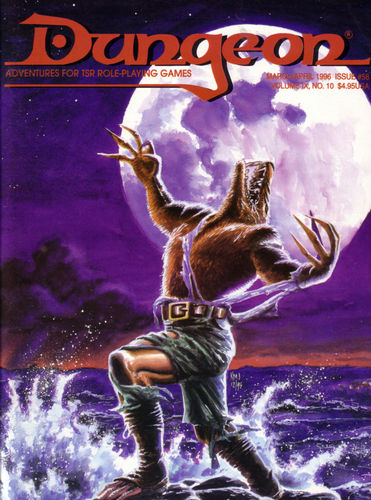
Let the buyer be-were! Sometimes you should be afraid to visit the dentist. A small coastal town is plagued with a curse and it is up to the PCs to find out what is causing the inhabitants of the town to transform into mad seawolfs. This adventure is set in the busy seaport of Rocky Harbor, which is located on a sheltered island dep in an extensive archipelago. Rocky Harbor is another location in the Volkrad campaign setting, as previously published in Dungeon Adventures issue #41, Old Man Katan and the Incredible, Edible, Dancing Mushroom Band. Pgs. 8-20

Something fell. A sickly gloaming lit up the night like mock daylight, just for a moment, and then the hills trembled. Now, an alien entity lies brooding in a crater gouged out of the moor. Local folk are enraptured with the toothsome jelly exuded by this being, but are blind to the true nature of the events unfolding in their rustic little backwater.

Rogues in Remballo is a city adventure set in Frog God Games' Lost Lands campaign world. As an introduction to adventuring in the Borderland Provinces, the City of Remballo immediately gets first-level characters embroiled in strange plots, sinister intrigue, and fierce battles. Is the thieves’ guild of Manas encroaching on the territory of the Remballo guild? What is hidden in the sanctuary-courtyard known as the Four Corners? How is the powerful banking house of Borgandy involved with all of it? What starts as a straightforward mission actually involves a host of complications — some of which can be deadly if the characters don’t play their cards right.
From time immemorial, the rulers of the mortal world have been counseled and tempted by capricious primordial spirits who rule over the elements. The greatest and most sinister of these was a half-kraken medusa known as the Maelstrom Queen, who sought to supplant the mortal races with her own line of immortal tentacled monstrosities. On the verge of her ultimate triumph, when the leviathans at her command rose from the depths, a legendary assassin murdered the Maelstrom Queen in her half-submerged palace with her own weapon. But the primordial mistress refused to let something as trifling as death put an end to her designs. Every 13 years, she regenerates enough mystic power to rise again, and the world’s greatest heroes are sent to murder the Maelstrom Queen once more.

“The Lamia’s Heart”: Your party are contracted by the nascent master of an unsanctioned thieves’ guild. To earn his favour, you must steal a singular gem from the mansion of a prominent merchant. Purloining this gem, however, may raise the ire of the city’s official thieves’ guild; notwithstanding, the reward is significant.

Part megadungeon, part underground expedition, Operation Unfathomable serves as both a one-shot adventure and a campaign framework. PCs are (optionally) drafted at swordpoint to recover the Nul Rod, a priceless artifact that was recently lost in a local prince's foolhardy attempt to destroy the Chaos Gods of the Underworld. The PCs have been drafted as an expendable set of pawns to venture into the vast and bewildering Underworld and retrieve the Nul Rod. With the Underworld's innumerable beasties being on high alert after the prince's expedition, the PCs must sneak through the incredibly dangerous Underworld. Fighting is not as important as stealth, fast-talking, and running away rapidly. This is the expansion from Sholtis's original Operation Unfathomable, released in Knockspell #5 (2011).