An adventure for the Midnight campaign setting from Fantasy Flight Games. The adventurers rise as Fell, intent on finishing their final mission.

The village of Gyles has been taken over by Ajax's forces, but after weeks of occupation, the War Dogs are becoming impatient with its newly appointed ruler. They weren’t made for watching over a bunch of villagers, they were made for action! The heroes arrive, seeing the devastation these monsters have caused and lives they’ve ruined, and realize they can offer them just what they need. Will they turn their Ground Commander against his master, or will they stand and fight them all, against impossible odds?

This self-contained game gives you and your friends the experience of playing the Dungeons & Dragons game in an easy-to-learn format. In this Fast-Play Game, you and your friends take on the imaginary roles in a fantastic tale of mighty heroes, mythical dragons, and powerful magic. This demo version of the game is designed to give you the feel of playing the Dungeons & Dragons game. The full game contains all sorts of options to help you create your own on-going sword and sorcery campaign. We'll tell you more about that at the end of this booklet.
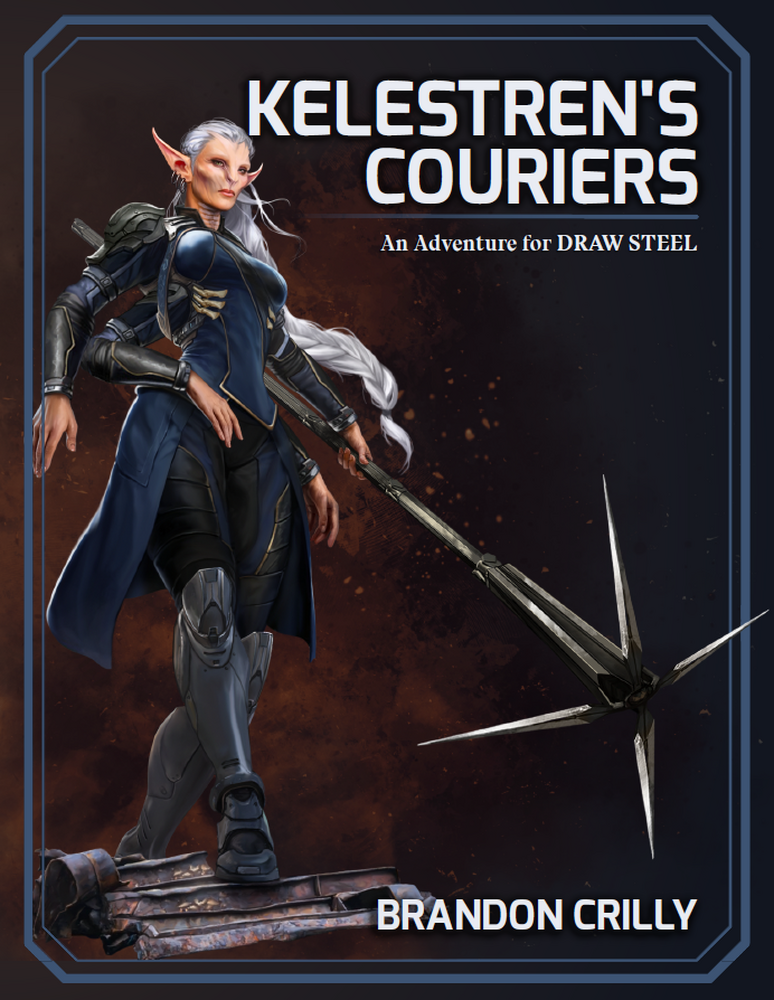
A mysterious broker comes to you with an offer: bring this box from Point to Point B, ask no questions, and you'll be rewarded. Do you take the gig? And when do you start wondering what's in the box? Kelestren's Couriers is the first in a series of science fantasy adventures for Draw Steel, introducing the original Gods of Futurity campaign setting. It is intended for a party of four Level 1 heroes, and can also be used as a one-shot, convention scenario, or an intro to your own Draw Steel campaign. Also included: a bonus setting primer! Complete with additional details on ancestries, classes and kits, plus an overview of Gods of Futurity to help with character creation. What You Get: - The complete adventure PDF of Kelestren's Couriers - Two original VTT maps - Five original art pieces for the Oculus of Tiza'ree, to help answer "what's in the box?" - Gods of Futurity Setting Primer - a bonus PDF with more details on Gods of Futurity, to help with character creation
Explore political intrigue, gene splicing, and a thrilling battle for survival in the Timescape's World Below in DOOM of the DRAGON GRAFTER, a 9th to 10th-level adventure for Draw Steel! You and everyone you know has a story of the dragon who ruined your life. You've lost so much and wondered why it had to be this way. Recently you learned that all these dragons that wreaked havoc on Orden were intentionally created to do so, all as an experiment run by a voiceless talker known as Lord Pulposa. You don't know why he did this, or how you're going to break into his lab. What you do know that you're going down into the World Below after him to make sure his schemes will never hurt anyone again. You are the Doom of the Dragon Grafter. Features: - Over 25 pages of an adventure written by the author of The Workshop Watches and The Fall of Blackbottom (that's me!) - 23 Victories worth of encounters - Lord Pulposa, a level 9 Solo Monster designed by Scott Bullock, guaranteed to terrorize your friends and enemies - Battle Maps & Positioning Maps for most combat encounters - Some Draconian fiction thrown in there for good measure - Shared under a CC-BY Sharealike so you can do whatever you want with it - A Goblin named Spanky

Peren, a guildless Devkarin collector of obscure relics has gone missing. The elf of shadow is in deep debt to the Orzhov as well as to the Rakdos performer, Ophyira. To discover Peren’s fate the party must descend into the Undercity of District Four, within the territory of the Golgari Swarm. Continuing the story which began with Off to a Weird Start, and picking up where The Palace of Pain’s Pleasures left off, this adventure is designed to be part of an ongoing campaign. For Dungeon Masters who wish to incorporate The Felicity Triskelion independently from the ongoing story, 10 Adventure Hooks (one for each guild) are included, giving The Felicity Triskelion flexibility for one-shot play or for inclusion in your own campaign!
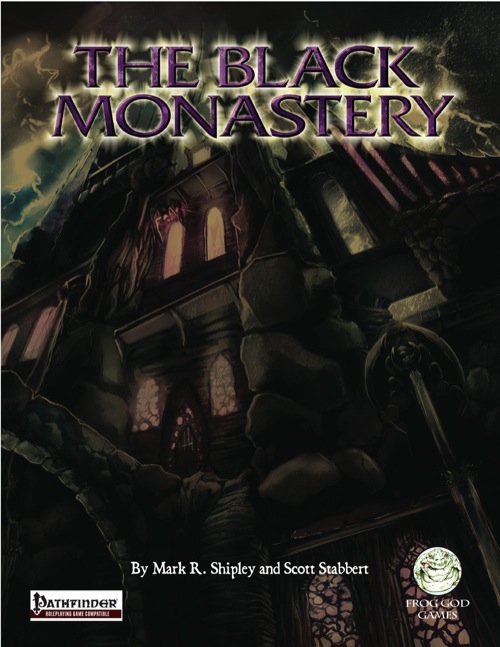
The Legend of the Black Monastery Two centuries have passed since the terrible events associated with the hideous cult known as the Black Brotherhood. Only scholars and story-tellers remember now how the kingdom was nearly laid to waste and the Black Monastery rose to grandeur and fell into haunted ruins. The Brothers first appeared as an order of benevolent priests and humble monks in black robes who followed a creed of kindness to the poor and service to the kingdom. Their rules called for humility and self denial. Other religious orders had no quarrel with their theology or their behavior. Their ranks grew as many commoners and nobles were drawn to the order by its good reputation. The first headquarters for the order was a campsite, located in a forest near the edge of the realm. The Brothers said that their poverty and dedication to service allowed them no resources for more grand accommodations. Members of the Black Brotherhood built chapels in caves or constructed small temples on common land near villages. They said that these rustic shrines allowed them to be near the people they served. Services held by the Brothers at these locations attracted large numbers of common people, who supported the Black Brotherhood with alms. Within 50 years of their first appearance, the Black Brotherhood had a number of larger temples and abbeys around the kingdom. Wealthy patrons endowed them with lands and buildings in order to buy favor and further the work of the Brothers. The lands they gained were slowly expanded as the order’s influence grew. Many merchants willed part of their fortunes to the Black Brotherhood, allowing the order to expand their work even further. The Brothers became bankers, loaning money and becoming partners in trade throughout the kingdom. Within 200 years of their founding, the order was wealthy and influential, with chapters throughout the kingdom and spreading into nearby realms. With their order well-established, the Black Brotherhood received royal permission to build a grand monastery in the hill country north of the kingdom’s center. Their abbot, a cousin of the king, asked for the royal grant of a specific hilltop called the Hill of Mornay. This hill was already crowned by ancient ruins that the monks proposed to clear away. Because it was land not wanted for agriculture, the king was happy to grant the request. He even donated money to build the monastery and encouraged others to contribute. With funds from around the realm, the Brothers completed their new monastery within a decade. It was a grand, sprawling edifice built of black stone and called the Black Monastery. From the very beginning, there were some who said that the Black Brotherhood was not what it seemed. There were always hints of corruption and moral lapses among the Brothers, but no more than any other religious order. There were some who told stories of greed, gluttony and depravity among the monks, but these tales did not weaken the order’s reputation during their early years. All of that changed with the construction of the Black Monastery. Within two decades of the Black Monastery’s completion, locals began to speak of troubling events there. Sometimes, Brothers made strange demands. They began to cheat farmers of their crops. They loaned money at ruinous rates, taking the property of anyone who could not pay. They pressured or even threatened wealthy patrons, extorting money in larger and larger amounts. Everywhere, the Black Brotherhood grew stronger, prouder and more aggressive. And there was more… People began to disappear. The farmers who worked the monastery lands reported that some people who went out at night, or who went off by themselves, did not return. It started with individuals…people without influential families…but soon the terror and loss spread to even to noble households. Some said that the people who disappeared had been taken into the Black Monastery, and the place slowly gained an evil reputation. Tenant farmers began moving away from the region, seeking safety at the loss of their fields. Slowly, even the king began to sense that the night was full of new terrors. Across the kingdom, reports began to come in telling of hauntings and the depredations of monsters. Flocks of dead birds fell from clear skies, onto villages and city streets. Fish died by thousands in their streams. Citizens reported stillborn babies and monstrous births. Crops failed. Fields were full of stunted plants. Crimes of all types grew common as incidents of madness spread everywhere. Word spread that the center of these dark portents was the Black Monastery, where many said the brothers practiced necromancy and human sacrifice. It was feared that the Black Brotherhood no longer worshipped gods of light and had turned to the service of the Dark God. These terrors came to a head when the Black Brotherhood dared to threaten the king himself. Realizing his peril, the king moved to dispossess and disband the Black Brother hood. He ordered their shrines, abbeys and lands seized. He had Brothers arrested for real and imagined crimes. He also ordered investigations into the Black Monastery and the order’s highest ranking members. The Black Brotherhood did not go quietly. Conflict between the order and the crown broke into violence when the Brothers incited their followers to riot across the kingdom. There were disturbances everywhere, including several attempts to assassinate the king by blades and by dark sorcery. It became clear to everyone that the Black Brotherhood was far more than just another religious order. Once knives were drawn, the conflict grew into open war between the crown and the Brothers. The Black Brotherhood had exceeded their grasp. Their followers were crushed in the streets by mounted knights. Brothers were rounded up and arrested. Many of them were executed. Armed supporters of the Black Brotherhood, backed by arcane and divine magic, were defeated and slaughtered. The Brothers were driven back to their final hilltop fortress – the Black Monastery. They were besieged by the king’s army, trapped and waiting for the king’s forces to break in and end the war. The final assault on the Black Monastery ended in victory and disaster. The king’s army took the hilltop, driving the last of the black-robed monks into the monastery itself. The soldiers were met by more than just men. There were monsters and fiends defending the monastery. There was a terrible slaughter on both sides. In many places the dead rose up to fight again. The battle continued from afternoon into night, lit by flames and magical energy. The Black Monastery was never actually taken. The king’s forces drove the last of their foul enemies back inside the monastery gates. Battering rams and war machines were hauled up the hill to crush their way inside. But before the king’s men could take the final stronghold, the Black Brotherhood immolated themselves in magical fire. Green flames roared up from the monastery, engulfing many of the king’s men as well. As survivors watched, the Black Monastery burned away, stones, gates, towers and all. There was a lurid green flare that lit the countryside. There was a scream of torment from a thousand human voices. There was a roar of falling masonry and splitting wood. Smoke and dust obscured the hilltop. The Black Monastery collapsed in upon itself and disappeared. Only ashes drifted down where the great structure had stood. All that was left of the Black Monastery was its foundations and debris-choked dungeons cut into the stones beneath. The war was over. The Black Brotherhood was destroyed. But the Black Monastery was not gone forever. Over nearly two centuries since its destruction, the Black Monastery has returned from time to time to haunt the Hill of Mornay. Impossible as it seems, there have been at least five incidents in which witnesses have reported finding the Hill of Mornay once again crowned with black walls and slate-roofed towers. In every case, the manifestation of this revenant of the Black Monastery has been accompanied by widespread reports of madness, crime and social unrest in the kingdom. Sometimes, the monastery has appeared only for a night. The last two times, the monastery reappeared atop the hill for as long as three months…each appearance longer than the first. There are tales of adventurers daring to enter the Black Monastery. Some went to look for treasure. Others went to battle whatever evil still lived inside. There are stories of lucky and brave explorers who have survived the horrors, returning with riches from the fabled hordes of the Black Brotherhood. It is enough to drive men mad with greed – enough to lure more each time to dare to enter the Black Monastery.

An adventure in Hyperborea designed for from four to six characters of 6th through 8th level In the far reaches of Hyperborea’s Crab Archipelago lies a small, mountainous island known as Crystal Point. Passing sailors recently have witnessed a crimson glow in Crystal Point’s waters and beams of russet light shining up from its steep cliffs. Too, unusually frequent lightning storms in the area have torn the sky in blinding flashes, shattering the air with their awesome sound. The seedy wharf taverns of Khromarium and elsewhere buzz with these strange tales—some even speculate that Crystal Point may hold the lost treasure of Atlantis! The Lost Treasure of Atlantis takes players into an action-packed realm of adventure: the mythical world of Hyperborea, a sword-and-sorcery campaign setting inspired by the fantastic fiction of Robert E. Howard, H.P. Lovecraft, Clark Ashton Smith, and others. This adventure is designed for Astonishing Swordsmen & Sorcerers of Hyperborea™ (AS&SH™), a role-playing game descended from the original 1974 fantasy wargame and miniatures campaign rules as conceived by E. Gary Gygax and Dave Arneson. Therefore, AS&SH is compatible with most traditional fantasy role-playing games (c. 1974 to 1999) and their modern simulacra, such as OSRIC™ and Swords & Wizardry™.

Part megadungeon, part underground expedition, Operation Unfathomable serves as both a one-shot adventure and a campaign framework. PCs are (optionally) drafted at swordpoint to recover the Nul Rod, a priceless artifact that was recently lost in a local prince's foolhardy attempt to destroy the Chaos Gods of the Underworld. The PCs have been drafted as an expendable set of pawns to venture into the vast and bewildering Underworld and retrieve the Nul Rod. With the Underworld's innumerable beasties being on high alert after the prince's expedition, the PCs must sneak through the incredibly dangerous Underworld. Fighting is not as important as stealth, fast-talking, and running away rapidly. This is the expansion from Sholtis's original Operation Unfathomable, released in Knockspell #5 (2011).

The village of Saxham has been struck by a terrible curse! Or perhaps it’s being terrorized by demons, ghosts, and the undead? Or… was there a terrible storm? Maybe? No one seems to know exactly what happened here. But the villagers are terrified, bizarre monsters roam the forest, and strange lights strike the woods every night at midnight… ADVENTURE TYPE: Small Sandbox Mystery DESIGN NOTES: This adventure includes a small village, several wilderness areas, and a simple network of tunnels to explore. Each area contains various encounters and unique magical items. There are many opportunities for combat, but it is possible for players to explore every area and complete every interaction without any combat at all, depending on their choices. INCLUDES: Story hooks, dialogue prompts, original creature stat blocks, original treasure/items, area overview map, and illustrations. Produced by Dungeon Age Adventures

The last of his line, Baron Paytro NeMoren has left his dark secret sealed for decades in the family's underground vault. Now, years after his death, a group of stalwart heroes has gathered according to the baron's final wishes. At last, the seal will be broken and the secrets of the vault revealed. Can all sins be forgiven? The adventure is designed to kick-off a campaign, as it provides for an interesting way to get the party together. Instead of meeting at a tavern or being recruited by the local militia, each party member starts with a key to the NeMoren's vault, a key that was handed down by a friend or given as a gift for some good deed peformed in the past. The executor of the estate has gathered together all of the key-holders so that they could claim the contents of the vault. The vault can only be opened with all of the keys in unison. The vault is protected by a number of minor traps and tricks, but it also became the final resting place for the Baron's ex-lover, Lisette, and her brothers--all three of whom had attempted to blackmail the Baron. They were buried alive and are now undead. To complicate matters, a young umber hulk made its way to the vault, leaving some crude tunnels that were later exploited by hobgoblins coming from another surface entrance. The party will need to deal with the hobgoblins, the undead, the traps, and possibly the young umber hulk. There is a side-plot of poisoned groundwater in the nearby town that the party can also resolve by clearing out the undead and properly disposing of the putrid corpses leaking into the groundwater from the vault. Produced by Fiery Dragon Productions
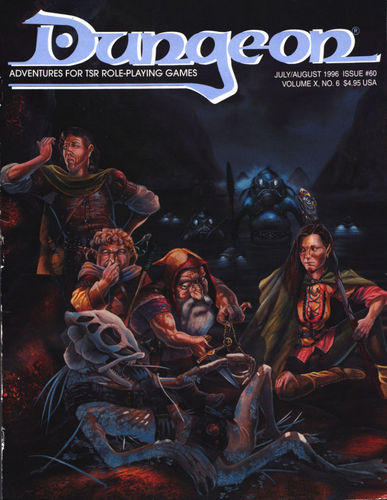
"Something Fishy" - a Celtic-world campaign. "Iasc" is set in a small Celtic kingdom that can be fit into any medieval/fantasy campaign. The PCs need not be Celts. The likelihood of combat is very high, and the party is recommended to host several warriors.
Wise rogues join the government, where their larceny has the cover of “legality” and the cash comes in heaps and piles from deceitful receipts and pocketed procurements rather than in small, bloodstained purses from breaking windows, scaling walls, and risking traps and long-fanged guard dogs. Wise rogues do not, by choice, go up against towering giants armed with clubs larger than the tallest rogue in the guild. Nor do they try to nick treasure from dragons without a group of powerful fellow adventurers behind them, who can hurl mighty spells, hack and hew toe to toe with an angry wyrm, heal the injured, and (when things go as they usually do), resurrect the dead. There are wise rogues, and then there are player characters. Emeralds of Highfang awaits them with open arms, offering special challenges and rewards to rogue characters—but as always, the prospects are much better for a party of adventurers from a variety of classes, with wide skills and experience, and of high level. Some might find that a broad base of experience is not only helpful, but essential for survival.
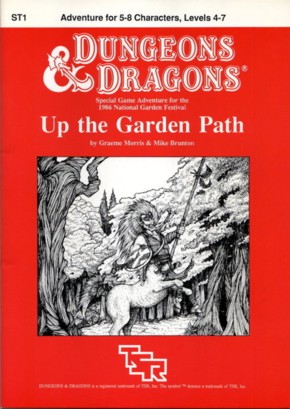
The day has been long and hard and, as night falls, you gratefully surrender to the soft, silent blackness of well-earned sleep. Then the dream comes. You are seated on a throne in a cavern where the sun has never shone; where no voice has ever spoken. Yet you are not alone. Through the darkness, silent figures are moving. Blacker than black... formless yet menacing... advancing towards you from every side... You fell their touch; icy claws plucking at your skin and hair, lifting the throne and carrying you helpless on a journey from darkness into further darkness, from silence into deeper silence. You scream, and a million anguished, reedy voices answer your call. Suddenly you awake... ... and the dream is real. A module printed exclusively in the United Kingdom by TSR UK. Using the 1986 National Garden Festival as its theme, this module was sold both at that festival, and at the 1986 Games Day RPG convention at the Royal Horticultural Society Hall in London (hosted by Games Workshop that Saturday, September 27th). It was briefly mentioned in White Dwarf magazine 82, page 49.
In ancient times, the area now known as the Dyrgalas Fens was home to a flourishing civilization of nature worshippers who wrested a living from the forest around them, built open-air temples, and generally did well. Over the centuries, a series of natural disasters (some say a series of foolish magical experiments) led to a rising water table and turned the forest into a vast swamp. As the water rose, most of the people left. Today, a few stalwart humans remain in the fens, living off the land through hunting, fishing, trapping, and even some agriculture. In addition to these honest folk, the Dyrgalas has some less savory residents, including both black and green dragons, trolls, hags, escaped criminals, and a host of lycanthropes. Most of these creatures prey on travelers foolish or unlucky enough to enter the fen, and sometimes raid both inside and outside the fen. This adventure, intended for characters of levels 6 to 8, deals with one group of raiders who make their lair in the Dyrgalas. A weretiger called Gavriil has formed a group of assorted lycanthropes into a band of cunning brigands. The lycanthropes favorite caper involves infiltrating a merchant caravan while posing as travelers, merchants, or swords for hire, then attacking it from within. Gavriil and his servants also take on kidnappings, murder for hire, and any other unsavory tasks that come their way.

Baron Ketterall’s lands are beset by a plague of marauding goblins! Goblins you say? Pah! Who's afraid of few poxy goblins? But two experienced parties have already gone looking for the goblin lair – never to be heard of again. Poxy goblins you say? Be afraid, be very afraid… The scenario is designed to be an extremely challenging adventure that might undermine a player’s bravado in dealing with low-level monsters such as goblins. Unusual traps, tricks and special weapons are used by the inhabitants of the dungeon to cause the party as much trouble as possible. Published by Dunromin University Press.

A kid-friendly adventure for heroes of all ages and experience levels! When the ancient wizard Tyndareus develops a craving for a special treat from his childhood, he will stop at nothing to get his hands on the best apple pie in the whole world. He hires a group of adventurers to seek out the bakery that once produced the wonderful dessert – unfortunately for them, the bakery has long since been overrun by goblins. But all is not as it seems at Grammy’s Bakery, and Tyndareus isn’t the only one who’d do anything for those pies.
People have been going missing in Oreskos. Merchants never finish their rounds, and leonin disappear during their hunts. At the center of this conspiracy sits a lone tower, and on its throne a vicious lamia seeking to claim the grasslands as her kingdom. The Oreskan Lamia is a 3rd level Greek mythology inspired 5e adventure, for use with the Mythic Odysseys of Theros setting book.

Deep in the wooded wilderness, the village of Grimmsgate is an outpost town on a seldom-traveled trail, right at the edge of nowhere. The village’s half-ruined temple of Law, dilapidated inn, drunken blacksmith, exiled trader and a few fur-trappers are enough to keep the bloody-minded denizens of the dark forest at bay, but nobody really expects the village to still be there in another ten years. The woods have become too dangerous for the trappers who once caught animals for fur, and merchants no longer travel the poorly-maintained road. What great evil and what fabulous treasures are to be found in these lands? A brave band of adventurers might make their fortunes here. Or perhaps they might never return… Grimmsgate is an introductory adventure for the Swords & Wizardry tabletop roleplaying game. The Swords & Wizardry rules are needed to play this adventure.
The set-up is interesting in a way – the PCs are plain folks of the Vale, everyday people, and the module begins promising, with the Thor-ordained sporty trek around the vale that inevitably results in trouble. The module, obviously, tries to chronicle the step from everyday-Joe/Jane to hero and the tidbits on culture provided are intriguing. But this, as much as I’m loathe to say it, is one of the worst modules FGG has ever released. If I didn’t know any better, I wouldn’t expect Mr. Ward’s pen at work here. Let me elaborate: The premise, is unique and hasn’t been done much recently, but it suffers from this being an adventure – to properly invest the players in the setting a closer gazetteer, nomenclature, suggested roles and origins for casting talent – all of that should have been covered. They’re not. Worse, everything here is a) clichéd and b) a non-threat in the great whole of things.