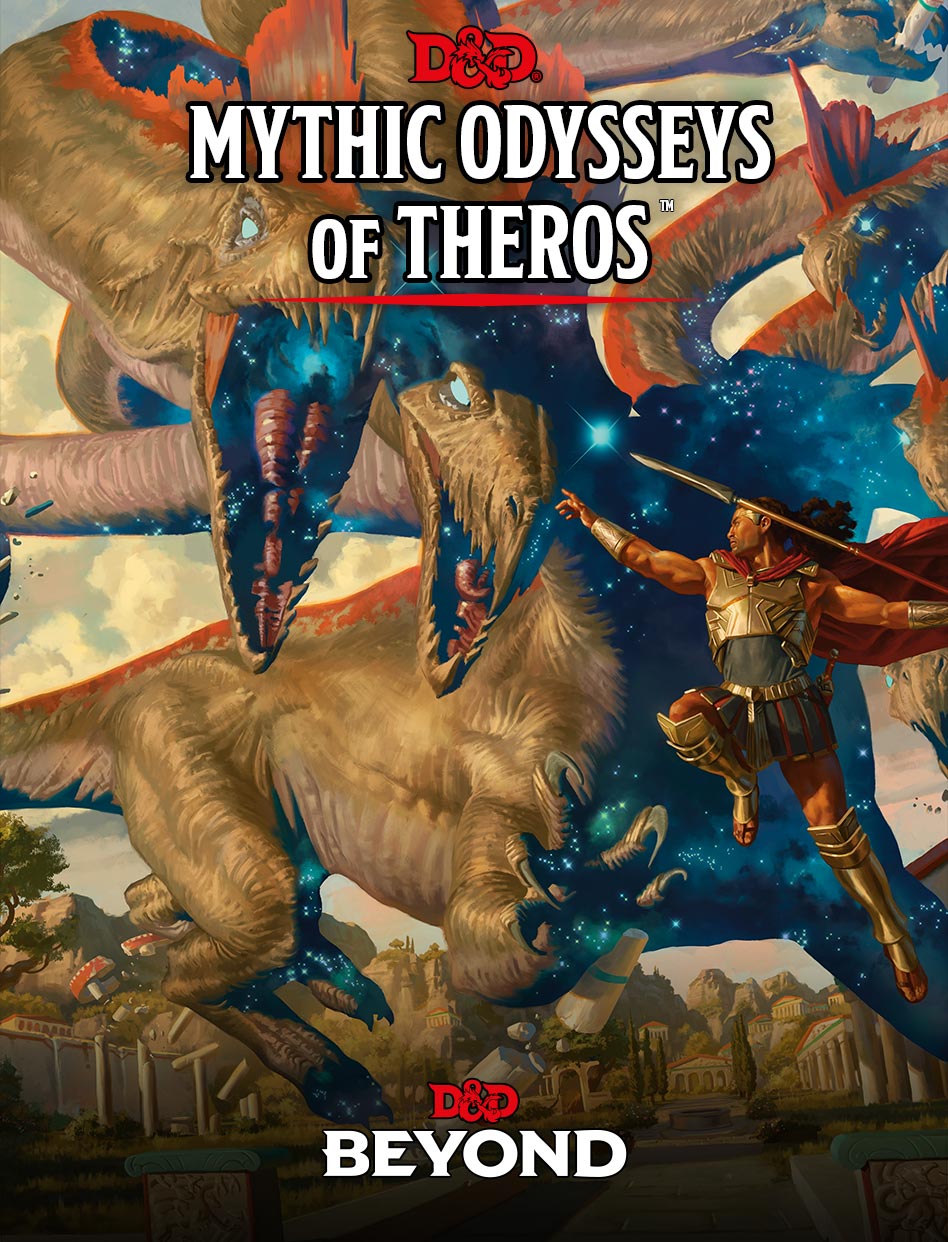
The adventure begins with the characters discovering the recently murdered Returned, Varyas, and confronting his killers. Varyas's gold mask bears a code on it, one that points toward the sage Khea who lives in the nearby polis. When the characters investigate, they learn from Khea that the writing is undecipherable except for the first line, which refers to the legendary Court of Orestes, a site sacred to the god Phenax. She also notes that a recent earthquake has uncovered a cave along the Khystonos River that could be the secret site's location. If so, then perhaps within lies the key to deciphering the mask, along with its own treasures. With the information provided by Khea, the adventurers set forth into the wilds, where they'll face multiple storied dangers before reaching the Court of Orestes. Once at the lost holy site, the characters discover ancient guardians, as well as an unliving entity with the potential to reveal Phenax's lost secret.

After turning himself into a manticore, the self-style wizard-artiste, Mortzengersturm, moved to the crystalline peak of Mount Geegaw to practice his transformation magic without interference. You've been hired to snatch his most prized artifact, the Whim-Wham Stone--or at least some of its eldritch light. A menagerie of magic hybrids, a self-absorbed vampire, more than a few hippogriffs, and of course, the mad manticore himself await! It's like a Rankin-Bass stop motion special--except it could end in a total party kill.
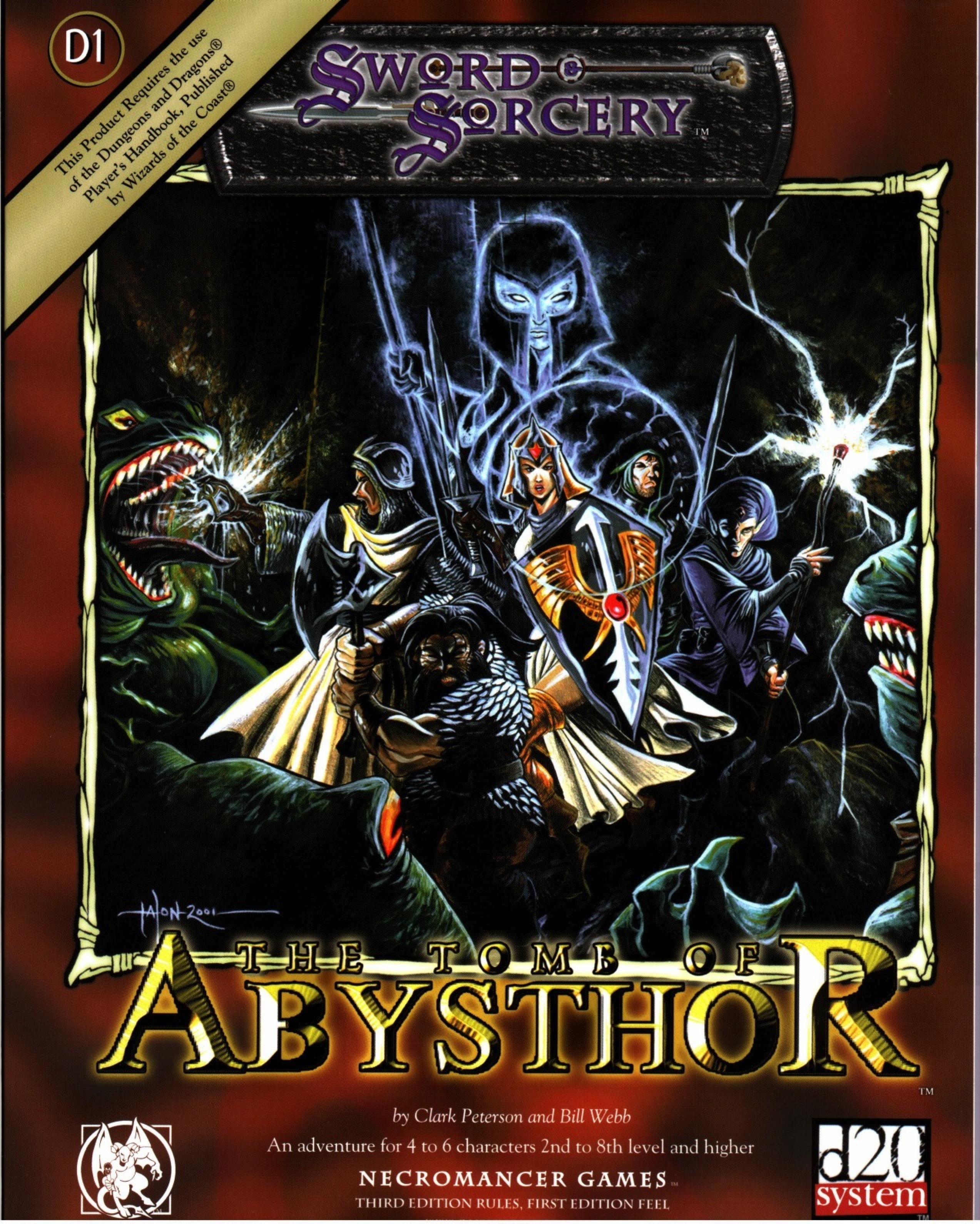
Restore an Abandoned Temple Enter the catacombs near the desecrated Temple of Muir, Goddess of Paladins, and search for the lost tomb of Abysthor. Will your party be able to cleanse the evil that now inhabits these once-sacred halls, and recover the Stone of Tircople? Can your characters survive the traps of an undead sorcerer? Will your players discover the chamber of Living Rock and the secret power it holds? Adventure awaits! Gold and Glory! A fantasy adventure published for the D20 system, The Tomb of Abysthor is the first module in Necromancer Games Dungeon series and can be played as a stand-alone story or in conjunction with The Crucible of Freya and the forthcoming city supplement Bards Gate. What secrets lie hidden in the tomb of Abysthor?

Run, play or splice up 66 pages of mayhem and weirdness in this Slavic mythic-inspired (with an acid fantasy-twist) mini-sandbox for Labyrinth Lord or the well-aged fantasy rpg of your druthers. Contains: • A 25-site pointcrawl of the otherwordly Slumbering Ursine Dunes region. Beyond the big ticket adventure sites you will find along the way a Polevik-haunted rye field, a Zardoz head-living hermit, bearling pilgrimage site, antediluvian beaver engineers and other assorted madness. • Two separate “dungeons”, the bio-mechanical, lost-in-time Golden Barge and the faction-contested Glittering Tower, with enough detail and portability to be slotted into an existing campaign. • The Chaos Index, a dynamic events system for modeling the mythic weirdness of the Dunes. Actions of the players in the sandbox will escalate or de-escalate the levels of events. • Four competing factions operating inside the Dunes, plus guidelines for their mutual interactions.
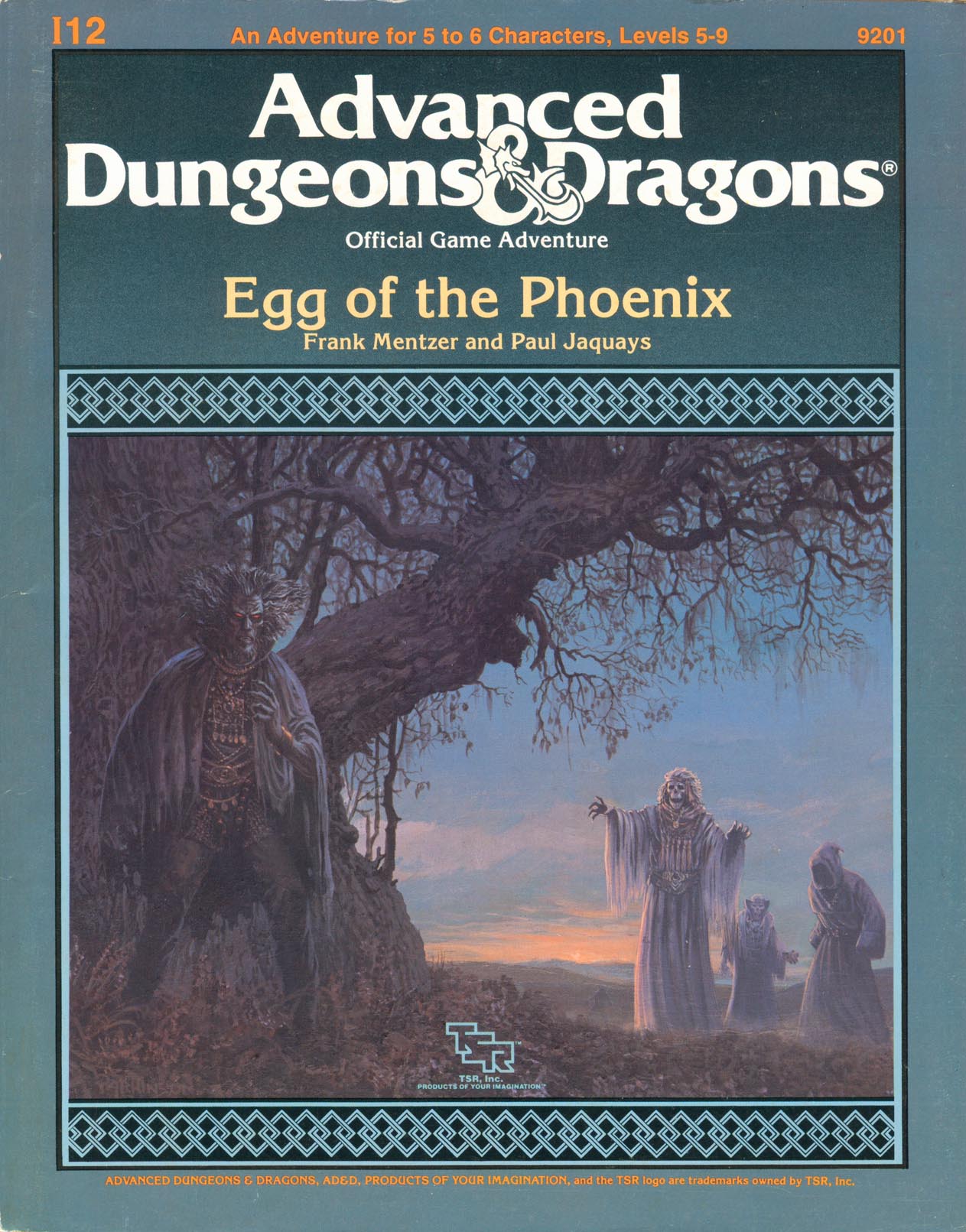
"Come on," they said, "It won't be so tough, just stopping a slavery ring," they said. "I don't know," you said. "Those slaves aren't even entirely human! How do we know they won't try to kill us?" But you went, and now you're having second thoughts. There were the thieves in the lost crypts of Empyrea, raising hundreds of - no, that's too disturbing to think about. There were the three daughters who - no, that's too painful to remember. Now there's this Egg of the Phoenix. What does that have to do with anything? This was supposed to be a cut-and-dried stop-the-slavers job. Who said anything about retrieving lost artifacts? Trudging through forests, traipsing through castles, trotting throug dungeons, traveling through other planes: this has turned into more than your run-of-the-mill adventure. The compensation had better be worth it! Provided, of course, you're around at the end to collect your share. TSR 9201

Sometimes sneaking into the dungeon, avoiding traps and slaying monsters is the easy part. The hard part is getting back out alive. This is a dungeon crawl adventure with a twist, the adventure starts at the end of the dungeon with the party trying to find their way back to safety.

557 pages - five adventures! The first act of the critically acclaimed ZEITGEIST: The Gears of Revolution Adventure Path now compiled into a gorgeous hardcover book! These five adventures are the first act of a steam & spell campaign for the Pathfinder RPG (also available for Dungeons & Dragons 4th edition). Steam and soot darken the skies above the city of Flint, and the choking products of its industrial forges sweep from the majestic harbor to the fey rainforests that dot its knife-toothed mountains. The Unseen Court, the Great Hunt, and the many spirits of the land no longer receive tribute, but they cannot enter these new domains of steam and steel to demand their tithe. The impoverished workers who huddle in factory slums fear monsters of a different breed, shadowy children of this bleak urban labyrinth. Times are turning. The skyseers – Risurs folk prophets since their homeland’s birth – witness omens in the starry wheels of heaven, and they warn that a new era is nigh. But what they cannot foresee, hidden beyond the smog of the night sky, is the face of this coming era, the spirit of the age. The zeitgeist. This tome contains Act One of ZEITGEIST: The Gears of Revolution, a cinematic adventure path designed for experienced Game Masters. These five 'steam and spell' adventures will take your party - members of the Royal Homeland Constabulary - from 1st to 8th level as they solve murders, engage in magical spycraft, and unearth villainous conspiracies. Take a step away from traditional fantasy, and play a part in shaping the coming age!

The last of his line, Baron Paytro NeMoren has left his dark secret sealed for decades in the family's underground vault. Now, years after his death, a group of stalwart heroes has gathered according to the baron's final wishes. At last, the seal will be broken and the secrets of the vault revealed. Can all sins be forgiven? The adventure is designed to kick-off a campaign, as it provides for an interesting way to get the party together. Instead of meeting at a tavern or being recruited by the local militia, each party member starts with a key to the NeMoren's vault, a key that was handed down by a friend or given as a gift for some good deed peformed in the past. The executor of the estate has gathered together all of the key-holders so that they could claim the contents of the vault. The vault can only be opened with all of the keys in unison. The vault is protected by a number of minor traps and tricks, but it also became the final resting place for the Baron's ex-lover, Lisette, and her brothers--all three of whom had attempted to blackmail the Baron. They were buried alive and are now undead. To complicate matters, a young umber hulk made its way to the vault, leaving some crude tunnels that were later exploited by hobgoblins coming from another surface entrance. The party will need to deal with the hobgoblins, the undead, the traps, and possibly the young umber hulk. There is a side-plot of poisoned groundwater in the nearby town that the party can also resolve by clearing out the undead and properly disposing of the putrid corpses leaking into the groundwater from the vault. Produced by Fiery Dragon Productions
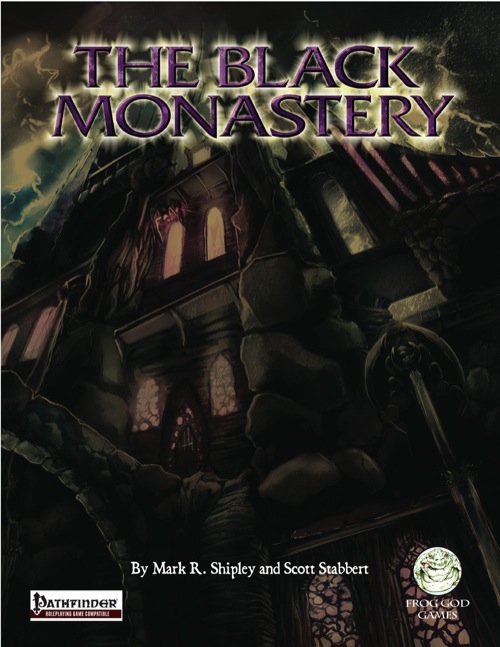
The Legend of the Black Monastery Two centuries have passed since the terrible events associated with the hideous cult known as the Black Brotherhood. Only scholars and story-tellers remember now how the kingdom was nearly laid to waste and the Black Monastery rose to grandeur and fell into haunted ruins. The Brothers first appeared as an order of benevolent priests and humble monks in black robes who followed a creed of kindness to the poor and service to the kingdom. Their rules called for humility and self denial. Other religious orders had no quarrel with their theology or their behavior. Their ranks grew as many commoners and nobles were drawn to the order by its good reputation. The first headquarters for the order was a campsite, located in a forest near the edge of the realm. The Brothers said that their poverty and dedication to service allowed them no resources for more grand accommodations. Members of the Black Brotherhood built chapels in caves or constructed small temples on common land near villages. They said that these rustic shrines allowed them to be near the people they served. Services held by the Brothers at these locations attracted large numbers of common people, who supported the Black Brotherhood with alms. Within 50 years of their first appearance, the Black Brotherhood had a number of larger temples and abbeys around the kingdom. Wealthy patrons endowed them with lands and buildings in order to buy favor and further the work of the Brothers. The lands they gained were slowly expanded as the order’s influence grew. Many merchants willed part of their fortunes to the Black Brotherhood, allowing the order to expand their work even further. The Brothers became bankers, loaning money and becoming partners in trade throughout the kingdom. Within 200 years of their founding, the order was wealthy and influential, with chapters throughout the kingdom and spreading into nearby realms. With their order well-established, the Black Brotherhood received royal permission to build a grand monastery in the hill country north of the kingdom’s center. Their abbot, a cousin of the king, asked for the royal grant of a specific hilltop called the Hill of Mornay. This hill was already crowned by ancient ruins that the monks proposed to clear away. Because it was land not wanted for agriculture, the king was happy to grant the request. He even donated money to build the monastery and encouraged others to contribute. With funds from around the realm, the Brothers completed their new monastery within a decade. It was a grand, sprawling edifice built of black stone and called the Black Monastery. From the very beginning, there were some who said that the Black Brotherhood was not what it seemed. There were always hints of corruption and moral lapses among the Brothers, but no more than any other religious order. There were some who told stories of greed, gluttony and depravity among the monks, but these tales did not weaken the order’s reputation during their early years. All of that changed with the construction of the Black Monastery. Within two decades of the Black Monastery’s completion, locals began to speak of troubling events there. Sometimes, Brothers made strange demands. They began to cheat farmers of their crops. They loaned money at ruinous rates, taking the property of anyone who could not pay. They pressured or even threatened wealthy patrons, extorting money in larger and larger amounts. Everywhere, the Black Brotherhood grew stronger, prouder and more aggressive. And there was more… People began to disappear. The farmers who worked the monastery lands reported that some people who went out at night, or who went off by themselves, did not return. It started with individuals…people without influential families…but soon the terror and loss spread to even to noble households. Some said that the people who disappeared had been taken into the Black Monastery, and the place slowly gained an evil reputation. Tenant farmers began moving away from the region, seeking safety at the loss of their fields. Slowly, even the king began to sense that the night was full of new terrors. Across the kingdom, reports began to come in telling of hauntings and the depredations of monsters. Flocks of dead birds fell from clear skies, onto villages and city streets. Fish died by thousands in their streams. Citizens reported stillborn babies and monstrous births. Crops failed. Fields were full of stunted plants. Crimes of all types grew common as incidents of madness spread everywhere. Word spread that the center of these dark portents was the Black Monastery, where many said the brothers practiced necromancy and human sacrifice. It was feared that the Black Brotherhood no longer worshipped gods of light and had turned to the service of the Dark God. These terrors came to a head when the Black Brotherhood dared to threaten the king himself. Realizing his peril, the king moved to dispossess and disband the Black Brother hood. He ordered their shrines, abbeys and lands seized. He had Brothers arrested for real and imagined crimes. He also ordered investigations into the Black Monastery and the order’s highest ranking members. The Black Brotherhood did not go quietly. Conflict between the order and the crown broke into violence when the Brothers incited their followers to riot across the kingdom. There were disturbances everywhere, including several attempts to assassinate the king by blades and by dark sorcery. It became clear to everyone that the Black Brotherhood was far more than just another religious order. Once knives were drawn, the conflict grew into open war between the crown and the Brothers. The Black Brotherhood had exceeded their grasp. Their followers were crushed in the streets by mounted knights. Brothers were rounded up and arrested. Many of them were executed. Armed supporters of the Black Brotherhood, backed by arcane and divine magic, were defeated and slaughtered. The Brothers were driven back to their final hilltop fortress – the Black Monastery. They were besieged by the king’s army, trapped and waiting for the king’s forces to break in and end the war. The final assault on the Black Monastery ended in victory and disaster. The king’s army took the hilltop, driving the last of the black-robed monks into the monastery itself. The soldiers were met by more than just men. There were monsters and fiends defending the monastery. There was a terrible slaughter on both sides. In many places the dead rose up to fight again. The battle continued from afternoon into night, lit by flames and magical energy. The Black Monastery was never actually taken. The king’s forces drove the last of their foul enemies back inside the monastery gates. Battering rams and war machines were hauled up the hill to crush their way inside. But before the king’s men could take the final stronghold, the Black Brotherhood immolated themselves in magical fire. Green flames roared up from the monastery, engulfing many of the king’s men as well. As survivors watched, the Black Monastery burned away, stones, gates, towers and all. There was a lurid green flare that lit the countryside. There was a scream of torment from a thousand human voices. There was a roar of falling masonry and splitting wood. Smoke and dust obscured the hilltop. The Black Monastery collapsed in upon itself and disappeared. Only ashes drifted down where the great structure had stood. All that was left of the Black Monastery was its foundations and debris-choked dungeons cut into the stones beneath. The war was over. The Black Brotherhood was destroyed. But the Black Monastery was not gone forever. Over nearly two centuries since its destruction, the Black Monastery has returned from time to time to haunt the Hill of Mornay. Impossible as it seems, there have been at least five incidents in which witnesses have reported finding the Hill of Mornay once again crowned with black walls and slate-roofed towers. In every case, the manifestation of this revenant of the Black Monastery has been accompanied by widespread reports of madness, crime and social unrest in the kingdom. Sometimes, the monastery has appeared only for a night. The last two times, the monastery reappeared atop the hill for as long as three months…each appearance longer than the first. There are tales of adventurers daring to enter the Black Monastery. Some went to look for treasure. Others went to battle whatever evil still lived inside. There are stories of lucky and brave explorers who have survived the horrors, returning with riches from the fabled hordes of the Black Brotherhood. It is enough to drive men mad with greed – enough to lure more each time to dare to enter the Black Monastery.

Something fell. A sickly gloaming lit up the night like mock daylight, just for a moment, and then the hills trembled. Now, an alien entity lies brooding in a crater gouged out of the moor. Local folk are enraptured with the toothsome jelly exuded by this being, but are blind to the true nature of the events unfolding in their rustic little backwater.
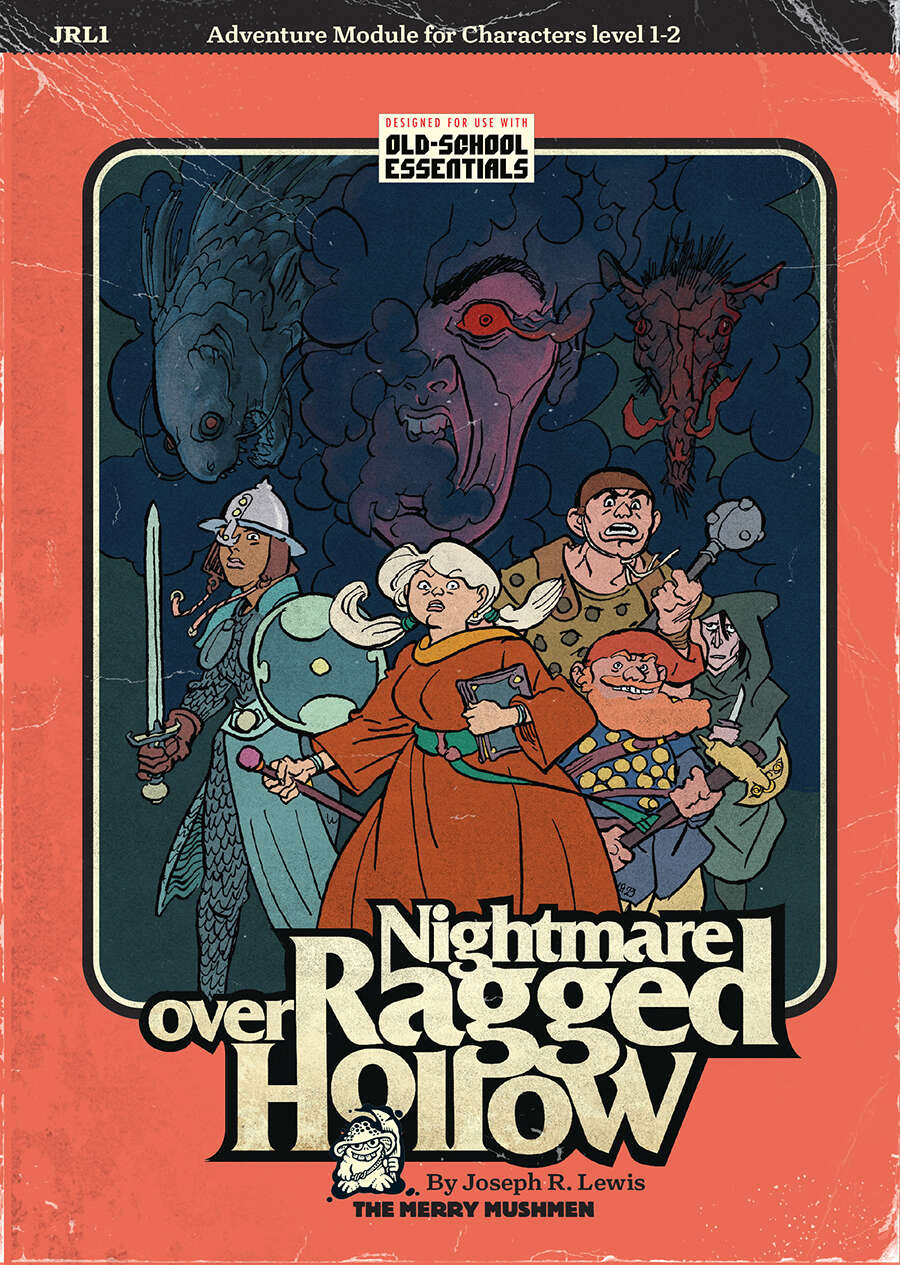
A new, expanded, OSR-ised, prettified edition of Joseph R. Lewis’ Ragged Hollow Nightmare which was rated among The Best by Tenfootpole. Joseph Lewis hit a perfect balance between the classics of dungeonverse fantasy and the whimsy of the folk tales we love so much (as testified by our Folklore Bestiary. we released last year), adding a dash of dreamworld strangeness and a pinch of body horror to spice up his brew. We did our best to respect his recipe when adding our extra material (about 30 pages of it). We worked with Joe and Li-An (the perfect artist to give life to spooky Ragged Hollow and its strange surroundings) to make the best module we could: a solid introduction to old-school gaming for both players and gamemasters. And for the veterans among us, it also makes an excellent, full-fledged campaign starter. Nightmare over Ragged Hollow is a sandbox adventure centred around a quaint town at the edge of the kingdom. But however quiet life in Ragged Hollow is, the town lies between places where you shouldn’t be traveling alone. Places like Gloam Wood (“A witch or two lurk there!”), the Bleak Mountains (“I’m told there are bugbears…”) and their infamous Mount Mourn (“Home, they say, to cursed Dwarven ruins”), not to forget the Wailing Hills (“Bandits on every road!”). There’s even a haunted house by the river (“That mad inventor riddled it with traps!”). But only when an impenetrable dome of golden light materialises around the Temple of Halcyon (“Hey, my kids go to school there!”) do things really get out of hand. Some selfless heroes (or, failing that, a bunch of greedy ne’er-do-wells) should really get involved. One town with three adventure mini-sites Three small dungeons One 50-room dungeon Three hexes with 16 detailed locations Two groups of potential allies or rivals Sixteen pre-generated characters One deadly countdown! Written for the Old-School Essentials (OSE) rule system
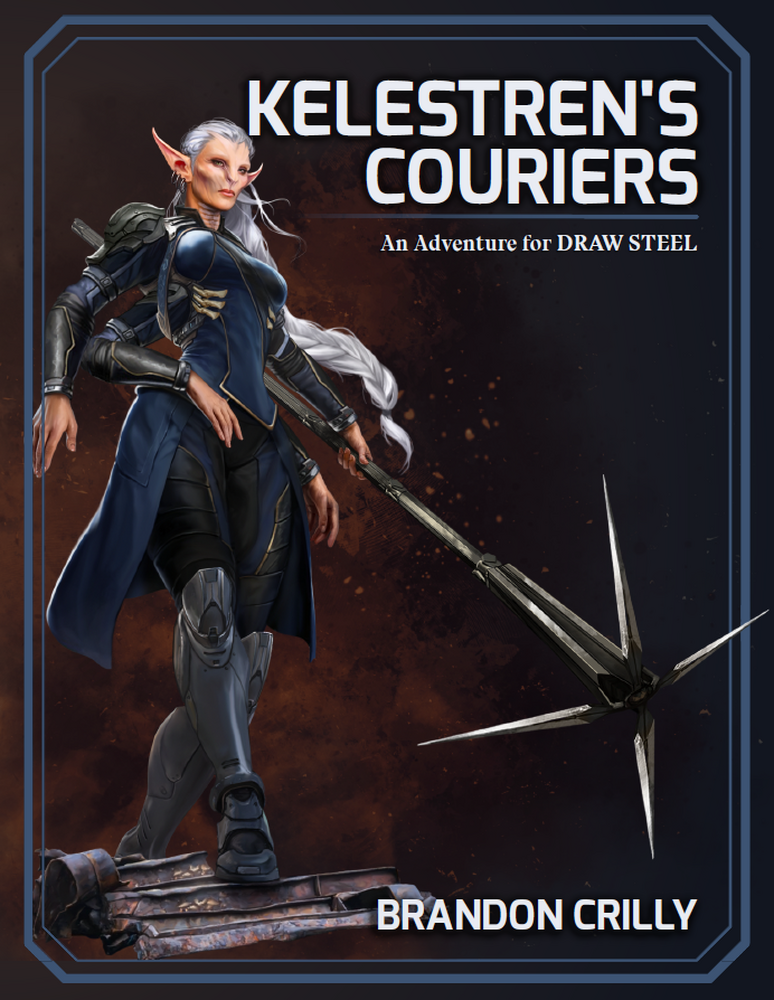
A mysterious broker comes to you with an offer: bring this box from Point to Point B, ask no questions, and you'll be rewarded. Do you take the gig? And when do you start wondering what's in the box? Kelestren's Couriers is the first in a series of science fantasy adventures for Draw Steel, introducing the original Gods of Futurity campaign setting. It is intended for a party of four Level 1 heroes, and can also be used as a one-shot, convention scenario, or an intro to your own Draw Steel campaign. Also included: a bonus setting primer! Complete with additional details on ancestries, classes and kits, plus an overview of Gods of Futurity to help with character creation. What You Get: - The complete adventure PDF of Kelestren's Couriers - Two original VTT maps - Five original art pieces for the Oculus of Tiza'ree, to help answer "what's in the box?" - Gods of Futurity Setting Primer - a bonus PDF with more details on Gods of Futurity, to help with character creation
:strip_icc()/pic2633965.jpg)
On the Purple Planet, amid the frosted Ancestor Peaks, the adventurers have encountered a small pyramid thrusting skyward from the bottom of a ravine. This is the Tomb of Dust, one of the ancient cairns found throughout the area. Here, the PCs find deadly puzzles, encounter the Moth Mother and her hungry brood, and face the tests of Anh-Tho the Learned, a forgotten scholar of a bygone age. If they manage to thwart these dangers they gain access to Anh-Tho’s Archive, a perilous repository of potent lore!
:strip_icc()/pic775603.jpg)
A routine recovery job, bread and butter work for any party of sell-respecting adventurers. What could go wrong? A few bugbears aren't going to cause any difficulty, are they?
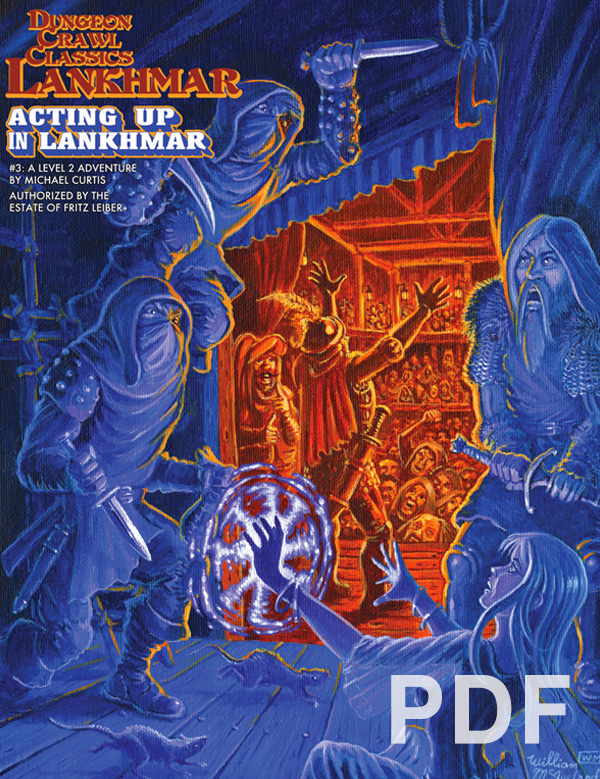
A corrupt Duke of Lankhmar’s foibles paraded before the masses for their entertainment puts an acting troupe in trouble. Threatened by the insulted Duke and his private guard, the performers need assistance to make it through their final performance of “The Fiascos of Duke Hogfat.” With nobody else to turn to, the troupe hires the PCs as their evening’s protectors. Will the play end in a standing ovation or will the Duke and his thugs bring down the house on the troupe and their defenders? Officially licensed from the estate of Fritz Leiber.
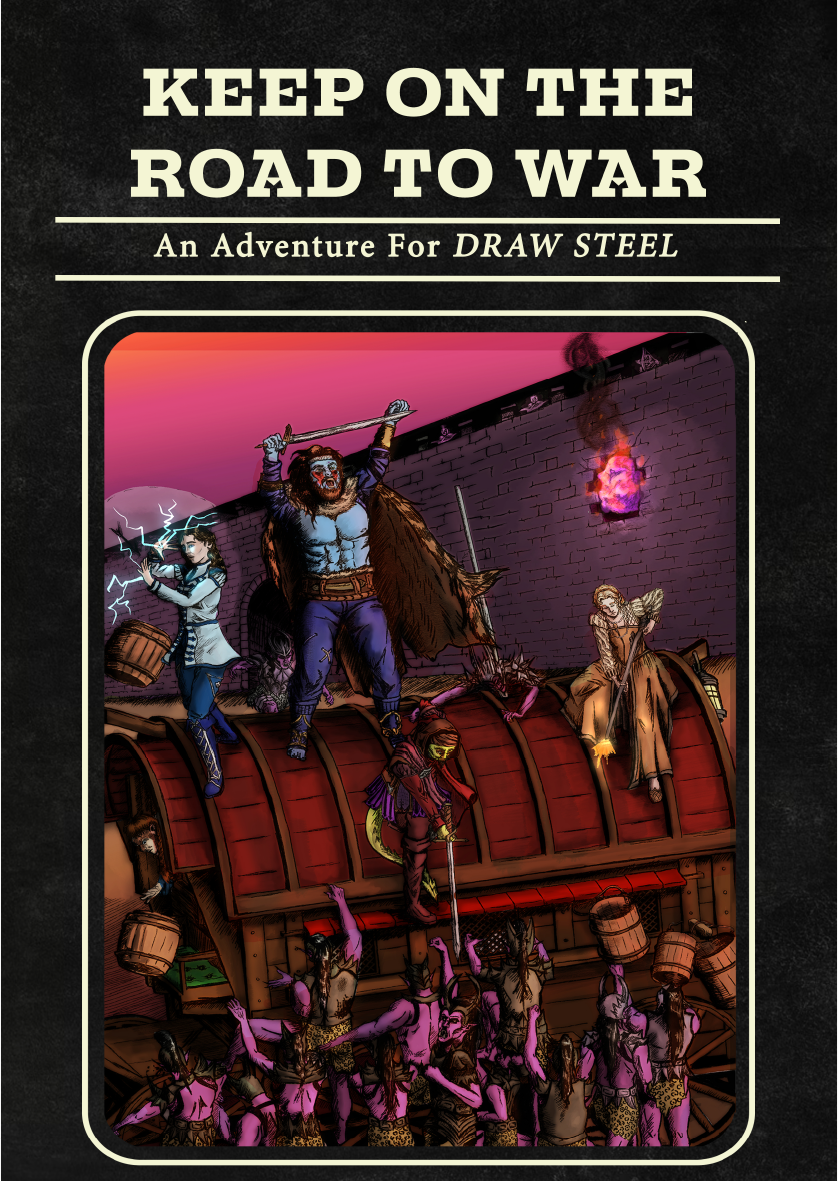
Keep on the Road to War is an adventure for 3rd level Draw Steel heroes. Over the course of 3-6 session of play, heroes can earn up to 17 victories. Inspired by the critically-acclaimed adventure Red Hand of Doom and infused with detail from MCDM's Orden setting, heroes are charged with crossing Western Vasloria's devastated countryside to seek out the Acolyte Maritete, Priestess of the Boatman so she may answer for her necromantic apostacy. Will Omund's Ferry survive? Answers lie within the KEEP ON THE ROAD TO WAR.

The company discovers the Easterly Inn, a piece of the Shire in the land of the Beornings. But the Wild is still the Wild, and it takes more than Hobbit cooking to keep adventures at bay; in no time, the companions find themselves involved in the search for a missing trade caravan. Their quest will put them on the road to the High Pass, and see them go over hills and under hills. Published by Cubicle7

Come visit the acid fantasy mini-sandbox of the Misty Isles, a hellish pocket plane that's brutally displaced a bucolic paradise. Marvel at its massive grub-ridges, shake at the body horror of its protein vats—and watch as your players dynamically unleash the Anti-Chaos Index through their own in-game actions. Misty Isles of the Eld is a stand-alone sequel to Slumbering Ursine Dunes and Fever-Dreaming Marlinko. It contains: Four dungeons. The Vat Complex (with its menacing sealed off-west wing, body-horrific industrial process and pocket dimensions), the flying god-prison Monument Five, the meth-fruit Plantation House and Colonel Zogg's Pagoda Bunker. Full “extra-planar” pointcrawl. The wilderness crawl spreads over one main isle and two smaller islets subdivided by massive, movable grubs. An “Anti-Chaos Index.” Through their actions the players shape the very reality of the Isles. Sometimes for the better, sometimes for the worst, but always for the weird. A slew of new otherwordly monsters. A large collection of bizarre technological Eldish artifacts and treasure. Includes a random generator for miscellaneous artifacts picked up. A new psionicist player class, the Psychonaut, with a soft scifi twist. Including its own powers and mutations.

The Fall of Blackbottom is an adventure for the Draw Steel roleplaying game for 1st-level heroes. It’s intended for four to six players, including the Director. This fast-paced, high-stakes adventure assumes that players have moderate experience with the Draw Steel system and the game’s core rulebooks. The Fall of Blackbottom begins on a calm morning at the Drunken Fool, a three-story inn renowned for its baths and jaunty atmosphere. When Ajax’s siege plunges the city into chaos, the heroes are instructed by a member of the Chain of Acheron to lead civilians to a safehouse where the Chain will regroup and help the helpless flee the city. When the heroes arrive at the safehouse, however, it becomes clear that no one is coming to help. What’s more, one or more of them are wanted by Ajax, known to the Overlord by name. Their lives—and the lives of everyone they’ve saved—now rest solely on their shoulders.

This scenario was originally written for use as a competition event at Games Day 1987. We have published the adventure so that you will be able to reproduce the competition. The scenario also serves as an introduction to the forthcoming supplement detailing the land of Lustria. (see WFRP World Map, p272). At Games Day the party had to play the part of a small band of pygmies, and we have included details of this party so that you can use them too. You should carefully read the notes on Witchdoctors, Ancestor Spirits and the spell Control Spirits before starting play. If a conventional party is used here there is a significant chance that players will lose favourite characters. Much of the scenario is geared towards pygmies, (some tunnel heights, the presence of pygmy ancestors and so on), and a party without access to pygmy-magic may find some areas extremely difficult. Pgs. 11-27 Published by Games Workshop