
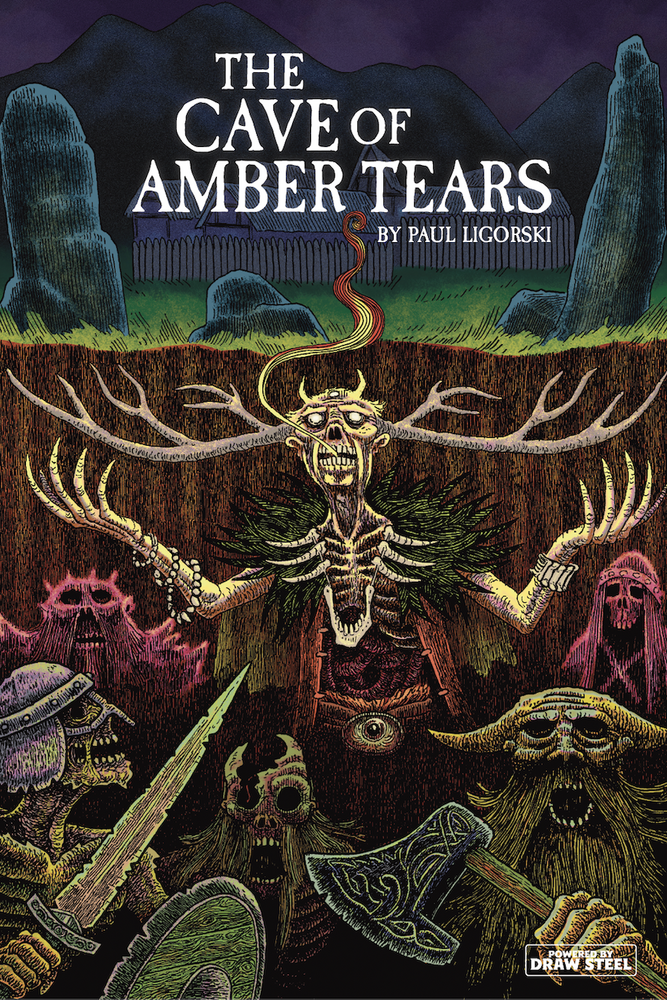
Far below the Fields of Petrichor is a vast cavern containing the skeletal remains of a long-dead Sonorous Titan, a whale-like beast that once floated through the skies of a lost age. Amongst the bones are ravines and grottos home to bizarre creatures and lost treasures that are as beautiful and valuable as they are deadly. Ghostly shapes swim through the air. Glowing mushroom groves hide frightened creatures. And the Titan’s bones sing sadly as an ambitious wizard and his weary hirelings dig for its precious marrow... ADVENTURE TYPE: Small Sandbox Dungeon DESIGN NOTES: This adventure is intended for characters levels 5 to 8. It includes several wilderness areas, a ruined village and a mining camp to explore. Each area contains various encounters and unique magical items.There are many opportunities for combat, but it is possible for players to explore most areas and complete many interactions without any combat at all, depending on their choices. INCLUDES: Story hooks, dialogue prompts, creature stat blocks, original creatures and treasures, and dungeon overview map. KEYWORDS: Grave, skeleton, ghost, undead, wizard, miner, puzzle, mushroom, myconid, hag, witch, social, curse, mutation, mutant, soul, insect, termite, scorpion, bat, monk, beetle, chicken
An adventure for the Midnight campaign setting from Fantasy Flight Games. The adventurers make contact with the Baden's Bluff underground to investigate a pair of recent murders. This adventure emphasizes information gathering and deduction, rather than combat.

None know from where the Heresiarch first came, but all remember the night that it did. It rode down from the bleeding stars on a great serpent, hurling bolts of obsidian lightning that shattered the monuments and capitols of every nation. Its infernal army swept aside the defenses of the mortal empires in a single hour, decimating legions once thought to be the invincible fist of humanity's god-kings. Faceless priests - each bearing the symbol of the trident - drifted through the fallen cities and scorched villages on a frigid wind, and when they rose to greet the huddled men and women ringed by their festering, bloated dead, they spoke a single, simple offer: worship the Heresiarch or die. Thousands of crusaders fell tonight so that you might be given this chance. In a last stand that, for the first time, united all of the empires of humanity as brothers and sisters, a way was cleared into an infernal stronghold said to contain a gate to the Heresiarch’s fane. All is silent save for the clangor of distant battle. Surrounded by grim-faced knights and teary-eyed peasants – their hands clasped in desperate hope – you step through the glowing, churning doorway, knowing there will be no help and likely no return. Published by Defy Danger and Save Versus Death
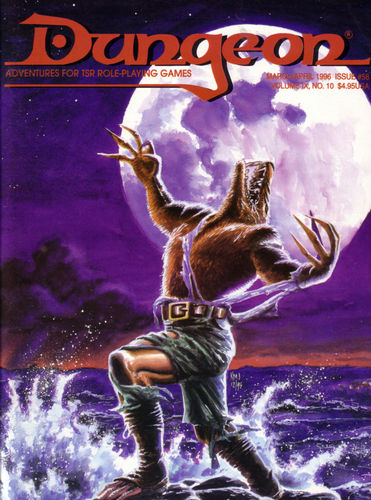
Let the buyer be-were! Sometimes you should be afraid to visit the dentist. A small coastal town is plagued with a curse and it is up to the PCs to find out what is causing the inhabitants of the town to transform into mad seawolfs. This adventure is set in the busy seaport of Rocky Harbor, which is located on a sheltered island dep in an extensive archipelago. Rocky Harbor is another location in the Volkrad campaign setting, as previously published in Dungeon Adventures issue #41, Old Man Katan and the Incredible, Edible, Dancing Mushroom Band. Pgs. 8-20
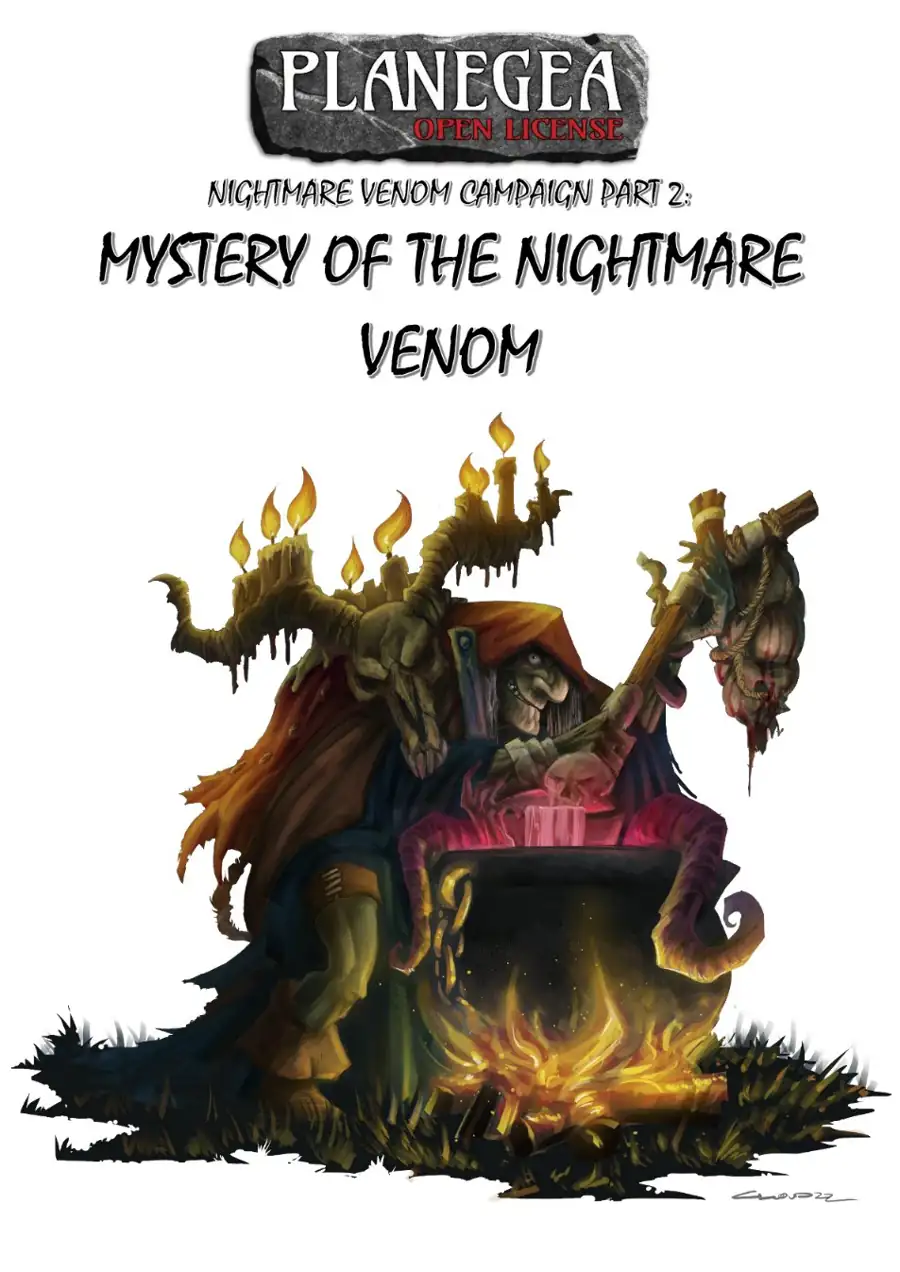
Mystery of the Nightmare Venom is the second adventure in the Nightmare Venom campaign for the prehistoric D&D Planegea campaign setting. It is designed for four to five 2nd-level characters using the D&D 2014 ruleset. In the first campaign adventure, Venom Attack!, the PCs encountered an envenomed spider-raptor sent by the Spiderfolk Queen to attack Edgegather, while a minion of a green hag sought to collect a sample of the venom. In Mystery of the Nightmare Venom, the PCs begin to investigate this strange magical poison at the behest of the Venom Guard: A vengeful green hag seeks to corrupt the inhabitants of Edgegather. Can the PCs stop her before her poison brings the settlement to its knees? The goblins of the Unfalls may have useful information but the PCs must first retrieve a lost relic from the spiderfolk of the Venom Abyss before they can ask their questions. The PCs investigate a vast and ancient temple beneath Edgegather where the mysterious Veiled Goddess can point them towards the Oracle of Seerfall. Mystery of the Nightmare Venom contains five new monsters (the envenomed chattercrest, the envenomed Venom Guard, the cauldronborn, the Glassback spiderfolk, and the faithful remnant) and two new magic items, the bloodtallow candle and the obsidian centipede.
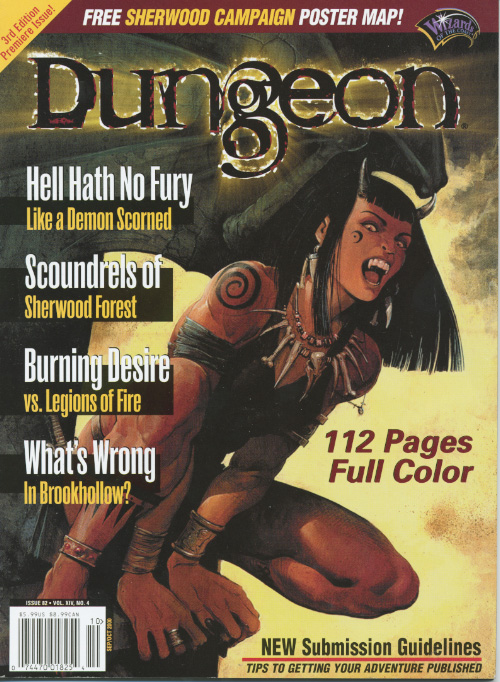
Where's Robin Hood When You Need Him? The Sheriff of Nottingham and the outlaws of Sherwood Forest share a common enemy. Will an unlikely alliance end this newest threat to the land? Pgs. 42-67
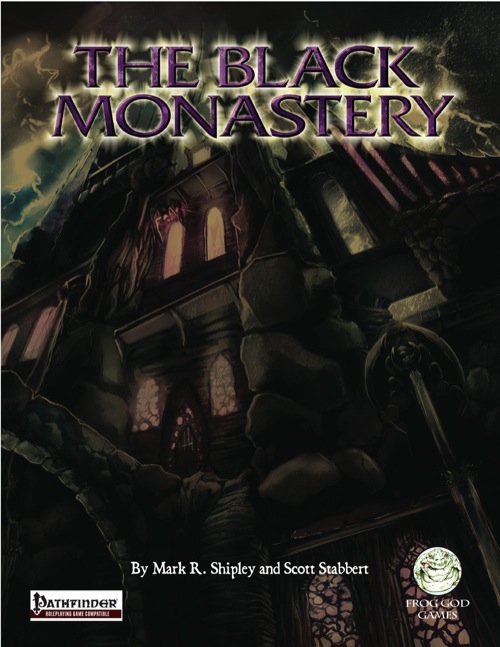
The Legend of the Black Monastery Two centuries have passed since the terrible events associated with the hideous cult known as the Black Brotherhood. Only scholars and story-tellers remember now how the kingdom was nearly laid to waste and the Black Monastery rose to grandeur and fell into haunted ruins. The Brothers first appeared as an order of benevolent priests and humble monks in black robes who followed a creed of kindness to the poor and service to the kingdom. Their rules called for humility and self denial. Other religious orders had no quarrel with their theology or their behavior. Their ranks grew as many commoners and nobles were drawn to the order by its good reputation. The first headquarters for the order was a campsite, located in a forest near the edge of the realm. The Brothers said that their poverty and dedication to service allowed them no resources for more grand accommodations. Members of the Black Brotherhood built chapels in caves or constructed small temples on common land near villages. They said that these rustic shrines allowed them to be near the people they served. Services held by the Brothers at these locations attracted large numbers of common people, who supported the Black Brotherhood with alms. Within 50 years of their first appearance, the Black Brotherhood had a number of larger temples and abbeys around the kingdom. Wealthy patrons endowed them with lands and buildings in order to buy favor and further the work of the Brothers. The lands they gained were slowly expanded as the order’s influence grew. Many merchants willed part of their fortunes to the Black Brotherhood, allowing the order to expand their work even further. The Brothers became bankers, loaning money and becoming partners in trade throughout the kingdom. Within 200 years of their founding, the order was wealthy and influential, with chapters throughout the kingdom and spreading into nearby realms. With their order well-established, the Black Brotherhood received royal permission to build a grand monastery in the hill country north of the kingdom’s center. Their abbot, a cousin of the king, asked for the royal grant of a specific hilltop called the Hill of Mornay. This hill was already crowned by ancient ruins that the monks proposed to clear away. Because it was land not wanted for agriculture, the king was happy to grant the request. He even donated money to build the monastery and encouraged others to contribute. With funds from around the realm, the Brothers completed their new monastery within a decade. It was a grand, sprawling edifice built of black stone and called the Black Monastery. From the very beginning, there were some who said that the Black Brotherhood was not what it seemed. There were always hints of corruption and moral lapses among the Brothers, but no more than any other religious order. There were some who told stories of greed, gluttony and depravity among the monks, but these tales did not weaken the order’s reputation during their early years. All of that changed with the construction of the Black Monastery. Within two decades of the Black Monastery’s completion, locals began to speak of troubling events there. Sometimes, Brothers made strange demands. They began to cheat farmers of their crops. They loaned money at ruinous rates, taking the property of anyone who could not pay. They pressured or even threatened wealthy patrons, extorting money in larger and larger amounts. Everywhere, the Black Brotherhood grew stronger, prouder and more aggressive. And there was more… People began to disappear. The farmers who worked the monastery lands reported that some people who went out at night, or who went off by themselves, did not return. It started with individuals…people without influential families…but soon the terror and loss spread to even to noble households. Some said that the people who disappeared had been taken into the Black Monastery, and the place slowly gained an evil reputation. Tenant farmers began moving away from the region, seeking safety at the loss of their fields. Slowly, even the king began to sense that the night was full of new terrors. Across the kingdom, reports began to come in telling of hauntings and the depredations of monsters. Flocks of dead birds fell from clear skies, onto villages and city streets. Fish died by thousands in their streams. Citizens reported stillborn babies and monstrous births. Crops failed. Fields were full of stunted plants. Crimes of all types grew common as incidents of madness spread everywhere. Word spread that the center of these dark portents was the Black Monastery, where many said the brothers practiced necromancy and human sacrifice. It was feared that the Black Brotherhood no longer worshipped gods of light and had turned to the service of the Dark God. These terrors came to a head when the Black Brotherhood dared to threaten the king himself. Realizing his peril, the king moved to dispossess and disband the Black Brother hood. He ordered their shrines, abbeys and lands seized. He had Brothers arrested for real and imagined crimes. He also ordered investigations into the Black Monastery and the order’s highest ranking members. The Black Brotherhood did not go quietly. Conflict between the order and the crown broke into violence when the Brothers incited their followers to riot across the kingdom. There were disturbances everywhere, including several attempts to assassinate the king by blades and by dark sorcery. It became clear to everyone that the Black Brotherhood was far more than just another religious order. Once knives were drawn, the conflict grew into open war between the crown and the Brothers. The Black Brotherhood had exceeded their grasp. Their followers were crushed in the streets by mounted knights. Brothers were rounded up and arrested. Many of them were executed. Armed supporters of the Black Brotherhood, backed by arcane and divine magic, were defeated and slaughtered. The Brothers were driven back to their final hilltop fortress – the Black Monastery. They were besieged by the king’s army, trapped and waiting for the king’s forces to break in and end the war. The final assault on the Black Monastery ended in victory and disaster. The king’s army took the hilltop, driving the last of the black-robed monks into the monastery itself. The soldiers were met by more than just men. There were monsters and fiends defending the monastery. There was a terrible slaughter on both sides. In many places the dead rose up to fight again. The battle continued from afternoon into night, lit by flames and magical energy. The Black Monastery was never actually taken. The king’s forces drove the last of their foul enemies back inside the monastery gates. Battering rams and war machines were hauled up the hill to crush their way inside. But before the king’s men could take the final stronghold, the Black Brotherhood immolated themselves in magical fire. Green flames roared up from the monastery, engulfing many of the king’s men as well. As survivors watched, the Black Monastery burned away, stones, gates, towers and all. There was a lurid green flare that lit the countryside. There was a scream of torment from a thousand human voices. There was a roar of falling masonry and splitting wood. Smoke and dust obscured the hilltop. The Black Monastery collapsed in upon itself and disappeared. Only ashes drifted down where the great structure had stood. All that was left of the Black Monastery was its foundations and debris-choked dungeons cut into the stones beneath. The war was over. The Black Brotherhood was destroyed. But the Black Monastery was not gone forever. Over nearly two centuries since its destruction, the Black Monastery has returned from time to time to haunt the Hill of Mornay. Impossible as it seems, there have been at least five incidents in which witnesses have reported finding the Hill of Mornay once again crowned with black walls and slate-roofed towers. In every case, the manifestation of this revenant of the Black Monastery has been accompanied by widespread reports of madness, crime and social unrest in the kingdom. Sometimes, the monastery has appeared only for a night. The last two times, the monastery reappeared atop the hill for as long as three months…each appearance longer than the first. There are tales of adventurers daring to enter the Black Monastery. Some went to look for treasure. Others went to battle whatever evil still lived inside. There are stories of lucky and brave explorers who have survived the horrors, returning with riches from the fabled hordes of the Black Brotherhood. It is enough to drive men mad with greed – enough to lure more each time to dare to enter the Black Monastery.
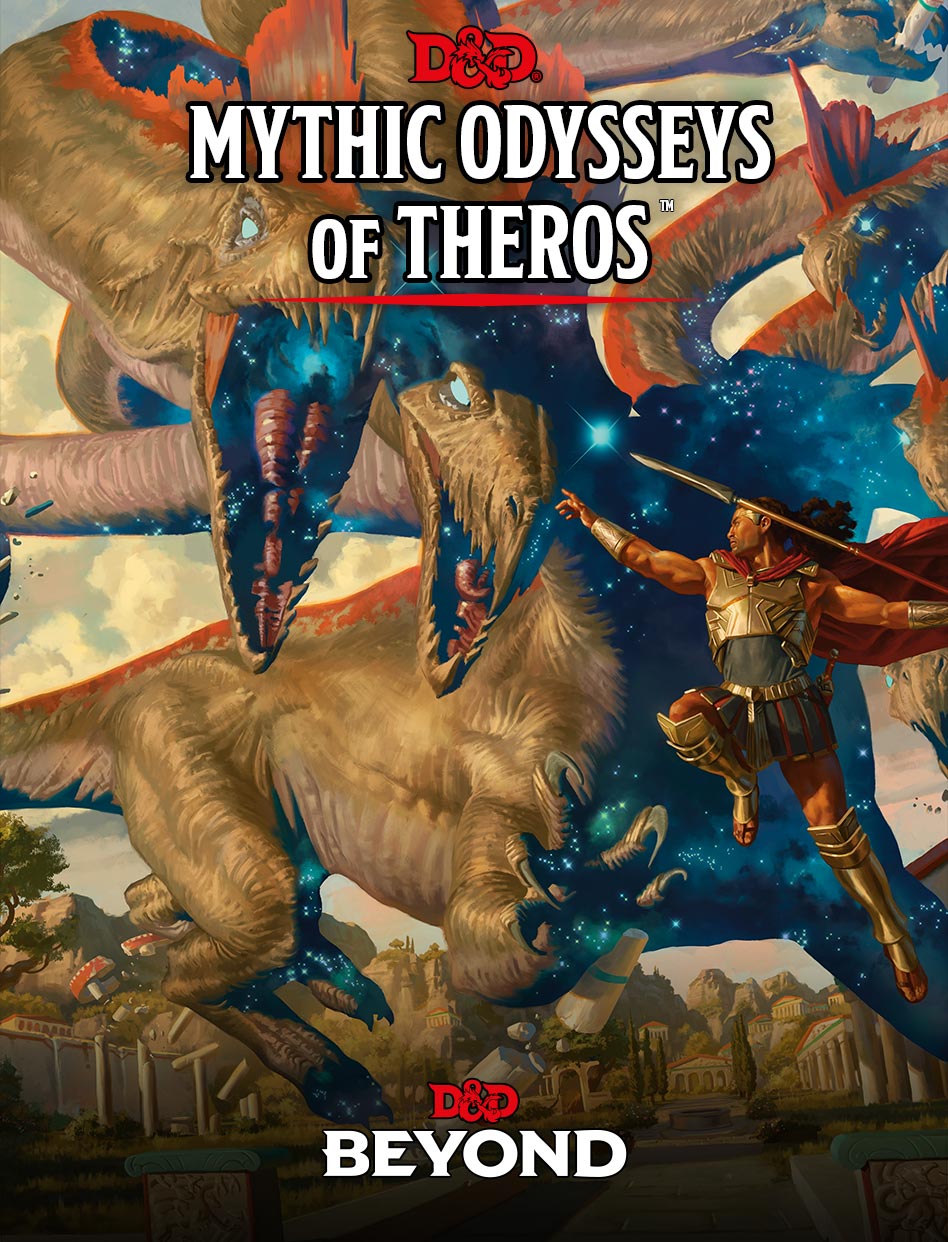
The adventure begins with the characters discovering the recently murdered Returned, Varyas, and confronting his killers. Varyas's gold mask bears a code on it, one that points toward the sage Khea who lives in the nearby polis. When the characters investigate, they learn from Khea that the writing is undecipherable except for the first line, which refers to the legendary Court of Orestes, a site sacred to the god Phenax. She also notes that a recent earthquake has uncovered a cave along the Khystonos River that could be the secret site's location. If so, then perhaps within lies the key to deciphering the mask, along with its own treasures. With the information provided by Khea, the adventurers set forth into the wilds, where they'll face multiple storied dangers before reaching the Court of Orestes. Once at the lost holy site, the characters discover ancient guardians, as well as an unliving entity with the potential to reveal Phenax's lost secret.

Shall you claim the glory of heroes, or accept your doom? You have raised the ire of the goblin warlord, and now you flee his kingdom with war parties hot on your trail. You must reach the borderland town of Felsentheim, for if you do not, no alarm will sound to hearken the coming of the Dogs of War and your bodies will lie in the forest grass, forgotten by all but the worms! Shall you claim the glory of heroes and warn the people or accept your doom and suffer death in the Treklant? Enter again the World of Inzae, where all things slip into the Maelstrom, and from hence true heroes are born.

The Tale of The Haunted Ravine is a Hex Crawl Adventure of Exploration that can be used for any game system but was designed for use with D&D 5e. A Hex crawl map and random roll tables are used to create surprising encounters and mysteries for your players to interact with. Wild necrotic magic, magical mutations, undead, lost souls, and demons all cloaked in a fog fog-choked landscape; forsaken by the gods and scarred by the battle fought here long ago. Will your adventurers survive and escape the Haunted Ravine? Or will they join the legions of cursed souls imprisoned in this corrupted land?

The Last Point is a prison and outpost of the Corrive Empire, a realm ruled by a cruel green dragon named Lady Corrive. The Corrivians are well known for their hatred of magic users, and their extensive slave trade industry. A forest realm with coasts on three sides and mountains running through the center, Corrive is rich with a variety of resources. However, the rocky northern coast is out of the way of their navy and relies heavily on hired ships to help transport various goods including prisoners and slaves to isolated outposts, training centers, and slave colonies. The northwest coast of Corrive is rocky and many parts of it are elevated, making it isolated from much of the mainland. The Last Point is a recycling center where captives meant for death row who are either deemed “not important enough” to execute publicly or “too disgraceful” to execute publicly are sent to be tortured and then killed. The place seems to operate on sort of a “well, we have too many so some have to go now” policy. The Last Point has no official deadlines for killing.

For decades, Theatre Infernalis offered shocking and frightful entertainment to customers who entered its gaping demonic facade and saw a frightful portrait of the eternal torments that await all sinners. Now rumours tell of the aging and supposedly-cursed proprietor's deteriorating health and the theatre's impending sale, and the Artist's Quarter has been abuzz with those seeking one final fright with a walk through the crucible-licked walls of the infernal house of the macabre before its final curtain call. But are the theatre's smoke-and-mirrors and cheap scares hiding a truly wicked secret? What is the nature of the curse and illness that afflict the owner? And did foul and profane rites once take place between its walls that outside forces now seek to exploit? What happens when the spookshow's fun and games transform into a terrifying reality, threatening to spill forth an infernal malevolence onto the streets of the Blight?

“Rats in the Walls”: A dockside tavern in Khromarium is plagued by rats of a most unusual breed. These abominable rodents have ruined the tavern keeper’s business and his life. The man is desperate, and he offers a substantial reward for the elimination of his horrific problem.
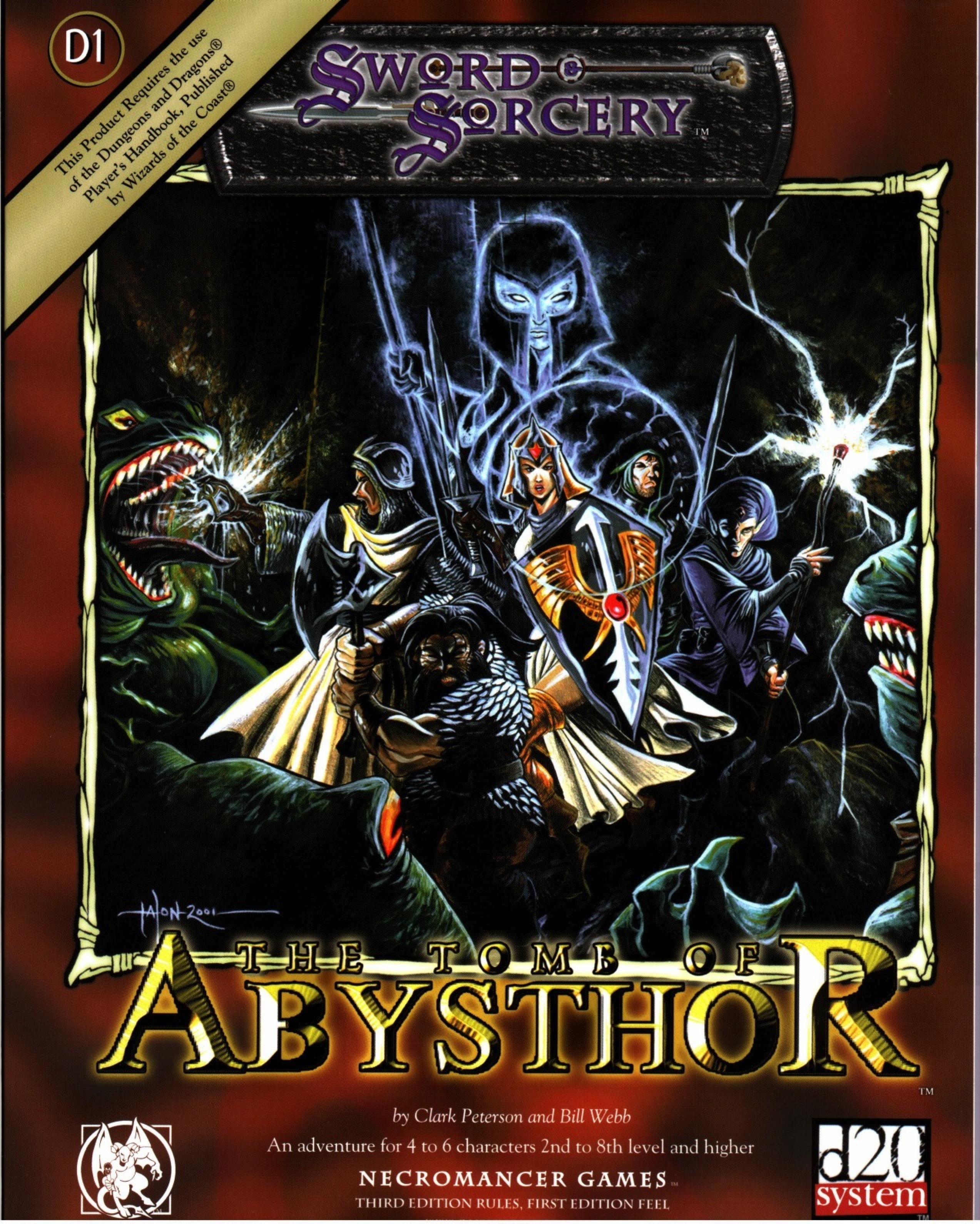
Restore an Abandoned Temple Enter the catacombs near the desecrated Temple of Muir, Goddess of Paladins, and search for the lost tomb of Abysthor. Will your party be able to cleanse the evil that now inhabits these once-sacred halls, and recover the Stone of Tircople? Can your characters survive the traps of an undead sorcerer? Will your players discover the chamber of Living Rock and the secret power it holds? Adventure awaits! Gold and Glory! A fantasy adventure published for the D20 system, The Tomb of Abysthor is the first module in Necromancer Games Dungeon series and can be played as a stand-alone story or in conjunction with The Crucible of Freya and the forthcoming city supplement Bards Gate. What secrets lie hidden in the tomb of Abysthor?
Many years ago a brutal bugbear chieftain united the goblinoid tribes of the Meirlara Forest and nearly wiped out all traces of the elves there within. A stroke of chance fate turned the tide and the dreaded bugbear warlord Spragnokk was defeated. His loyal kin hid his body away in a sealed chamber and then the world forgot about Spragnokk... until now. Now his bloodline continues, and they have plans to resurrect their fallen "great chieftain," to bring ruin and revenge upon the elves that handed them defeat decades past. The goblinoid tribes have once more been gathered, and their bloody revenge is imminent, except fate has yet once more placed new champions to stand in their way. They just don't realize it yet.

A prison escape for an unlikely group of heroes turns into a race for an ancient relic sought by the Legion of Dusk. Can you brave the unknown and capture the treasure before the enemy does? This Dungeons & Dragons adventure is set on the plane of Ixalan from Magic: The Gathering. It uses 4th-level characters provided with the adventure.

A peaceful isolated village has hosted its share of superstitions, but something real is poised to plague the citizens of the community. Can heroes rise to prevent the destruction of the village? What drives some to leave the safety of their communities and start along the path of adventure. Maybe it is something in their background that compels them; maybe it is the lure of treasure; maybe it is just a curious map. It is the first episode in the Drow Conspiracy. Published by Dan Hass Endeavors.
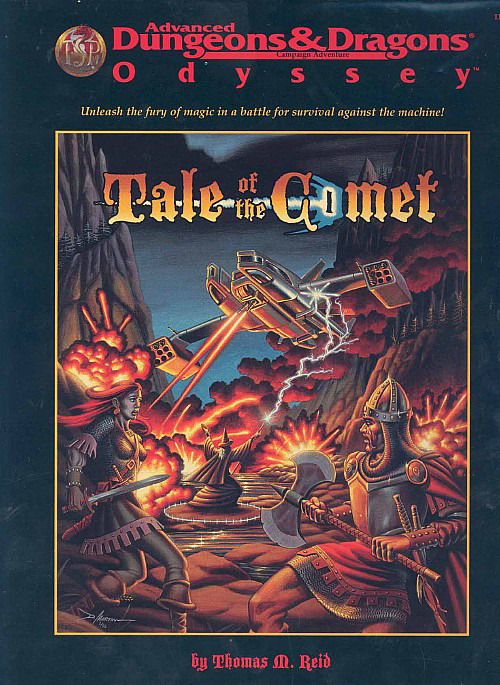
Strange lights in the sky, prophecies of doom, and a threat unlike any other draw the heroes to Aston Point. In this small frontier town, the fate of the world will be decided. If the heroes and their strange new allies defeat the invaders, they must then pass through a portal to another battleground, a metal city on a far-distant world, where aliens fight desperately against death machines that threaten to overwhelm all organic life. So trade in your sword for a blaster rifle, your sling stones for a few high-explosive grenades, and see what happens when you mix magic with high technology. This box contains A 32-page book, The Cast and Props, describing new, high-tech equipment, detailing the battleground of the Rael-Overseer war, and explaining how to mix fantasy and science under the AD&D game system. Two 64-page books, The Tale Begins and Crossing Over, presenting the grand adventure that is the Tale of the Comet. Eight sheets of charts, maps, art, and statistics for the players and the DM. Two posters, one a double-sided map of the regions where the action takes place and the other an illustration of all the technological terrors the heroes will have to face in the course of the adventure. TSR 1143, From 1997
Within the burial mound of a village on the edge of the frigid northern frontier, a decades-long spell of undead transformation reaches its conclusion on the day of Sun Return. Nightmares of the honored dead, risen and bloodthirsty, torment the villagers. Meanwhile, the village chief fitfully recovers from a grievous wound. The heroes, summoned for a feast to commemorate the solar holiday, are secretly tasked to uncover the source of the nightmares and put an end to the horrors that stir within the burial mound. But mysteries await the party, as a deeper plot and plan wait to be discovered… In 120 pages, spanning 10-13 Victories, you'll encounter: - 4 unique monster bands, with 21 fearsome foes - 4 new complications - 6 new magic items - 5 exquisitely detailed battlemaps - 16 original illustrations - Festival games and solar feast rituals - Norse-myth-inspired terror

Things are not right at Du Sharid Manor. Months ago, a deranged parish priest and his most devout followers formed a heretical cult. These self-proclaimed “Seekers of the White Heart” chose the desolate Wild Hills to practice their secret rites; but the strange goings on at the Wild Hills did not escape the prying eyes of the more pious villagers who set out to confront the cultists. Once there, the villagers witnessed something terrifying and unexpected. Since the events of that night, the cultists have vanished, but the remaining serfs of Du Sharid now live in constant paranoia. Your party has been hired by the local bishop to to learn the truth about what happened at Du Sharid Manor. For use with Swords & Wizardry (or the like) and designed for the experienced Referee, Jewel of the Lunar Rift is a first-level campaign-starter and an introduction to the Messoria setting. Included as a bonus are campaign journals from the author's own sessions.