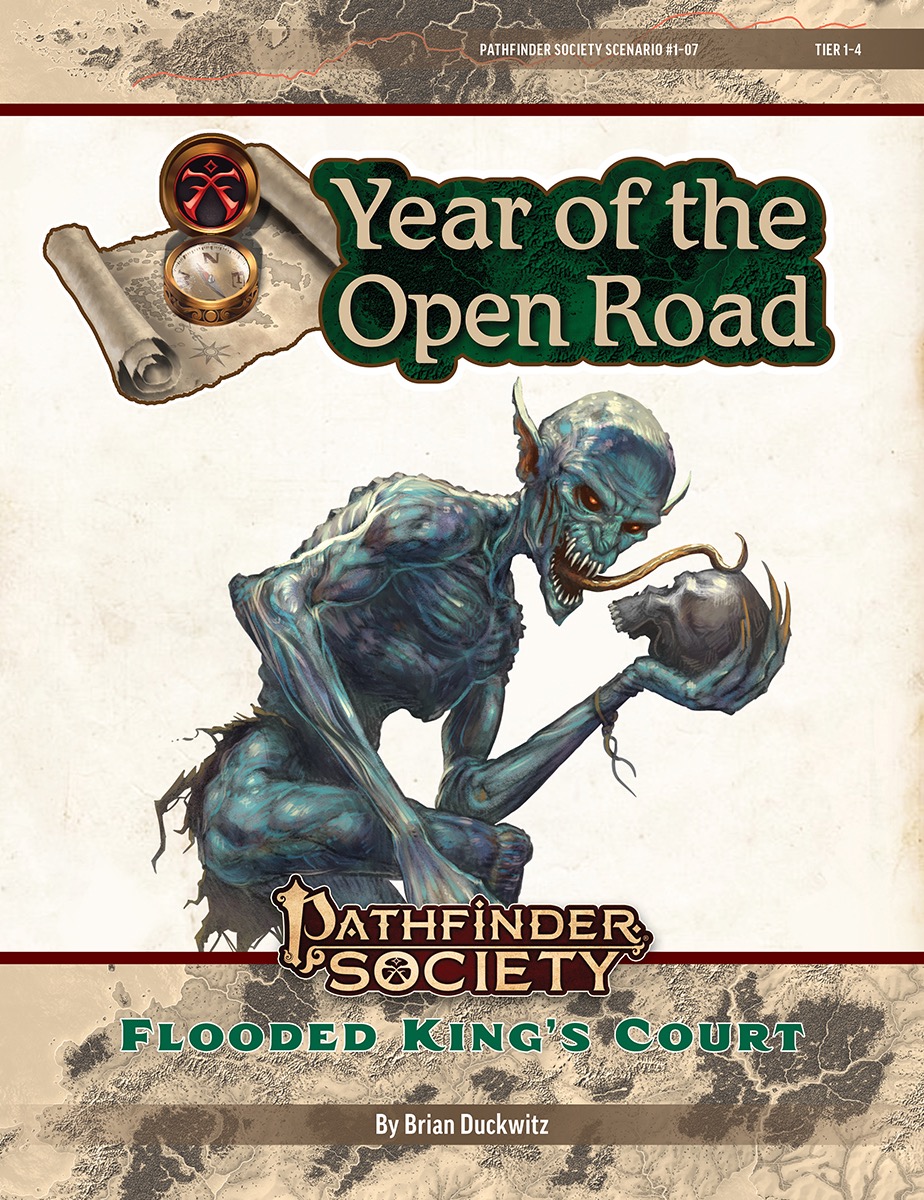
From a ruined theater in the run-down Puddles district of Absalom, a goblin hero and self-styled king rules over the nearby goblins. Shifting foundations beneath the playhouse have revealed ruins from Absalom's early history, and the goblin king has put out a call for explorers to search the area and clear out its dangers. The Pathfinder Society has answered the call. They aren't the only group that is interested, however, and they must prove themselves to earn the right to enter these lost chambers.

In a dark cell, Rollo Bargamnn, merchant of Thyatis, turns away in disgust from his evil, green-skinned prisoner; capturing this wretch cost a ship and sixty gallant men. Then his heart hardens once more, and he resumes the interrogation. Here, perhaps, he may find an answer to the question that haunts him. What new evil is casting its shadow over the storm-swept eastern reaches of the Sea of Dread? The trading routes are no longer safe. The attacks of the green-skinned "Orcs-of-the-Sea" and the mysterious "Ship-bane" now go unchecked. Once their raids were random, but the influence of some unseen master has made them into an organized menace. Soon the questioning will be over; Rollo will know enough to track the threat to its lair. Then he will need a band of hardy adventurers brave enough to take on the task. You perhaps? TSR 9127 (Graeme Morris's name is spelled 'Grame' on the cover of this module)
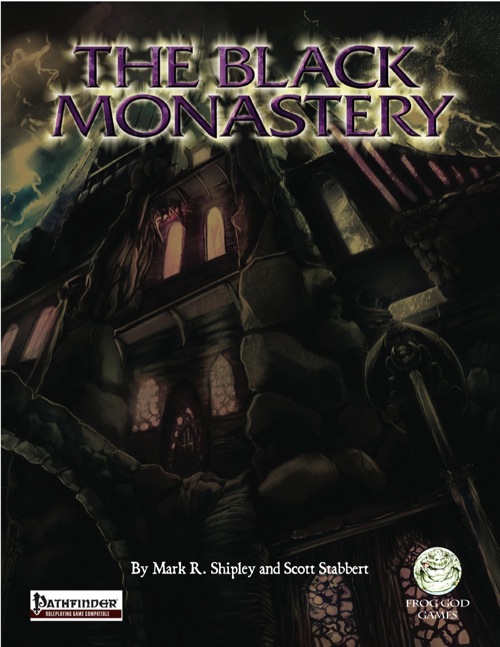
The Legend of the Black Monastery Two centuries have passed since the terrible events associated with the hideous cult known as the Black Brotherhood. Only scholars and story-tellers remember now how the kingdom was nearly laid to waste and the Black Monastery rose to grandeur and fell into haunted ruins. The Brothers first appeared as an order of benevolent priests and humble monks in black robes who followed a creed of kindness to the poor and service to the kingdom. Their rules called for humility and self denial. Other religious orders had no quarrel with their theology or their behavior. Their ranks grew as many commoners and nobles were drawn to the order by its good reputation. The first headquarters for the order was a campsite, located in a forest near the edge of the realm. The Brothers said that their poverty and dedication to service allowed them no resources for more grand accommodations. Members of the Black Brotherhood built chapels in caves or constructed small temples on common land near villages. They said that these rustic shrines allowed them to be near the people they served. Services held by the Brothers at these locations attracted large numbers of common people, who supported the Black Brotherhood with alms. Within 50 years of their first appearance, the Black Brotherhood had a number of larger temples and abbeys around the kingdom. Wealthy patrons endowed them with lands and buildings in order to buy favor and further the work of the Brothers. The lands they gained were slowly expanded as the order’s influence grew. Many merchants willed part of their fortunes to the Black Brotherhood, allowing the order to expand their work even further. The Brothers became bankers, loaning money and becoming partners in trade throughout the kingdom. Within 200 years of their founding, the order was wealthy and influential, with chapters throughout the kingdom and spreading into nearby realms. With their order well-established, the Black Brotherhood received royal permission to build a grand monastery in the hill country north of the kingdom’s center. Their abbot, a cousin of the king, asked for the royal grant of a specific hilltop called the Hill of Mornay. This hill was already crowned by ancient ruins that the monks proposed to clear away. Because it was land not wanted for agriculture, the king was happy to grant the request. He even donated money to build the monastery and encouraged others to contribute. With funds from around the realm, the Brothers completed their new monastery within a decade. It was a grand, sprawling edifice built of black stone and called the Black Monastery. From the very beginning, there were some who said that the Black Brotherhood was not what it seemed. There were always hints of corruption and moral lapses among the Brothers, but no more than any other religious order. There were some who told stories of greed, gluttony and depravity among the monks, but these tales did not weaken the order’s reputation during their early years. All of that changed with the construction of the Black Monastery. Within two decades of the Black Monastery’s completion, locals began to speak of troubling events there. Sometimes, Brothers made strange demands. They began to cheat farmers of their crops. They loaned money at ruinous rates, taking the property of anyone who could not pay. They pressured or even threatened wealthy patrons, extorting money in larger and larger amounts. Everywhere, the Black Brotherhood grew stronger, prouder and more aggressive. And there was more… People began to disappear. The farmers who worked the monastery lands reported that some people who went out at night, or who went off by themselves, did not return. It started with individuals…people without influential families…but soon the terror and loss spread to even to noble households. Some said that the people who disappeared had been taken into the Black Monastery, and the place slowly gained an evil reputation. Tenant farmers began moving away from the region, seeking safety at the loss of their fields. Slowly, even the king began to sense that the night was full of new terrors. Across the kingdom, reports began to come in telling of hauntings and the depredations of monsters. Flocks of dead birds fell from clear skies, onto villages and city streets. Fish died by thousands in their streams. Citizens reported stillborn babies and monstrous births. Crops failed. Fields were full of stunted plants. Crimes of all types grew common as incidents of madness spread everywhere. Word spread that the center of these dark portents was the Black Monastery, where many said the brothers practiced necromancy and human sacrifice. It was feared that the Black Brotherhood no longer worshipped gods of light and had turned to the service of the Dark God. These terrors came to a head when the Black Brotherhood dared to threaten the king himself. Realizing his peril, the king moved to dispossess and disband the Black Brother hood. He ordered their shrines, abbeys and lands seized. He had Brothers arrested for real and imagined crimes. He also ordered investigations into the Black Monastery and the order’s highest ranking members. The Black Brotherhood did not go quietly. Conflict between the order and the crown broke into violence when the Brothers incited their followers to riot across the kingdom. There were disturbances everywhere, including several attempts to assassinate the king by blades and by dark sorcery. It became clear to everyone that the Black Brotherhood was far more than just another religious order. Once knives were drawn, the conflict grew into open war between the crown and the Brothers. The Black Brotherhood had exceeded their grasp. Their followers were crushed in the streets by mounted knights. Brothers were rounded up and arrested. Many of them were executed. Armed supporters of the Black Brotherhood, backed by arcane and divine magic, were defeated and slaughtered. The Brothers were driven back to their final hilltop fortress – the Black Monastery. They were besieged by the king’s army, trapped and waiting for the king’s forces to break in and end the war. The final assault on the Black Monastery ended in victory and disaster. The king’s army took the hilltop, driving the last of the black-robed monks into the monastery itself. The soldiers were met by more than just men. There were monsters and fiends defending the monastery. There was a terrible slaughter on both sides. In many places the dead rose up to fight again. The battle continued from afternoon into night, lit by flames and magical energy. The Black Monastery was never actually taken. The king’s forces drove the last of their foul enemies back inside the monastery gates. Battering rams and war machines were hauled up the hill to crush their way inside. But before the king’s men could take the final stronghold, the Black Brotherhood immolated themselves in magical fire. Green flames roared up from the monastery, engulfing many of the king’s men as well. As survivors watched, the Black Monastery burned away, stones, gates, towers and all. There was a lurid green flare that lit the countryside. There was a scream of torment from a thousand human voices. There was a roar of falling masonry and splitting wood. Smoke and dust obscured the hilltop. The Black Monastery collapsed in upon itself and disappeared. Only ashes drifted down where the great structure had stood. All that was left of the Black Monastery was its foundations and debris-choked dungeons cut into the stones beneath. The war was over. The Black Brotherhood was destroyed. But the Black Monastery was not gone forever. Over nearly two centuries since its destruction, the Black Monastery has returned from time to time to haunt the Hill of Mornay. Impossible as it seems, there have been at least five incidents in which witnesses have reported finding the Hill of Mornay once again crowned with black walls and slate-roofed towers. In every case, the manifestation of this revenant of the Black Monastery has been accompanied by widespread reports of madness, crime and social unrest in the kingdom. Sometimes, the monastery has appeared only for a night. The last two times, the monastery reappeared atop the hill for as long as three months…each appearance longer than the first. There are tales of adventurers daring to enter the Black Monastery. Some went to look for treasure. Others went to battle whatever evil still lived inside. There are stories of lucky and brave explorers who have survived the horrors, returning with riches from the fabled hordes of the Black Brotherhood. It is enough to drive men mad with greed – enough to lure more each time to dare to enter the Black Monastery.

Adventures from the Potbellied Kobold provides you with fifteen unique adventures to use as one-shots, additions to your current campaign, or inspiration for a new campaign. We've even included a way to link several of the adventures, allowing you to run a short and quick campaign. The adventures use basic 5E creatures, custom creatures, and several Kobold Press creatures. Each adventure is written for a specific party level, but we've also included suggestions on how to adjust each adventure for a weaker or stronger adventuring party. In addition to fun adventures, you'll also find a few new magic items and NPCs to add to your game.

FQ3- Outpost of the Humanoids is the third adventure for the Filbar Quest Series. As you make your way to a meeting with the Baron of the Knolls you come across a roadside inn and a pair of old adventurers that have a small task for you near some old abandoned ruins. Sounds easy enough right? For some reason it never is easy, especially in Filbar!

Your party is on a journey through a mountainous region distinguished by sheer cliffs and dangerous precipices. Thus everyone is quite grateful when, just at nightfall, they find a small abandoned chapel. It provides a dry shelter from the wind and radiates such an aura of good that there is no hesitation about sheltering within it. This is an adventure for a balanced party of six second- and third-level characters; ifd esired, the number may be increased by including three first-level characters.

Fear stalks the streets of Old Korvosa as the Curse of the Crimson Throne continues! Anarchy, plague, and the mandates of a pitiless queen have thrown the island community into chaos. Forsaken by the government and cut off from the rest of the city, hundreds of unfortunates stand helpless against the rising criminal warlords, each eager to carve out a slice of Korvosa as his own. Yet, amid the turmoil of warring gangs and sinister power mongers hides the only man who might be able to restore sanity to the beleaguered city. But why has he remained silent for so long? What secret of the new queen does he hide? And what fiendish power grows in the shadows, ready to sink its claws into the heart of Old Korvosa? This volume of Pathfinder includes: ► “Escape from Old Korvosa,” an adventure for 8th-level characters, by Richard Pett. ► A glimpse into the world of assassins and the blood-soaked path of Golarion’s peerless killers, the Red Mantis, by James Jacobs and Nicolas Logue. ► The merciless manipulations and earthbound evils of the rakshasa, by Owen K. C. Stephens. ► Eando Klein finds more to fear than orcs in the heart of the Hold of Belkzen, a new entry into the Pathfinder’s Journal, by Amber Scott. ► Five new monsters by Brian Cortijo, Joshua J. Frost, James Jacobs, and Richard Pett.

The Ivory Scimitar now has a choice, continue on into the azure glow that leads to Mithelvarn's Dungeon or retrace their steps and investigate the source of the sounds they heard on the way in. Inside the unknown region is a massive forge, home to mad Kin who has been crafting weapons and armor that are delivered to his 'god', although in reality they are transported into Mithelvarn's Dungeon. This adventure is formatted to both 1E & 5E gaming rules.
Thordak, the Cinder King has been destroyed but the city of Emon still reels from his terrible reign. It has been a year and the whole of Tal'dorei thought the threat was over...until the finding of a piece of red leathery, heavy as stone egg is found. A primordial child has survived. Now the council of Tal'dorei seeks help in dealing with this issue in secret before it causes panic. A fan made adventure based on the world of Exandria by Matthew Mercer and seen on Geek & Sundry's Critical Role

God of Ore is a 3rd-level adventure that takes the characters from the quiet, mountainside town of Miners’ Refuge into the heart of the Stoneheart Mountains in pursuit of a failed pilgrimage to discover a phony religious relic deep inside legendary Mithral Mountain. The dark, twisting tunnels that bore into the fabled mountain soon reveal that some mysteries are not what they first appear to be.
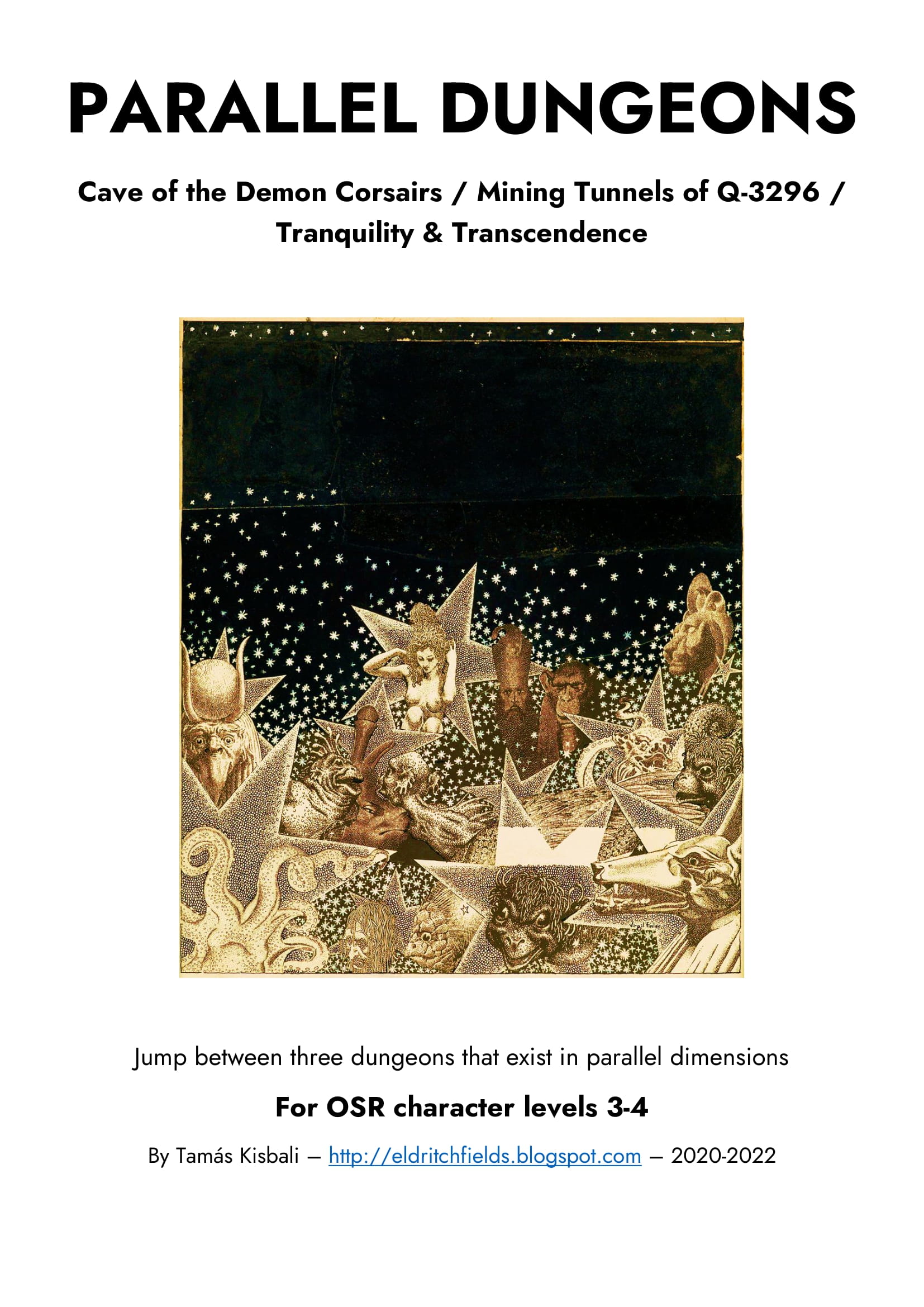
Three dungeons in one! The party is given a "dimension shifting device" and sets out to explore a 15-area cave, simultaneously occupied by the DEMON CORSAIRS, the remnants of an ASTEROID MINING OPERATION, and the MONASTERY OF TRANQUILITY & TRANSCENDENCE! The three dungeons are presented in three columns, so when the characters shift from one dimension into another, it's easy to find the corresponding area description. For use with old-school or OSR RPG systems. Recommended for character levels 3-4. Published by Eldritch Fields.

Just when you thought it was safe to take a long rest. She's Back! The terrifying SEQUEL to the PLATINUM bestselling, and Dragon+ Magazine featured horror adventure: The Haunt. The Haunt 2 is both a one-shot, and a sequel that can be run as either. Long, long ago St. Greycastle’s Hospital served the city through the years, mainly treating the wounded and sick among the militia. Over time, the lower basement was converted into a sanatorium, housing those who became maddened from enduring the violent, brutal orcs raids which plagued the region during that time. This was the place where Gertrude, the night hag, tormented patients, and created her masterpiece, the Evil Doll. Now, after all of these years, Montarthas Manor has finally fallen, and the Evil Doll has been wounded. She has returned to the only familiar and safe place she remembers, to lick her wounds and plot her next move. Her presence in the hospital awakens the evil inside, creating a nightmarish charnel house of terror. In addition, the hospital itself feeds on fear. Do your players have what it takes to enter the haunted and evil hospital, to finally end the haunt and terror of the Evil Doll?! Published by P.B. Publishing.

This adventure takes place in the Moonsea of Faerûn. The players have been brought to Melvaunt to search for the missing scions of the city's great families. To the north, in Thar the orc tribes converge on the ruined fortress of Xul-Jarak, flocking to the banner of a charismatic warlord. There, he intends to sacrifice the scions of the great families of Melvaunt in a bloodritual to Gruumsh. The players will escape Melvaunt, search along the wilderness of Thar for the Fortress of Xul-Jarak, and then explore the dungeons of the ruined fortress and hopefully rescue the scions before they are sacrificed. There also is a Web Enhancement by Eric Cagle on the archives of wizards of the coast's website designed to scale the adventure to level 8. For example, it replaces the Owlbear with a Tyrannosaurus. This is an easy to scale adventure with much of the player's difficulty coming from intelligently avoiding problems, choosing how to approach each floor in the most tactical way, and quickly adjusting when something goes wrong. The adventure has sidebars including common orc battle cries (In Orc!), ready to use orc names, weather and random encounter table in Thar, a description of what happens if the party fails or partially succeeds, and suggested minis for each of the encounters. There is even an extended description of the bloodspear ritual, an event the party is not meant to encounter in a normal run. The appendix is detailed for all the humanoid characters including the scions and their equipment, the named villains, and variety of unnamed orcs the party will encounter. The fortress also offers an opportunity to introduce the players to the Underdark and the Zhentil Keep. There is a passage to the Underdark the players can accidentally explore, and return to later. Emissaries from Zhentil Keep have come to watch the ritual and have their own motivations. These npcs provide an opportunity for exposition and role playing at a point which otherwise might be combat heavy, acting as a valve for the first floor - helping or hurting the party with subtle magic should the difficulty be off.

In your last adventure you discovered a strange, and somewhat sinister looking, key. After a long wait it appears you have found an answer to what it opens. The good news is that it leads to great wealth, the bad news is that it opens a tomb. Oh yea, there may, also, be some…individuals that want the key too…

The Premature Burial is the first in a series of four interconnected stories that recall the themes and atmosphere of Edgar Allan Poe's Tales of Terror. Baldur's Gate, year 1492 DR, a dark and terrifying sect works secretly in the slums with the aim of punishing all those who have long oppressed, marginalized and killed the city's poorest and weakest citizens. The patriars, unaware of anything, are the cult's main targets, and a magical plague is about to fall on them that can cause a veritable slaughter. The characters will find themselves caught up in these dangerous events and will be drawn into a spiral of horror, blood and madness that will strain their bodies and souls. The Prior who leads the mysterious cult has "a special plan" in mind for them and will do anything to achieve his goal. Players will be forced more than once to question their morals and make difficult choices in a scenario of complex social conflicts, personal revenge stories and tremendous machinations. What repercussions would the cult's plan have if it were carried out? And what would happen instead if it were averted and the patriars continued to run the city as they always have? Shadows as black as night once again loom over Baldur's Gate, and this time they may change its face forever. - Adventure: story lasting 4 to 8 hours for characters ranging in level from 4 to 6 - Setting: adventure set in the famous city of Baldur's Gate but easily adaptable to any setting - Narrative: detailed descriptions and an emphasis on story immersiveness - Roleplay: in-depth characterization of NPCs with biographies, descriptions of their personalities and their physical appearance - Bestiary: 3 new customizable opponents with the mechanics "Affixes," which can add an extra degree of complexity to confrontations, and " Weak spots," which grant a strategic advantage to characters who manage to discover them - Magic: obscure and unknown spells used by cultists to carry out their plans - Layout: designed to make it easier for DMs to browse information, featuring special attention to color coding and visual immediacy of text boxes - Maps: 3 maps available in high resolution, VTT and printer-friendly versions - PDF: available in high-quality, interactive, printer-friendly print versions - Playlist: a collection of songs selected by the authors to create the right atmosphere during game sessions

A Ravaged Land... Villains that really are larger than life... A time for heroes... A decade ago, the land of Geoff was overrun by a horde of giants, ogres, and evil humanoids, its people either slain, enslaved, or driven into exile. Now at last the tide has turned. The time to free the people of Geoff from their servitude to the giantish tyrants has come! But don't forget to watch your step when you confront the true masters behind the giant Clans! Contains the full text of three classic adventures by Gary Gygax: G1, Steading of the Hill Giant Chief; G2, The Glacial Rift of the Frost Giant Jarl; and G3, Hall of the Fire GIant King. Details Eighteen new encounter sites in the war-torn land of Geoff, linked together to form a grand campaign. Provides dozens of hours of gameplay as the heroes struggle to free an entire country from the grasp of giant overlords. TSR 11413
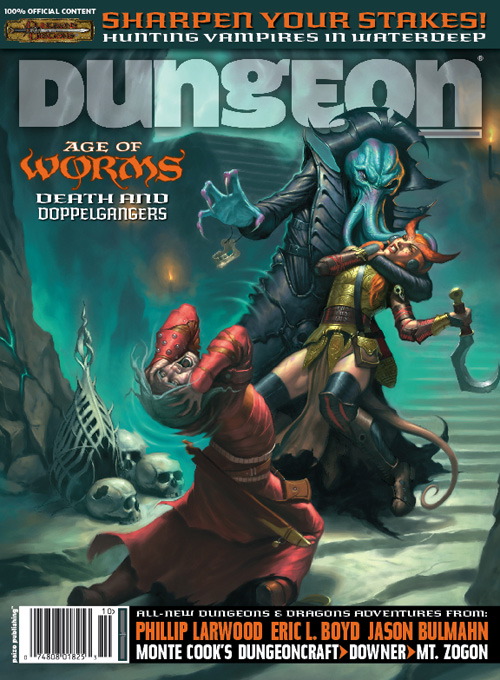
The High Hunt leaves the streets of Waterdeep and heads beneath the City of the Dead where monstrous criminal overlords compete for the favor of their mysterious master. It will take more than skill with a blade to cut through the web of deceit and treachery that surrounds the Vampire Master of Waterdeep. Do you have what it takes to survive the Dungeon of the Crypt? "Dungeon of the Crypt" is part two of the three-part Vampires of Waterdeep Campaign Arc. Pgs. 62-88

Desperately needed supplies have failed to arrive at the suffering frontier settlement of Ravendale. Rumors are flying that the supply wagon must have fallen afoul of the legendary troll of Stonebottom bridge. The townsfolk are in desperate need of heroes to reclaim their supplies or the town won't survive the encroaching winter! A 2-4 hour adventure for four to six players of 1st or 2nd level characters

Today we kick off offerings from Margou Campaign. This scenario takes a group of 3rd level PCs that come upon, with help, an abandoned manor home. Perhaps they will find treasure or maybe death is about to find them!
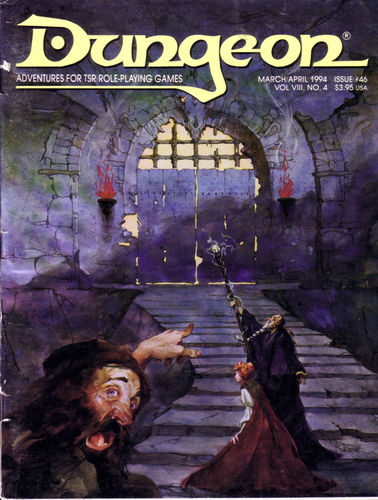
The Northmen and their allies play hardball. The Northmen are on a rampage, and only the duergar know why. Discover the secret of the iron orb. In the lands of the Northmen, near the city of Tallborg a mysterious relic was uncovered in a mine: a perfect orb of black iron. The orb was taken to the temple. When Ulvmard, high priest of Odin lifted the orb it revealed its true nature. The orb levitated from his hands, floating before him. The orb had changed Ulvmard, bestowing him great powers. The orb spoke to him with flattery and advice. As he became reliant on the orb, its power over him extended, bending him to its will and taking control. It used him to further its agenda: destruction of the dwarven race and restoration of the duergar! Claiming to be acting on Odin's behalf, Ulvmard lead the Northmen to rise up against the dwarves, and ordered raids to pillage the southern kingdoms for the materials he would need to construct a colossal iron warrior to defeat the dwarves. This adventure has viking and norse mythology influences. Pgs. 50-71