Ra’s Evil Grin challenges adventurers of at least 11th level who are seeking a powerful magic item—the globe of Arden. If a different item suits your campaign better, another appropriate powerful item can be substituted as the final objective. This dungeon culminates in a battle with Dendorandra, a lesser marilith known as a dark daughter. As a lead-in to this adventure, the GM may use a map from another treasure hoard showing the location of the globe (detailed more fully in “The Legend of the Globe of Arden,” below) or a priestly tome describing Arden, the long-dead avatar of Ra, and the wondrous powers of an unknown artifact called the globe of Arden. Such a tome might mention that the globe emits rays as intense as those of the sun, destroying all they touch. In any event, characters should need to consult with sages and oracles to determine the location and history of the globe and dungeon. A sage could also provide a map to the dungeon’s location, referenced in the “The Legend of the Globe of Arden,” below. We set the dungeon on a small, remote island far across the sea, but you can relocate it to suit your campaign. This dungeon provides numerous puzzles, a few traps, and only two monsters. Those monsters, though few in number, should challenge and threaten even the most combat-hardened party—particularly after the party encounters all the vicious creatures that inhabit the Island of the Globe.
The Sleeper Awakes! At last, after languishing in its crypt for an age, the secrets of the slumbering city of Tsar burst forth in all their macabre glory. Poured forth from the eldritch furnaces and crucibles of the Necromancer and Orcus himself comes Frog God Games bringing you at long last The Slumbering Tsar Saga™. Something Stirs in the City of Evil Over the distant northern hills, beyond The Camp, and past the Desolation stand the pitted walls of Tsar. A hundred armies have crushed themselves against this bulwark in futile attempts to breach the city. Even the combined might of the Heavens and Earth were unable to break through in the final battle of Tsar. So why was the city suddenly abandoned on the verge of victory, and what waits for those foolish enough to enter the Temple-City of Orcus? The Black Gates Await Only the bravest and most powerful of heroes dare the depths of the Desolation and live to tell of it. But what happens when they penetrate that blasted landscape and look upon the gates of the very center of evil on the earth. Can even heroes of such renown breach the Walls of Death and live?

“Rats in the Walls”: A dockside tavern in Khromarium is plagued by rats of a most unusual breed. These abominable rodents have ruined the tavern keeper’s business and his life. The man is desperate, and he offers a substantial reward for the elimination of his horrific problem.
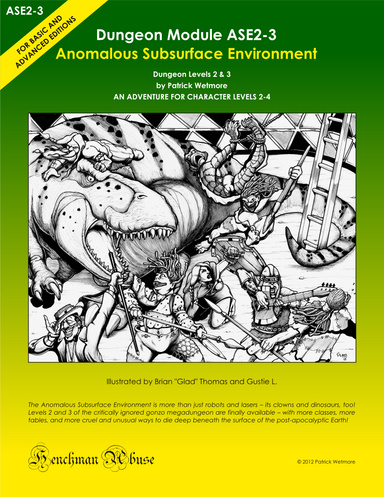
"The Anomalous Subsurface Environment is more than just robots and lasers – it's clowns and dinosaurs, too! Levels 2 and 3 of the critically ignored gonzo megadungeon are finally available – with more classes, more tables, and more cruel and unusual ways to die deep beneath the surface of the post-apocalyptic Earth!" "ASE2-3 – Anomalous Subsurface Environment" expands upon the ASE1 module, exploring the second and third levels of a vast underground complex in a unique post-apocalyptic setting blending fantasy, science fiction, and bizarre elements. Extensive list of bizarre and unique items and monsters. Written for Labyrinth Lord
It’s up to your brave heroes to fight off the invading kobolds and save… the cheese?? Well, a job’s a job, and things underground are seldom what they seem. Wheel of Evil is a 16-page adventure for old-school characters of levels 3 to 5, plus a full-color cover, classic maps, and handouts. Compatible with Labyrinth Lord™ and similar games, including the Advanced Edition Companion. "Wheel of Evil" is part of the Eastern Valnwall setting, based on the Known Lands in Labyrinth Lord™! This adventure blends traditional dungeon crawling with unique elements of horror and intrigue, set against the backdrop of a seemingly mundane task turned deadly by the influence of a hidden evil.
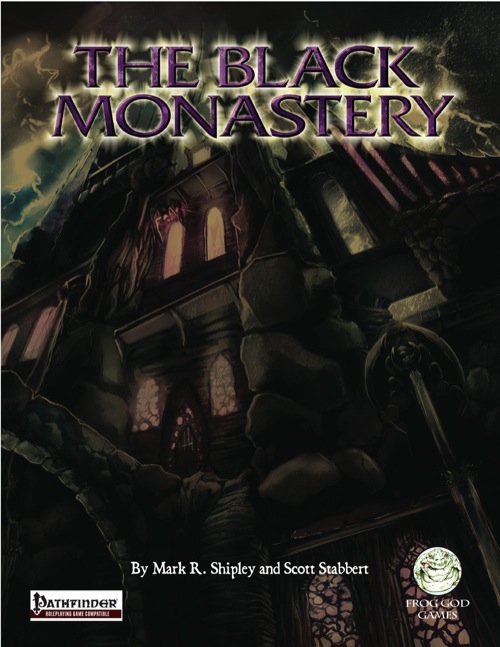
The Legend of the Black Monastery Two centuries have passed since the terrible events associated with the hideous cult known as the Black Brotherhood. Only scholars and story-tellers remember now how the kingdom was nearly laid to waste and the Black Monastery rose to grandeur and fell into haunted ruins. The Brothers first appeared as an order of benevolent priests and humble monks in black robes who followed a creed of kindness to the poor and service to the kingdom. Their rules called for humility and self denial. Other religious orders had no quarrel with their theology or their behavior. Their ranks grew as many commoners and nobles were drawn to the order by its good reputation. The first headquarters for the order was a campsite, located in a forest near the edge of the realm. The Brothers said that their poverty and dedication to service allowed them no resources for more grand accommodations. Members of the Black Brotherhood built chapels in caves or constructed small temples on common land near villages. They said that these rustic shrines allowed them to be near the people they served. Services held by the Brothers at these locations attracted large numbers of common people, who supported the Black Brotherhood with alms. Within 50 years of their first appearance, the Black Brotherhood had a number of larger temples and abbeys around the kingdom. Wealthy patrons endowed them with lands and buildings in order to buy favor and further the work of the Brothers. The lands they gained were slowly expanded as the order’s influence grew. Many merchants willed part of their fortunes to the Black Brotherhood, allowing the order to expand their work even further. The Brothers became bankers, loaning money and becoming partners in trade throughout the kingdom. Within 200 years of their founding, the order was wealthy and influential, with chapters throughout the kingdom and spreading into nearby realms. With their order well-established, the Black Brotherhood received royal permission to build a grand monastery in the hill country north of the kingdom’s center. Their abbot, a cousin of the king, asked for the royal grant of a specific hilltop called the Hill of Mornay. This hill was already crowned by ancient ruins that the monks proposed to clear away. Because it was land not wanted for agriculture, the king was happy to grant the request. He even donated money to build the monastery and encouraged others to contribute. With funds from around the realm, the Brothers completed their new monastery within a decade. It was a grand, sprawling edifice built of black stone and called the Black Monastery. From the very beginning, there were some who said that the Black Brotherhood was not what it seemed. There were always hints of corruption and moral lapses among the Brothers, but no more than any other religious order. There were some who told stories of greed, gluttony and depravity among the monks, but these tales did not weaken the order’s reputation during their early years. All of that changed with the construction of the Black Monastery. Within two decades of the Black Monastery’s completion, locals began to speak of troubling events there. Sometimes, Brothers made strange demands. They began to cheat farmers of their crops. They loaned money at ruinous rates, taking the property of anyone who could not pay. They pressured or even threatened wealthy patrons, extorting money in larger and larger amounts. Everywhere, the Black Brotherhood grew stronger, prouder and more aggressive. And there was more… People began to disappear. The farmers who worked the monastery lands reported that some people who went out at night, or who went off by themselves, did not return. It started with individuals…people without influential families…but soon the terror and loss spread to even to noble households. Some said that the people who disappeared had been taken into the Black Monastery, and the place slowly gained an evil reputation. Tenant farmers began moving away from the region, seeking safety at the loss of their fields. Slowly, even the king began to sense that the night was full of new terrors. Across the kingdom, reports began to come in telling of hauntings and the depredations of monsters. Flocks of dead birds fell from clear skies, onto villages and city streets. Fish died by thousands in their streams. Citizens reported stillborn babies and monstrous births. Crops failed. Fields were full of stunted plants. Crimes of all types grew common as incidents of madness spread everywhere. Word spread that the center of these dark portents was the Black Monastery, where many said the brothers practiced necromancy and human sacrifice. It was feared that the Black Brotherhood no longer worshipped gods of light and had turned to the service of the Dark God. These terrors came to a head when the Black Brotherhood dared to threaten the king himself. Realizing his peril, the king moved to dispossess and disband the Black Brother hood. He ordered their shrines, abbeys and lands seized. He had Brothers arrested for real and imagined crimes. He also ordered investigations into the Black Monastery and the order’s highest ranking members. The Black Brotherhood did not go quietly. Conflict between the order and the crown broke into violence when the Brothers incited their followers to riot across the kingdom. There were disturbances everywhere, including several attempts to assassinate the king by blades and by dark sorcery. It became clear to everyone that the Black Brotherhood was far more than just another religious order. Once knives were drawn, the conflict grew into open war between the crown and the Brothers. The Black Brotherhood had exceeded their grasp. Their followers were crushed in the streets by mounted knights. Brothers were rounded up and arrested. Many of them were executed. Armed supporters of the Black Brotherhood, backed by arcane and divine magic, were defeated and slaughtered. The Brothers were driven back to their final hilltop fortress – the Black Monastery. They were besieged by the king’s army, trapped and waiting for the king’s forces to break in and end the war. The final assault on the Black Monastery ended in victory and disaster. The king’s army took the hilltop, driving the last of the black-robed monks into the monastery itself. The soldiers were met by more than just men. There were monsters and fiends defending the monastery. There was a terrible slaughter on both sides. In many places the dead rose up to fight again. The battle continued from afternoon into night, lit by flames and magical energy. The Black Monastery was never actually taken. The king’s forces drove the last of their foul enemies back inside the monastery gates. Battering rams and war machines were hauled up the hill to crush their way inside. But before the king’s men could take the final stronghold, the Black Brotherhood immolated themselves in magical fire. Green flames roared up from the monastery, engulfing many of the king’s men as well. As survivors watched, the Black Monastery burned away, stones, gates, towers and all. There was a lurid green flare that lit the countryside. There was a scream of torment from a thousand human voices. There was a roar of falling masonry and splitting wood. Smoke and dust obscured the hilltop. The Black Monastery collapsed in upon itself and disappeared. Only ashes drifted down where the great structure had stood. All that was left of the Black Monastery was its foundations and debris-choked dungeons cut into the stones beneath. The war was over. The Black Brotherhood was destroyed. But the Black Monastery was not gone forever. Over nearly two centuries since its destruction, the Black Monastery has returned from time to time to haunt the Hill of Mornay. Impossible as it seems, there have been at least five incidents in which witnesses have reported finding the Hill of Mornay once again crowned with black walls and slate-roofed towers. In every case, the manifestation of this revenant of the Black Monastery has been accompanied by widespread reports of madness, crime and social unrest in the kingdom. Sometimes, the monastery has appeared only for a night. The last two times, the monastery reappeared atop the hill for as long as three months…each appearance longer than the first. There are tales of adventurers daring to enter the Black Monastery. Some went to look for treasure. Others went to battle whatever evil still lived inside. There are stories of lucky and brave explorers who have survived the horrors, returning with riches from the fabled hordes of the Black Brotherhood. It is enough to drive men mad with greed – enough to lure more each time to dare to enter the Black Monastery.

It is Autumn. Most of the clans of the Great Valley have departed south with the herd animals they depend on for survival. But one small clan lags behind. For seven nights they have been unable to travel, plagued by a terrible monster known as the Night Thing, which has killed their people and wounded more. Your party answers the call of dwarf chieftain Skarna Two-Axe, begging hunters from neighboring clans to pursue and kill the monster that’s been attacking her clan, and that slayed her son. Starting at the chieftain’s clanfire, the characters uncover mysteries about the creature that can only be fully solved by tracking the awful Night Thing to its lair, which is full of frightening apparitions. As the party ventures deeper into the Night Thing's lair, they'll discover an even deeper menace, and a plot to overthrow the chieftain. Only they can save Skarna and her people from the grim machinations of their powerful enemies! Published by Atlas Games

Something fell. A sickly gloaming lit up the night like mock daylight, just for a moment, and then the hills trembled. Now, an alien entity lies brooding in a crater gouged out of the moor. Local folk are enraptured with the toothsome jelly exuded by this being, but are blind to the true nature of the events unfolding in their rustic little backwater.

Yesterday, young Tobias went to investigate an old tomb by himself. Everyone told him it was a bad idea. Everyone was right. Today, you and your companions awaken to a town in chaos. Why is the temple sealed behind a divine shield? Why are children and worshippers trapped within? How do we get inside? What did Tobias do?! Ragged Hollow is a full-service starting town, full of classic creatures and challenges all updated and brought together for newbies and nostalgia-lovers alike. There are goblins and witches in the woods, a house full of traps, a basement of vermin, kobolds in a cave, bandits on the road, riddling ravens, a 50-room temple dungeon, nursery-rhyme monsters, living nightmares, Lovecraftian horrors, and tons of unique items to find. This is a mystery with lots of relevant side-quests around the town. The heroes can investigate the situation, get into the temple, save the innocents, and stop the monsters. And get some loot! ADVENTURE TYPE: Medium Dungeon / Town / Wilderness Adventure DESIGN NOTES This adventure is intended for characters levels 1 to 4. It includes several wilderness areas (forest, hills, mountain), a bustling town, several local mini-dungeons, and one 50-room temple dungeon. Each area contains various encounters and unique items. There are many opportunities for combat, but it is possible for players to explore most areas and complete many interactions without any combat at all, depending on their choices. INCLUDES: Story hooks, dialogue prompts, random encounters, stat blocks, original creatures and treasures, and maps. KEYWORDS: town, village, forest, goblins, goblin market, witches, hags, hills, bandits, ogres, mountain, kobolds, caves, dwarves, temple, clerics, nightmares, demons, riddles, traps, ghosts, fairy tales, Lovecraft, mutant
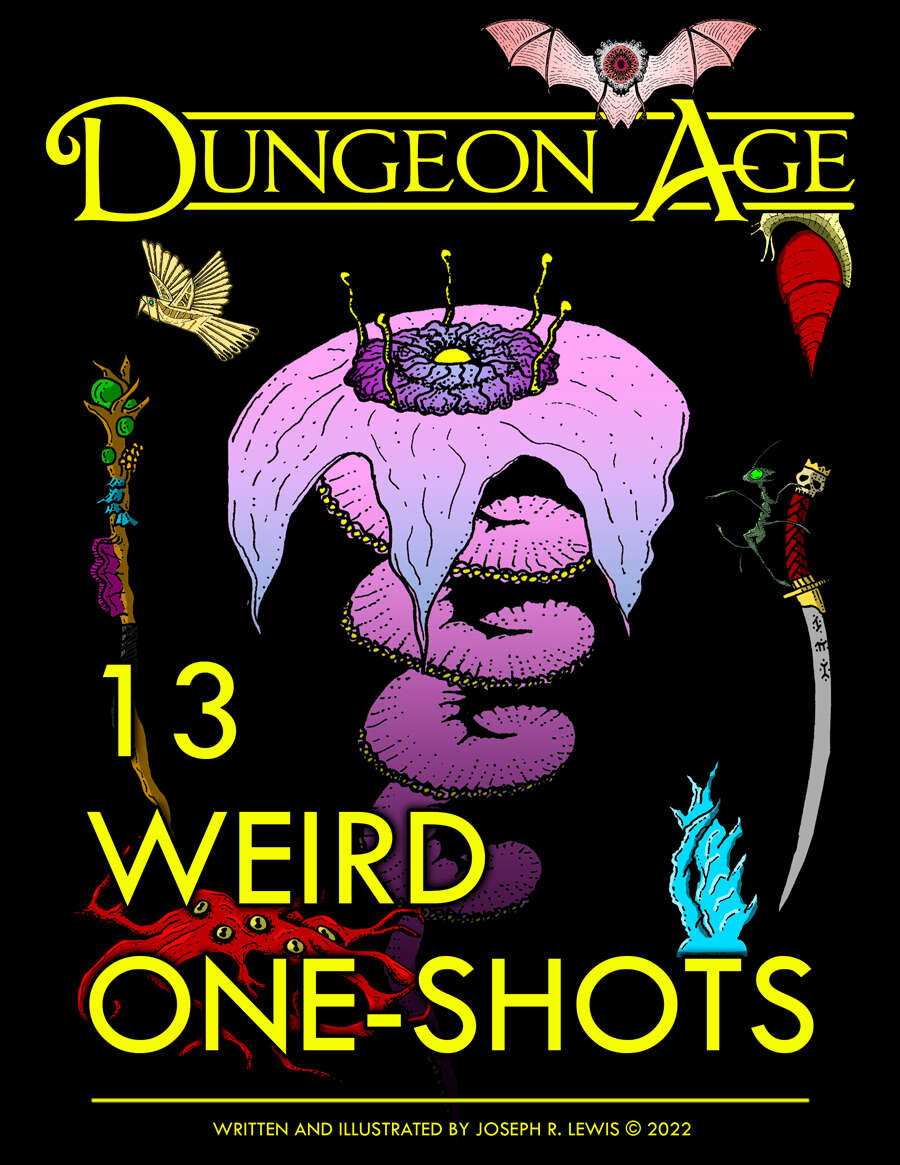
The ancient world of Harth withers beneath its dying sun…but it’s not dead yet. The land is still riddled with villages in danger, cultists in caves, angels gone mad, eldritch horrors making strange deals, raging dragons, bandits in the woods, and cruel monsters lurking in every shadow. These 13 adventures span a wide variety of locations, environments, creatures, and genres. They are meant for use as quick-play sessions or one-shots, or to be dropped into campaigns as side-quests. These are linear dungeons and mini-quests full of interactivity and strangeness, encouraging exploration, risk-taking, and creative combat. ADVENTURE TYPE: One-Shot / Low Level / Combat / Exploration / Village / Wilderness / City / Subterranean / Dungeon Delve DESIGN NOTES These 13 adventures are intended for low-level characters around Level 3 Overall, these adventures tend to be linear dungeon delves in caves or single buildings 93 unique encounter locations 69 original magic items 71 original monsters (with 28 illustrations) 13 maps/diagrams Each adventure runs 2-4 hours in length

Beneath the roots of a silver elm, there lies a sidereal prison… Vaz’kin’rai is a one-session adventure for the 5th Edition of the world’s most popular roleplaying game, which sees 1st level heroes venture beneath the village of Dur to uncover the secrets of a mysterious cosmic vault. What will the heroes find within? And what price might they pay for uncovering it? Featuring: Two bespoke creature statblocks, including a Paragon Creature! Four new magic items! Five premade characters suitable for playing through Vaz’kin’rai! A host of original artwork by Izzy Collins, Emma Durno, and Robin Baxter! A fully supported hook, as well as suggestions for others and how to develop the storylines and themes the adventure introduces into a larger game! A selection of free companion Sonoria – audio ambiences and sound effects you can use to bring the adventure to life sonically! Vaz’kin’rai comes embedded in an original campaign setting, but is self-contained enough that it can be sited easily in most other campaign settings with minimal effort. A selection of deities and lineage origins are also provided in the appendices to help fit characters within Vaz’kin’rai’s setting as presented. Go forth, and see what lurks within the vault of Vaz’kin’rai… Published by Animancer

In the eastern desert stands the ancient tomb of Solomon III. Like all tombs, it is full of magical treasure and crawling with deadly creatures. But unlike other tombs, this one is screaming. Years ago, soldiers and wizards went in to silence the screams, and they succeeded, but they never returned. Now Solomon’s tomb is once again screaming out across the dunes, and no one knows why. Solomon’s treasure is still down there, but then, so is whatever is screaming. ADVENTURE TYPE: Small Linear Dungeon DESIGN NOTES: This adventure is intended for characters levels 5 to 7. It includes a desert wilderness area, an oasis, the tomb exterior, the tomb interior, and a cave system below the tomb to explore. Each area contains various NPCs, new monsters, old traps, shiny treasures, and strange magical items. There are many opportunities for (deadly) combat, and a few of them may be inescapable, but it is possible for players to have complex interactions and to experience very different consequences, depending on their choices. INCLUDES: Story hooks, dialogue prompts, creature stat blocks, dungeon overview map, and full-sized battle maps of each dungeon room that can be printed and used right on the table. KEYWORDS: Tomb, ghuul, ghoul, skeleton, ooze, demon, devil, thief, wizard, desert, sabercat, oasis, spider, viper
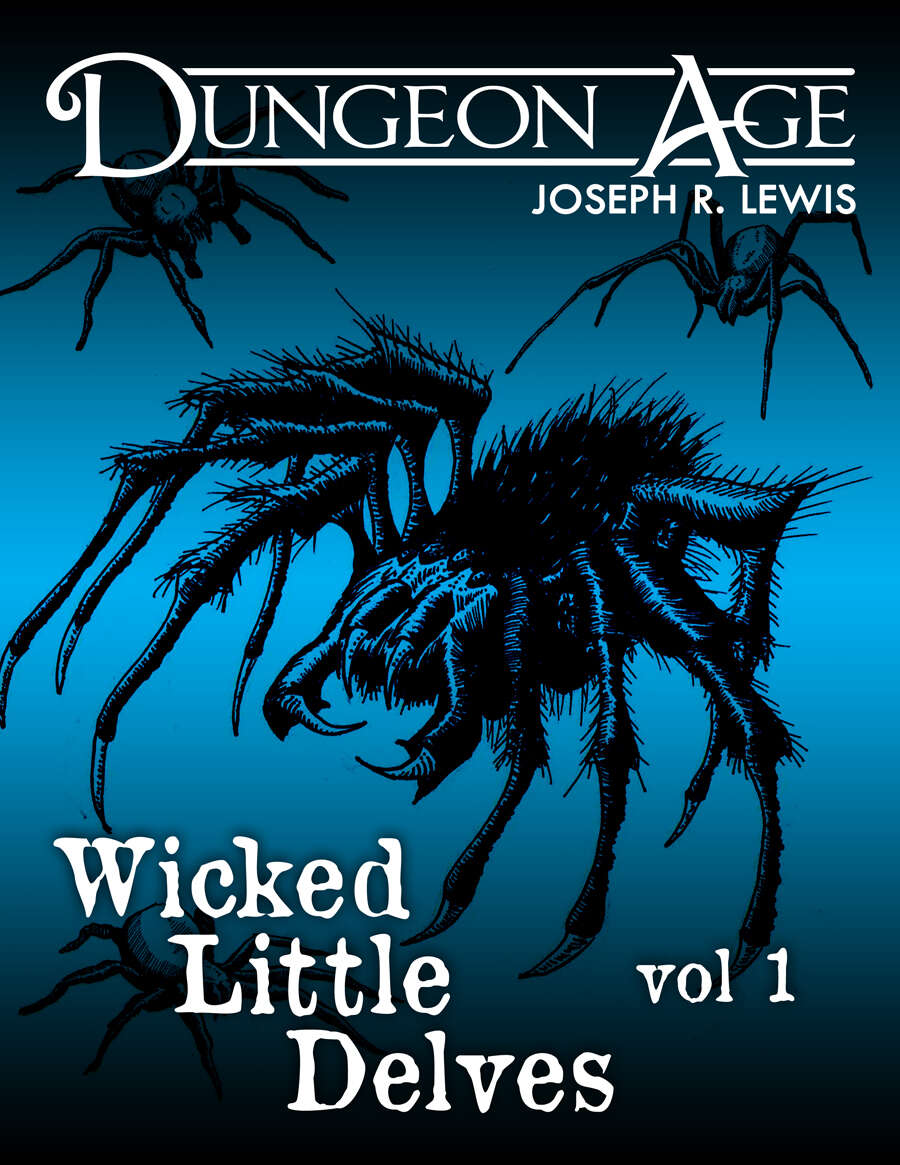
These are three one-shot dungeon delves. Each delve features nine rooms or locations full of challenges and interactivity. Each delve has only one type of monster, but they are complex, and there are lots of them! This volume of Wicked Little Delves includes three small dungeon adventures: - a new twist on the classic spiders-in-the-cellar, - a prison full of attack dogs, and - an abandoned cult lair full of pirate treasure and killer crabs. SYSTEM: Each monster has stats for Fifth Edition, Old School Essentials, and Into the Odd. These adventures are intended for characters at levels 1, 2, and 3. They are mainly focused on exploration and combat, with some minor social encounters. Estimated run time for each: 1 session, or 2-5 hours. Each adventure includes one complex original monster and a variety of unique treasures. ADVENTURE TYPE: Low Level / Combat / Exploration / One-Shot / Dungeon Delve
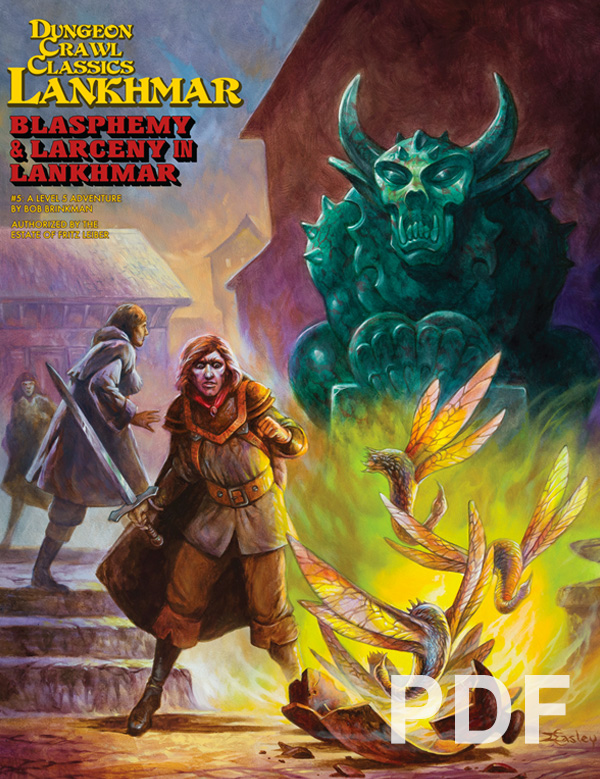
A member of your gang awakens in an alleyway with foggy memories of a deal made, a job taken, a partner slain, and a heist planned. They struggle to remember the details, but you all agree that breaking into an abandoned temple should be a simple matter – in and out. Yet the heist is on a collision course with something sinister. What begins as an easy job becomes anything but, as you confront cultists, vengeful spirits, and the servitors of a long-forgotten god. While seeking an easy score, you uncover a plan to strike a blow into the heart of Lankhmar, and no one is safe from the blasphemous plot. A choice needs to be made. Will you stand with the city, or risk letting it descend into chaos? Curse the gods of Lankhmar for their cruel joke that, in the shadowed alleyways of Lankhmar, there is no such thing as a “simple matter.” Officially licensed from the estate of Fritz Leiber.

Hunt for the Thessalhydra is a short adventure published by Wizards of the Coast as a tie in to the "Stranger Things" franchise and part of the Stranger Things Dungeons & Dragons Starter Set. The adventure features characters, locations, and monsters inspired by that series. The adventure is suitable for characters of level 3-5.
Irtep’s Dish is an adventure for characters from 6th to 8th level. This adventure requires the skills of a rogue or some other expert at traps, a cleric or character that can heal allies and offer beneficial bonuses to the team, a wizard or other master of the arcane arts, and a fighter to take care of “the heavy lifting.”
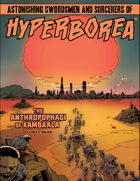
Ancient port city on the edge of a desert. The city is stratified by social class and some of the slaves have formed a cannibal cult to Kthulhu. City + hexcrawl + dungeon. The Anthropophagi of Xambaala™ takes players into an action-packed realm of adventure: the mythical world of Hyperborea, a sword-and-sorcery campaign setting inspired by the fantastic fiction of Robert E. Howard, H.P. Lovecraft, Clark Ashton Smith, and others. This adventure is inspired by Robert E. Howard’s “The Man-Eaters of Zamboula” and by various short tales of H.P. Lovecraft and Clark Ashton Smith. It is designed for use with Astonishing Swordsmen & Sorcerers of Hyperborea ™(AS&SH™), a role-playing game descended from the original 1974 fantasy wargame and miniatures campaign rules as conceived by E. Gary Gygax and Dave Arneson. AS&SH is compatible with most traditional fantasy role-playing games (c. 1974 to 1999) and their modern simulacra, such as OSRIC™ and Swords & Wizardry™. This work is both a setting and an adventure. The setting describes the town of Xambaala, noting key people, locations, and local lore. The adventure proper provides players with a variety of environments and the several factions fighting over them for their own goals. With a bit of skill and luck, stalwart adventurers may emerge richer and maybe wiser. The situation that will develop in Xambaala will be determined by the players’ choices.

The Goblins of Kaelnor Forest – Adventure This first level adventure takes the adventurers into the Kaelnor Forest. While the eastern side of the forest has long been the home of the forest elves, the western side is infested with goblins, boggarts, spiders, and more. The adventure takes players through the forest, investigating a rumor of raiding creatures. They begin in South Hollow, a farming community south of Ferryport proper, and will travel deep within the dark, enchanted woods. Are there supernatural creatures in the woods taking the farmers’ stores? Will they survive the strange fey forest? The adventure comes with 5 pre-made Uteria player characters, so players can jump right into the adventure.

Revenge of the Pale Master plunges the adventurers into the rusted heart of the industrial city of Kizaki on the eve of a great evil’s reawakening. At its heart lies a mystery, and GMs running this module are encouraged to build tension and an aura of danger as the PCs uncover the secret history that casts a long shadow upon the future of this settlement in Gekido Prefecture. Part of the adventure’s tension is based upon the ticking clock—the party arrives as night falls on the eve before the Festival of Falling Hawks, giving them less than 24 hours to uncover the truth and take action against those they believe to be the villains of the story. What's inside Revenge of the Pale Master: The story of the Pale Master and his most recent machinations in the eastern fantasy noir steampunk lands of Soburin The continental map of Soburin by Michael McCarthy Information about Gekido Prefecture where the adventure takes place Rules for the dangerous Mists of Akuma and the new misted condition, as well as the Haitoku and Dignity attributes Dozens of NPCs and oni that play a part in the adventure (as well as several that don't so the GM can insert their own stories and subplots) Lots and lots of maps: the city of Kizaki, the Oyami Tea House, Graveyard of the Damned, and more
The road to the remote village of Swordfall is a long and winding one. It takes pilgrims who wish to visit the holy site from the main trade road, through the hills, and into the mountains where once, thousands of years ago, two gods engaged in an epic battle. Now, all that remains of the battlefield is a lone sword, several hundred feet tall, embedded in the ground at the center of a massive crater. Over the years, a large temple to Thuul, god of battle, sprung up around the site. Now, warriors and fighters from across the land travel to Swordfall to pay their respects once in their lifetime. Recently, however, pilgrims have begun going missing. Somewhere between the main road and Swordfall itself, something, or someone, has been waylaying travelers. Unbeknownst to most, a cult to Ghenna has taken over one of the lone inns along the route and has begun using it to capture and sacrifice pilgrims to their own dark god. Unless a group of adventurers can stop them, the sacrifices won't stop.