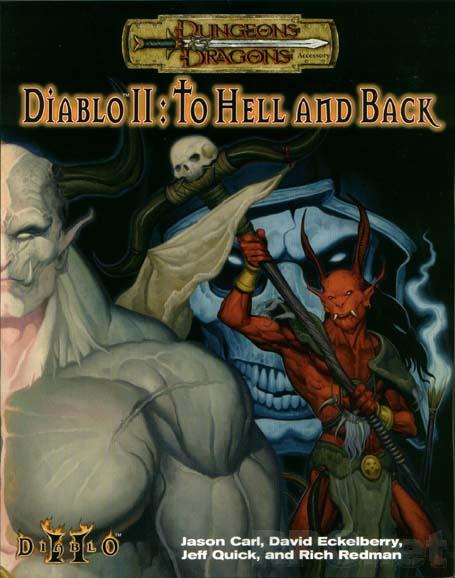
Bringing Diablo II to the tabletop. The legendary Diablo and Diablo II computer games come to life with the release of the tabletop Diablo II: To Hell & Back roleplaying adventure. All a player needs is the Dungeons & Dragons(r) Player's Handbook (0786915501-8/00) to accompany the Diablo II game. Every level and all 4 acts of the computer game are represented in the tabletop mega-adventure, which will also include 64 pages of monsters, information for levels 1-30, and over 60 maps!

In times ancient, an infamous paladin-artificer named Khaldun unearthed a cursed tome bound in the flesh of the first medusa. Driven to madness by its secrets, he used the necromantic magic contained within to call forth an army of dread warriors from the Netherworld. Though his assault was devastating, he was ultimately unsuccessful, and the mightiest crusaders of the realm banished Khaldun to the Netherworld, where he would rot for eternity at the bottom of the River Dis. Unfortunately, rather than perishing in that bleak plane, Khaldun escaped his silt grave and thrived, amassing a legion of undead followers and erecting a Tomb in which he could perfect his mechanical craft without interruption. It was not long before he shed his body and became a demilich. After several centuries of scheming, the undead warriors under the command of the ‘Iron Lich’ have burst free of the Netherworld, laying waste to not only the mortal kingdoms that exiled him, but also the exalted domains of the gods themselves. The crusaders’ quest is simple – stead the Tomb and destroy the Iron Lich. Published by Defy Danger and Save Versus Death

Written in celebration of Swords and Wizardry Appreciation Day 2017, Return to Fel’Valashar picks up where Dungeons of Fel’Valashar left off. In this book is a collection of mini dungeon adventures with a small region called Fel’Valashar that they take place within. Each of these adventures is written in such a way that they don’t have any ties to each other or to Fel’Valashar. This means you can easily drop them into your own world with no fuss. Includes: Details of the south-western region of Fel’Valashar. Four mini dungeon adventures. New monsters. New magic items.

This scenario was originally written for use as a competition event at Games Day 1987. We have published the adventure so that you will be able to reproduce the competition. The scenario also serves as an introduction to the forthcoming supplement detailing the land of Lustria. (see WFRP World Map, p272). At Games Day the party had to play the part of a small band of pygmies, and we have included details of this party so that you can use them too. You should carefully read the notes on Witchdoctors, Ancestor Spirits and the spell Control Spirits before starting play. If a conventional party is used here there is a significant chance that players will lose favourite characters. Much of the scenario is geared towards pygmies, (some tunnel heights, the presence of pygmy ancestors and so on), and a party without access to pygmy-magic may find some areas extremely difficult. Pgs. 11-27 Published by Games Workshop

The characters have escaped the maze only to find themselves in strange dimensions of fire, stone and ice, and a strange idyllic hunting ground where all is not as it appears.
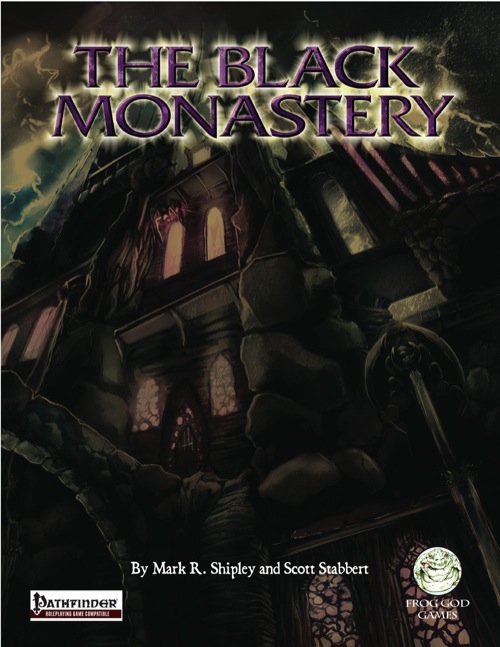
The Legend of the Black Monastery Two centuries have passed since the terrible events associated with the hideous cult known as the Black Brotherhood. Only scholars and story-tellers remember now how the kingdom was nearly laid to waste and the Black Monastery rose to grandeur and fell into haunted ruins. The Brothers first appeared as an order of benevolent priests and humble monks in black robes who followed a creed of kindness to the poor and service to the kingdom. Their rules called for humility and self denial. Other religious orders had no quarrel with their theology or their behavior. Their ranks grew as many commoners and nobles were drawn to the order by its good reputation. The first headquarters for the order was a campsite, located in a forest near the edge of the realm. The Brothers said that their poverty and dedication to service allowed them no resources for more grand accommodations. Members of the Black Brotherhood built chapels in caves or constructed small temples on common land near villages. They said that these rustic shrines allowed them to be near the people they served. Services held by the Brothers at these locations attracted large numbers of common people, who supported the Black Brotherhood with alms. Within 50 years of their first appearance, the Black Brotherhood had a number of larger temples and abbeys around the kingdom. Wealthy patrons endowed them with lands and buildings in order to buy favor and further the work of the Brothers. The lands they gained were slowly expanded as the order’s influence grew. Many merchants willed part of their fortunes to the Black Brotherhood, allowing the order to expand their work even further. The Brothers became bankers, loaning money and becoming partners in trade throughout the kingdom. Within 200 years of their founding, the order was wealthy and influential, with chapters throughout the kingdom and spreading into nearby realms. With their order well-established, the Black Brotherhood received royal permission to build a grand monastery in the hill country north of the kingdom’s center. Their abbot, a cousin of the king, asked for the royal grant of a specific hilltop called the Hill of Mornay. This hill was already crowned by ancient ruins that the monks proposed to clear away. Because it was land not wanted for agriculture, the king was happy to grant the request. He even donated money to build the monastery and encouraged others to contribute. With funds from around the realm, the Brothers completed their new monastery within a decade. It was a grand, sprawling edifice built of black stone and called the Black Monastery. From the very beginning, there were some who said that the Black Brotherhood was not what it seemed. There were always hints of corruption and moral lapses among the Brothers, but no more than any other religious order. There were some who told stories of greed, gluttony and depravity among the monks, but these tales did not weaken the order’s reputation during their early years. All of that changed with the construction of the Black Monastery. Within two decades of the Black Monastery’s completion, locals began to speak of troubling events there. Sometimes, Brothers made strange demands. They began to cheat farmers of their crops. They loaned money at ruinous rates, taking the property of anyone who could not pay. They pressured or even threatened wealthy patrons, extorting money in larger and larger amounts. Everywhere, the Black Brotherhood grew stronger, prouder and more aggressive. And there was more… People began to disappear. The farmers who worked the monastery lands reported that some people who went out at night, or who went off by themselves, did not return. It started with individuals…people without influential families…but soon the terror and loss spread to even to noble households. Some said that the people who disappeared had been taken into the Black Monastery, and the place slowly gained an evil reputation. Tenant farmers began moving away from the region, seeking safety at the loss of their fields. Slowly, even the king began to sense that the night was full of new terrors. Across the kingdom, reports began to come in telling of hauntings and the depredations of monsters. Flocks of dead birds fell from clear skies, onto villages and city streets. Fish died by thousands in their streams. Citizens reported stillborn babies and monstrous births. Crops failed. Fields were full of stunted plants. Crimes of all types grew common as incidents of madness spread everywhere. Word spread that the center of these dark portents was the Black Monastery, where many said the brothers practiced necromancy and human sacrifice. It was feared that the Black Brotherhood no longer worshipped gods of light and had turned to the service of the Dark God. These terrors came to a head when the Black Brotherhood dared to threaten the king himself. Realizing his peril, the king moved to dispossess and disband the Black Brother hood. He ordered their shrines, abbeys and lands seized. He had Brothers arrested for real and imagined crimes. He also ordered investigations into the Black Monastery and the order’s highest ranking members. The Black Brotherhood did not go quietly. Conflict between the order and the crown broke into violence when the Brothers incited their followers to riot across the kingdom. There were disturbances everywhere, including several attempts to assassinate the king by blades and by dark sorcery. It became clear to everyone that the Black Brotherhood was far more than just another religious order. Once knives were drawn, the conflict grew into open war between the crown and the Brothers. The Black Brotherhood had exceeded their grasp. Their followers were crushed in the streets by mounted knights. Brothers were rounded up and arrested. Many of them were executed. Armed supporters of the Black Brotherhood, backed by arcane and divine magic, were defeated and slaughtered. The Brothers were driven back to their final hilltop fortress – the Black Monastery. They were besieged by the king’s army, trapped and waiting for the king’s forces to break in and end the war. The final assault on the Black Monastery ended in victory and disaster. The king’s army took the hilltop, driving the last of the black-robed monks into the monastery itself. The soldiers were met by more than just men. There were monsters and fiends defending the monastery. There was a terrible slaughter on both sides. In many places the dead rose up to fight again. The battle continued from afternoon into night, lit by flames and magical energy. The Black Monastery was never actually taken. The king’s forces drove the last of their foul enemies back inside the monastery gates. Battering rams and war machines were hauled up the hill to crush their way inside. But before the king’s men could take the final stronghold, the Black Brotherhood immolated themselves in magical fire. Green flames roared up from the monastery, engulfing many of the king’s men as well. As survivors watched, the Black Monastery burned away, stones, gates, towers and all. There was a lurid green flare that lit the countryside. There was a scream of torment from a thousand human voices. There was a roar of falling masonry and splitting wood. Smoke and dust obscured the hilltop. The Black Monastery collapsed in upon itself and disappeared. Only ashes drifted down where the great structure had stood. All that was left of the Black Monastery was its foundations and debris-choked dungeons cut into the stones beneath. The war was over. The Black Brotherhood was destroyed. But the Black Monastery was not gone forever. Over nearly two centuries since its destruction, the Black Monastery has returned from time to time to haunt the Hill of Mornay. Impossible as it seems, there have been at least five incidents in which witnesses have reported finding the Hill of Mornay once again crowned with black walls and slate-roofed towers. In every case, the manifestation of this revenant of the Black Monastery has been accompanied by widespread reports of madness, crime and social unrest in the kingdom. Sometimes, the monastery has appeared only for a night. The last two times, the monastery reappeared atop the hill for as long as three months…each appearance longer than the first. There are tales of adventurers daring to enter the Black Monastery. Some went to look for treasure. Others went to battle whatever evil still lived inside. There are stories of lucky and brave explorers who have survived the horrors, returning with riches from the fabled hordes of the Black Brotherhood. It is enough to drive men mad with greed – enough to lure more each time to dare to enter the Black Monastery.
Fallow and abandoned for years, Bloodsworn Vale has long been a dangerous wood separating two kingdoms. A recent call-to-arms asks adventurers from around the world to establish a trade route through this dark and forboding forest.

For decades, Theatre Infernalis offered shocking and frightful entertainment to customers who entered its gaping demonic facade and saw a frightful portrait of the eternal torments that await all sinners. Now rumours tell of the aging and supposedly-cursed proprietor's deteriorating health and the theatre's impending sale, and the Artist's Quarter has been abuzz with those seeking one final fright with a walk through the crucible-licked walls of the infernal house of the macabre before its final curtain call. But are the theatre's smoke-and-mirrors and cheap scares hiding a truly wicked secret? What is the nature of the curse and illness that afflict the owner? And did foul and profane rites once take place between its walls that outside forces now seek to exploit? What happens when the spookshow's fun and games transform into a terrifying reality, threatening to spill forth an infernal malevolence onto the streets of the Blight?
Irtep’s Dish is an adventure for characters from 6th to 8th level. This adventure requires the skills of a rogue or some other expert at traps, a cleric or character that can heal allies and offer beneficial bonuses to the team, a wizard or other master of the arcane arts, and a fighter to take care of “the heavy lifting.”
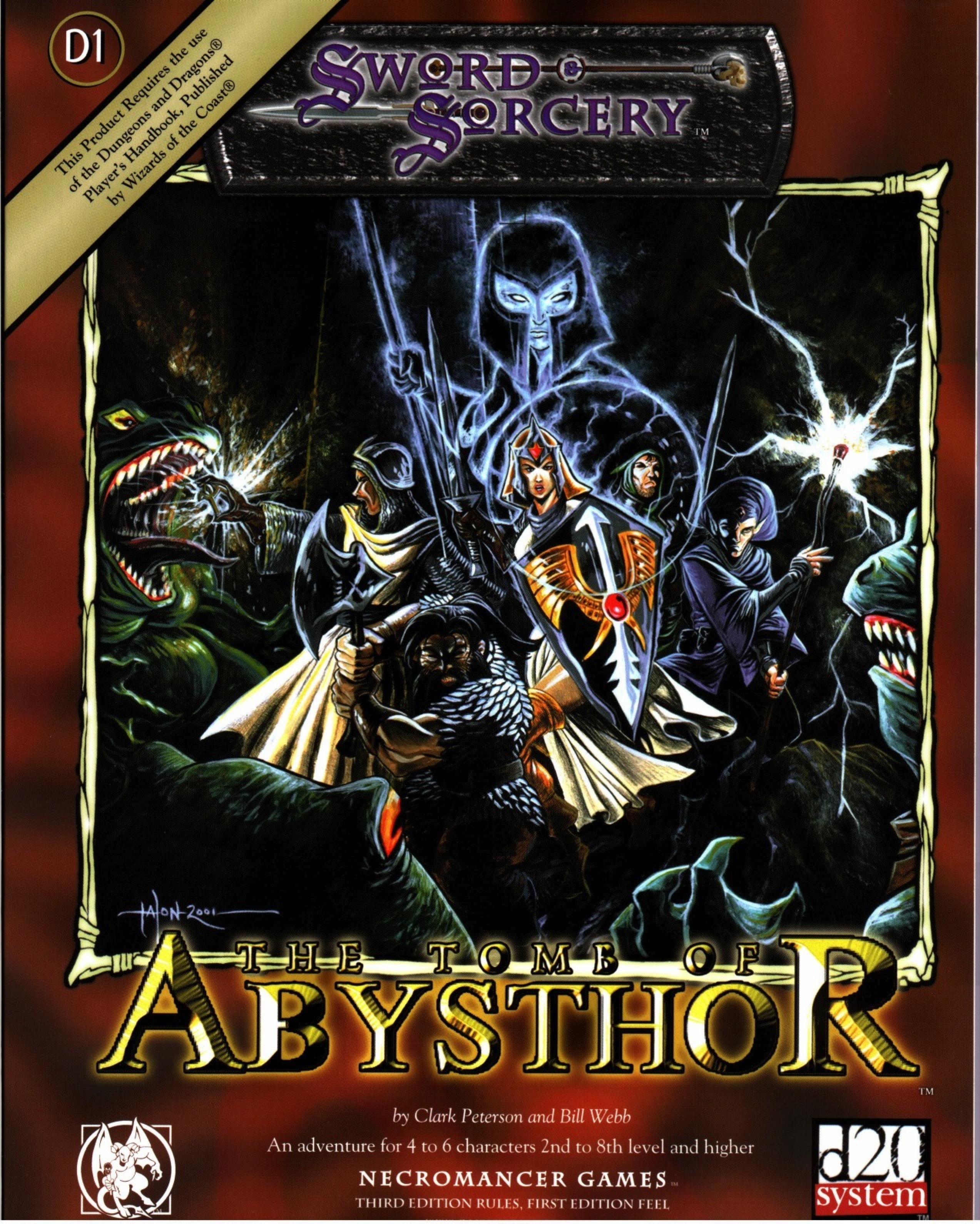
Restore an Abandoned Temple Enter the catacombs near the desecrated Temple of Muir, Goddess of Paladins, and search for the lost tomb of Abysthor. Will your party be able to cleanse the evil that now inhabits these once-sacred halls, and recover the Stone of Tircople? Can your characters survive the traps of an undead sorcerer? Will your players discover the chamber of Living Rock and the secret power it holds? Adventure awaits! Gold and Glory! A fantasy adventure published for the D20 system, The Tomb of Abysthor is the first module in Necromancer Games Dungeon series and can be played as a stand-alone story or in conjunction with The Crucible of Freya and the forthcoming city supplement Bards Gate. What secrets lie hidden in the tomb of Abysthor?
It’s up to your brave heroes to fight off the invading kobolds and save… the cheese?? Well, a job’s a job, and things underground are seldom what they seem. Wheel of Evil is a 16-page adventure for old-school characters of levels 3 to 5, plus a full-color cover, classic maps, and handouts. Compatible with Labyrinth Lord™ and similar games, including the Advanced Edition Companion. "Wheel of Evil" is part of the Eastern Valnwall setting, based on the Known Lands in Labyrinth Lord™! This adventure blends traditional dungeon crawling with unique elements of horror and intrigue, set against the backdrop of a seemingly mundane task turned deadly by the influence of a hidden evil.

After turning himself into a manticore, the self-style wizard-artiste, Mortzengersturm, moved to the crystalline peak of Mount Geegaw to practice his transformation magic without interference. You've been hired to snatch his most prized artifact, the Whim-Wham Stone--or at least some of its eldritch light. A menagerie of magic hybrids, a self-absorbed vampire, more than a few hippogriffs, and of course, the mad manticore himself await! It's like a Rankin-Bass stop motion special--except it could end in a total party kill.

People in the Blight begin to awaken at night burning with an all-too-real fire. Most of them die horribly, spouses or lovers staring in shocked horror at their sudden death throes in the grip of consuming flames. A few of the truly unlucky actually manage to survive -- if living in such a state can be called survival. There seems to be no rhyme or reason in the victims of these incinerating dreams, as those among the high and low fall victim to its touch, and the locals each pray that he or she will not be next. Now no one dares to sleep. By renowned author and creator of the Blight, Richard Pett, The Crucible is a 7th-level stand-alone adventure of urban horror set in his own crooked city of the Blight. This adventure may not be suitable for children below the age of 13.
The road to the remote village of Swordfall is a long and winding one. It takes pilgrims who wish to visit the holy site from the main trade road, through the hills, and into the mountains where once, thousands of years ago, two gods engaged in an epic battle. Now, all that remains of the battlefield is a lone sword, several hundred feet tall, embedded in the ground at the center of a massive crater. Over the years, a large temple to Thuul, god of battle, sprung up around the site. Now, warriors and fighters from across the land travel to Swordfall to pay their respects once in their lifetime. Recently, however, pilgrims have begun going missing. Somewhere between the main road and Swordfall itself, something, or someone, has been waylaying travelers. Unbeknownst to most, a cult to Ghenna has taken over one of the lone inns along the route and has begun using it to capture and sacrifice pilgrims to their own dark god. Unless a group of adventurers can stop them, the sacrifices won't stop.
An elder warlock from the goblinoid swamp village of Urzin has been kidnapped by soldiers of the Dwendallion Empire. Now the machinations of an evil imperial inquisitor might unleash an evil that could threaten the garrison at Fort Venture and the goblinoids of Urzin alike.

Visit Marlinko, a borderlands city where life takes a strange fever-dream cast, in this 72-page urban adventure fantasy supplement. Part city-setting, part full-blown adventure, Fever-Dreaming Marlinko is a stand-alone companion to the Slavic acid fantasy weirdness of the Slumbering Ursine Dunes. Contains background and hooks for the city's four city quarters, two complete dungeon adventure sites, two new players classes (Mountebank and Robodwarf), Chaos Index with escalating events/triggers scattered throughout the city, news generator with full news briefs and hooks, and tiger-wrestling mini-game.
Two Days to Live! Welcome to Om Amarna, and the annual Horse Festival. It is a time of celebration, drinking, haggling, and thanksgiving. Celebrate while you can, because soon the peace will be shattered. And in its wake will come danger, suspicion, and tragedy. In this first adventure in the cursed land of Tieros, beginning characters will be forced to work together in a race against time to find critical answers in a crowded, diverse, and paranoid city. Answers that will satisfy the Dark Guard and the Cult of Justice. Answers that will save their own necks from the gallows. The Sword of Justice introduces Tieros, a land cursed by the acts of an ancient hero, bound by common fate, and diverse in culture and belief. In this adventure characters will become familiar with an exotic new PC race, the dangers of practicing magic in Tieros, the fanatical Cult of Justice who worships Law itself, and the ubiquitous Dark Guard, the military power that protects and enforces peace. Will you survive your first adventure in Tieros, or will it claim your life? Published by MonkeyGod Enterprises
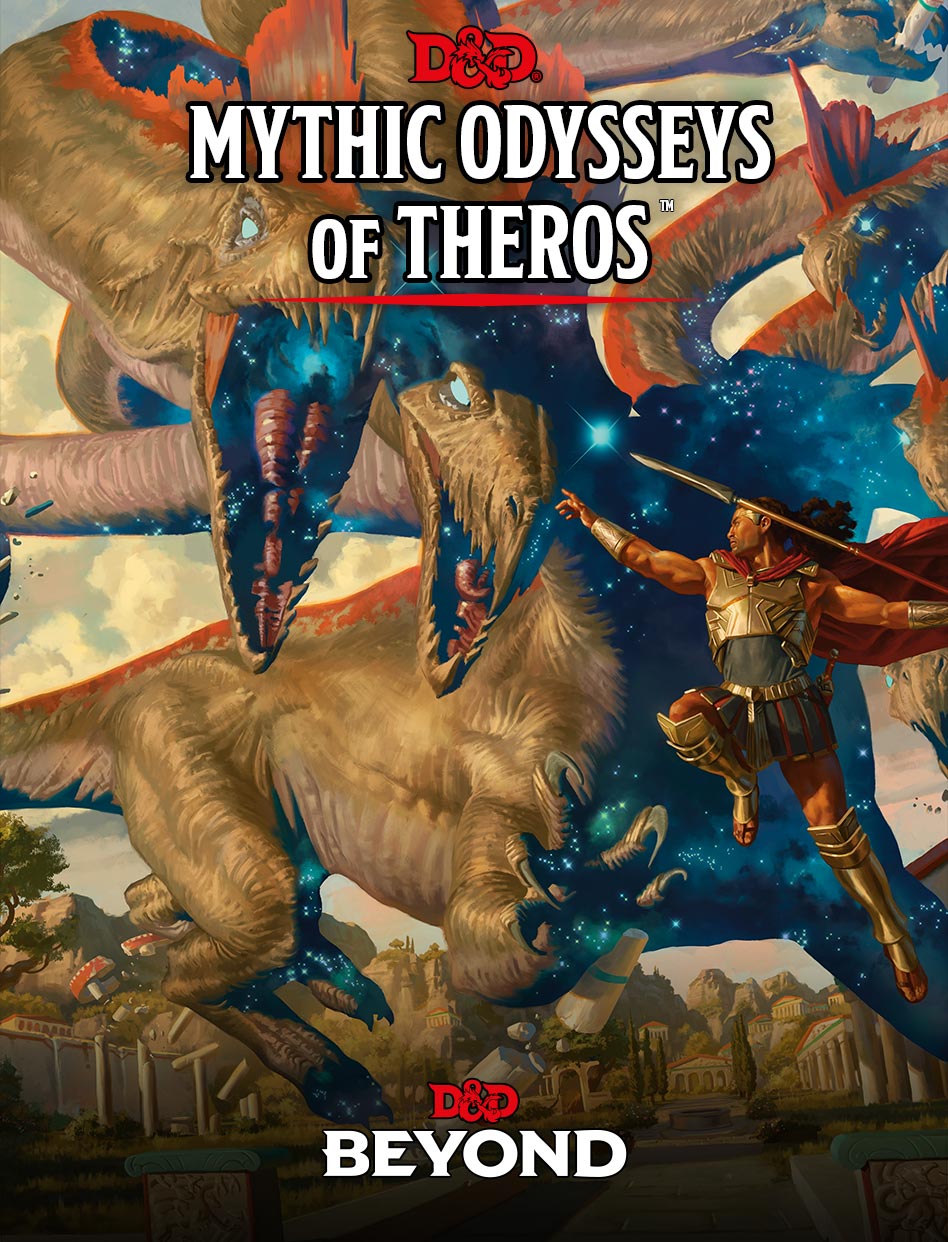
The adventure begins with the characters discovering the recently murdered Returned, Varyas, and confronting his killers. Varyas's gold mask bears a code on it, one that points toward the sage Khea who lives in the nearby polis. When the characters investigate, they learn from Khea that the writing is undecipherable except for the first line, which refers to the legendary Court of Orestes, a site sacred to the god Phenax. She also notes that a recent earthquake has uncovered a cave along the Khystonos River that could be the secret site's location. If so, then perhaps within lies the key to deciphering the mask, along with its own treasures. With the information provided by Khea, the adventurers set forth into the wilds, where they'll face multiple storied dangers before reaching the Court of Orestes. Once at the lost holy site, the characters discover ancient guardians, as well as an unliving entity with the potential to reveal Phenax's lost secret.
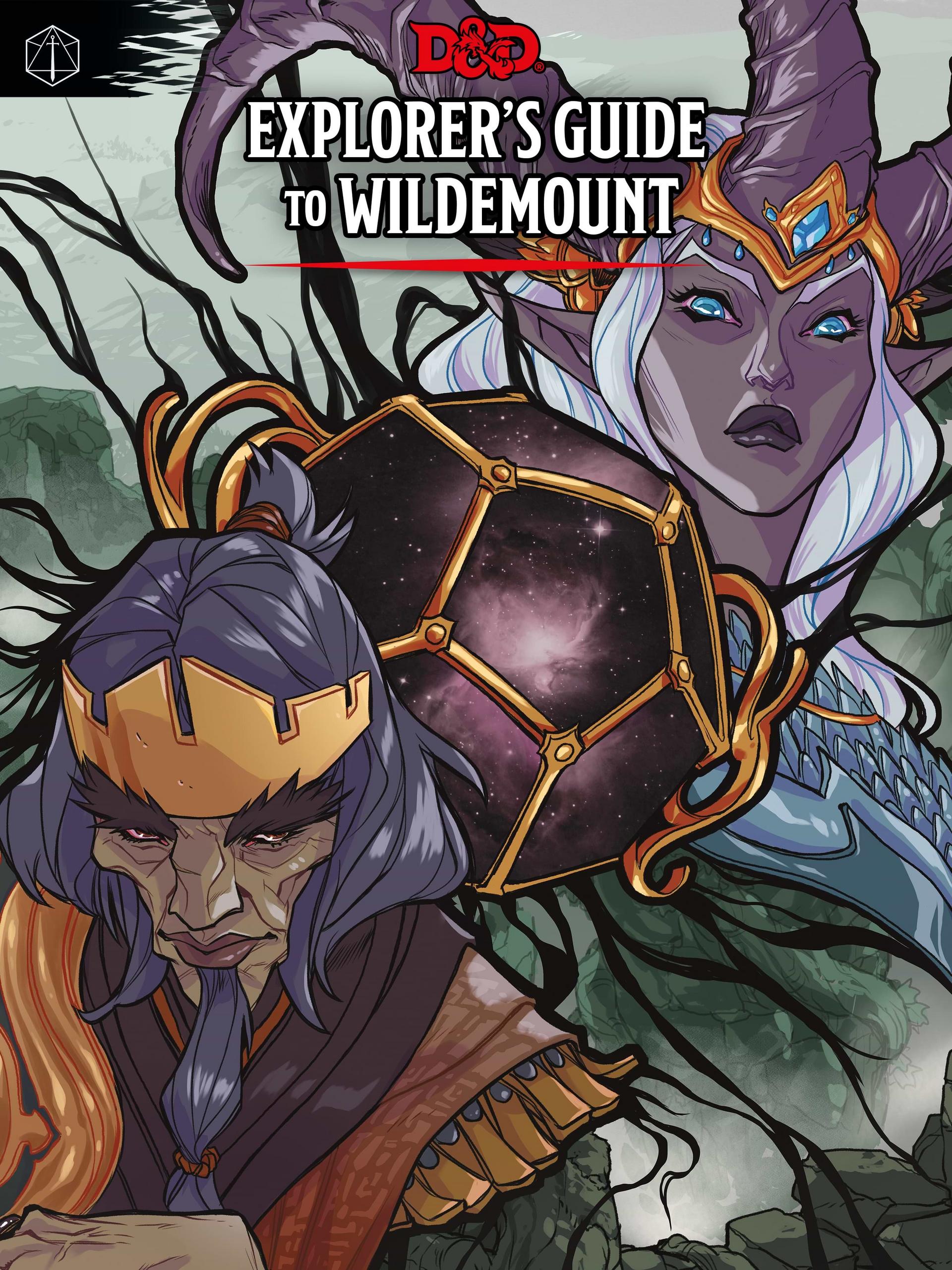
Create your own Critical Role campaigns with this sourcebook for the world's greatest roleplaying game! Explorer’s Guide to Wildemount provides everything you need to play Dungeons & Dragons on the continent of Wildemount (set within the world of Exandria)—a land of war, betrayal, and swashbuckling adventure. Comprised of four regions, Wildemount provides endless potential for adventure in a land of brewing conflict and incredible magic. Rising tensions boil over into all-out war between the politically dubious Dwendalian Empire and the light-worshiping wastefolk of Xhorhas, supplying a vibrant backdrop for any D&D campaign to explore. Uncover a trove of new options usable in any D&D game, featuring subclasses, spells, magic items, monsters, and more, rooted in the adventures of Critical Role—such as Vestiges of Divergence and the possibility manipulating magic of dunamancy. Start a campaign in any of Wildemount’s regions using a variety of introductory adventures, dozens of regional plot seeds, and the heroic chronicle system—a way to create character backstories rooted in Wildemount. Explore every corner of Wildemount and discover mysteries revealed for the first time by Critical Role Dungeon Master, Matthew Mercer. Includes: Frozen Sick: https://www.adventurelookup.com/adventures/frozen-sick Unwelcome Spirits: https://www.adventurelookup.com/adventures/unwelcome-spirits Tide of Retribution: https://www.adventurelookup.com/adventures/tide-of-retribution Dangerous Designs: https://www.adventurelookup.com/adventures/dangerous-designs
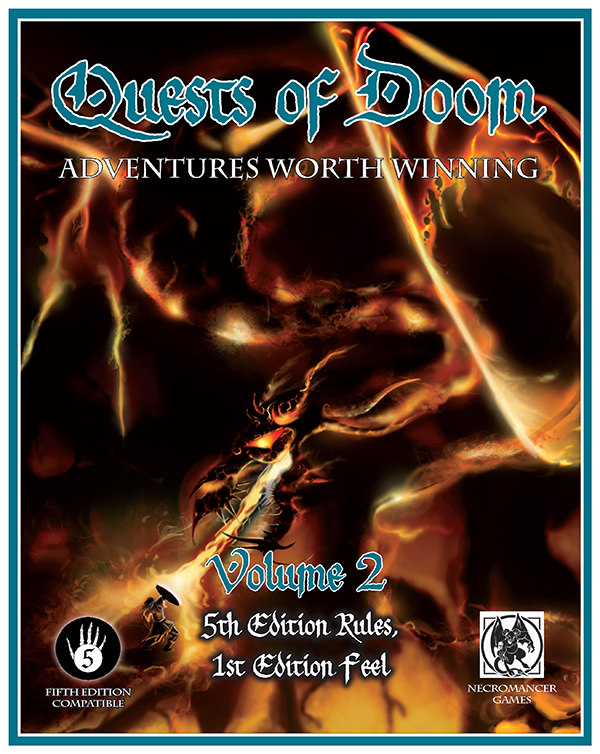
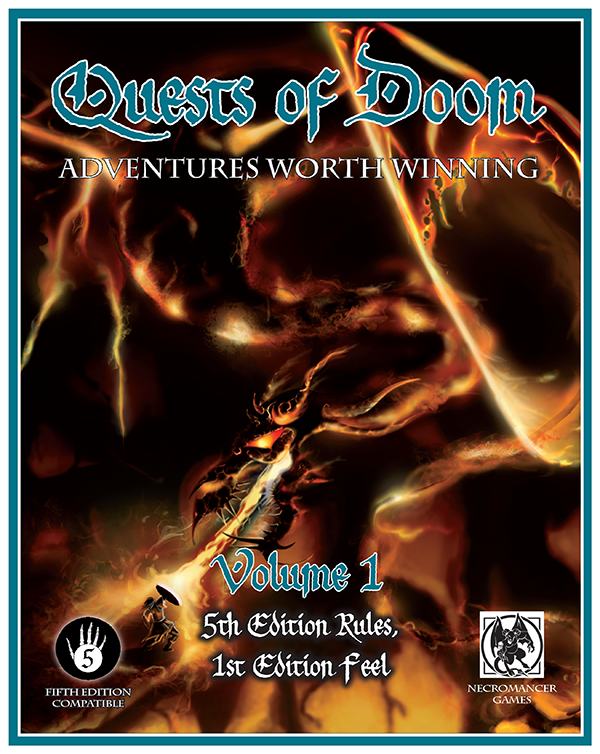
Quests of Doom Volume 2: 6 MORE Adventures for Fifth Edition Rules, First Edition Feel! For Quests of Doom Volume 1, we brought in some of the biggest stars in adventure-writing history to produce 12 mindbogglingly insidious adventures for Fifth Edition. This is volume 2, containing six more explorations into “doom or glory” for your players. Once again, the all-star cast of authors delivers what we strive to give you: Adventures Worth Winning! Volume 2 of Quests of Doom contains 6 adventures in 100 pages, byBill Webb (Of Ants & Men, Pit of Despair, Isle of Eliphaz), Matt Finch (Perils of Ghostwind Pass), Jim Ward (Dread Dragon Temple), Michael Curtis (The Darkening of Namjan Forest), and Casey Christofferson (Pit of Despair).