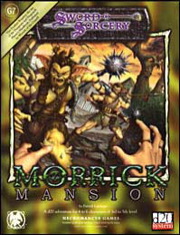
A Deadly Curse is Spreading! Morrick Mansion and the surrounding vineyards were deserted years ago when a terrible curse twisted every living thing on the property into a mockery of its prior form. Once whispered about and avoided, fear now grips the land. The curse spreads and someone needs to stop it. Can you find its source and cure it forever, or will the very curse you are investigating touch you with madness? Hatred, Death, and Danger! Morrick Mansion challenges adventurers to battle strange, mutant creatures in an effort to solve a mystery and stop an insidious curse. Do your players dare enter the mysterious mansion and can they survive long enough to discover the source of the curse?

I am the Set Rahotep No man was more potent when I was amongst those dwelling in the land of Khemit. In death I am greater still! Do you not fear serpents? I am the Aepep Rahotep! Who does not tremble before the monsters of the Duat? I am one! Does your flesh not crawl at the sight of a terrible wyrm? I am the Deathwyrm Rahotep! Does your blood run cold before the face of a fiend? Know then that I am Rahotep the Fiend! Who shuns not demons? Shun me, for I am the demon Rahotep, the Red Devil. And which fool listens? That one is wise! Praise Set and the Set Rahotep, that one, and pity the rest! An Epic Adventure and Sourcebook Gary Gygax's Necropolis is a vast campaign scenario that sweeps the characters into an epic adventure across the magical desert kingdom of Khemit. From a hidden evil in a desert village, to the secrets of ancient tombs, Necropolis takes the characters on a dangerous mission to thwart the plans of an undying archpriest-wizard who would be a god! Necropolis is also a campaign sourcebook, detailing the lands of Khemit, new classes and prestige classes, new spells and more than 60 monsters unique to the desert lands. This book also details over 50 new gods and new cleric domains, allowing DMs to run extended campaigns in the desert kingdom.

There have been disturbing signs over the last few months, signalling that something is wrong in Humblewood. The troubles appear to originate from activity in the Scorched Grove, an ashen plain that was ravaged many centuries ago by a destructive fire. Whatever caused the fire has scarred the land with elemental magic, making it inhospitable to all but strange fire-based creatures. Of late, the Grove has begun to expand. At first, it was hard to notice the slow expansion, but those in tune with nature (especially the Tenders) could see the imbalance in the elemental forces of Humblewood. For many common folk, this imbalance has been experienced as unseasonal dryness, which has led to crop failure and an increased frequency of forest fires. There have also been a number of unusually aggressive emberbat clouds reported far outside of their natural ranges. The true nature of the danger still remains hidden from the people of the Wood. A corvum necromancer named Odwald Ebonhart has stirred the elemental aspect of fire, which has lain dormant beneath the Scorched Grove since its first burning. The aspect’s energies have begun to empower fire-based creatures within the Wood. The increased range of emberbat swarms have brought fires that have expanded the Grove. Many forest-dwellers, who have been left without homes, have turned to banditry to survive. Soon the elemental incarnation will break free, and players must find a way to stop the aspect of fire before it reduces the Wood to ashes.
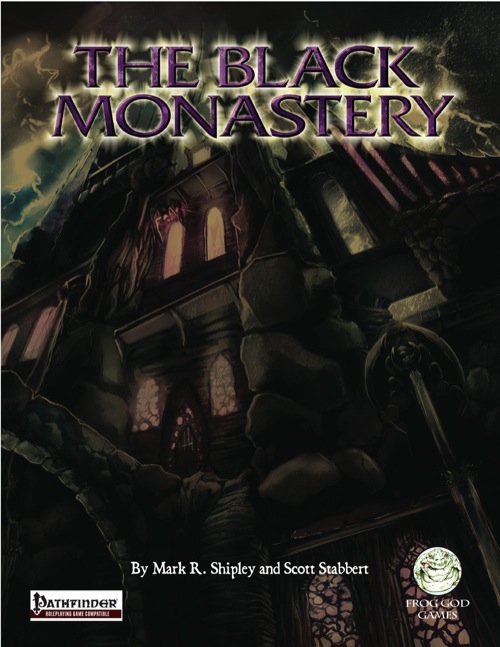
The Legend of the Black Monastery Two centuries have passed since the terrible events associated with the hideous cult known as the Black Brotherhood. Only scholars and story-tellers remember now how the kingdom was nearly laid to waste and the Black Monastery rose to grandeur and fell into haunted ruins. The Brothers first appeared as an order of benevolent priests and humble monks in black robes who followed a creed of kindness to the poor and service to the kingdom. Their rules called for humility and self denial. Other religious orders had no quarrel with their theology or their behavior. Their ranks grew as many commoners and nobles were drawn to the order by its good reputation. The first headquarters for the order was a campsite, located in a forest near the edge of the realm. The Brothers said that their poverty and dedication to service allowed them no resources for more grand accommodations. Members of the Black Brotherhood built chapels in caves or constructed small temples on common land near villages. They said that these rustic shrines allowed them to be near the people they served. Services held by the Brothers at these locations attracted large numbers of common people, who supported the Black Brotherhood with alms. Within 50 years of their first appearance, the Black Brotherhood had a number of larger temples and abbeys around the kingdom. Wealthy patrons endowed them with lands and buildings in order to buy favor and further the work of the Brothers. The lands they gained were slowly expanded as the order’s influence grew. Many merchants willed part of their fortunes to the Black Brotherhood, allowing the order to expand their work even further. The Brothers became bankers, loaning money and becoming partners in trade throughout the kingdom. Within 200 years of their founding, the order was wealthy and influential, with chapters throughout the kingdom and spreading into nearby realms. With their order well-established, the Black Brotherhood received royal permission to build a grand monastery in the hill country north of the kingdom’s center. Their abbot, a cousin of the king, asked for the royal grant of a specific hilltop called the Hill of Mornay. This hill was already crowned by ancient ruins that the monks proposed to clear away. Because it was land not wanted for agriculture, the king was happy to grant the request. He even donated money to build the monastery and encouraged others to contribute. With funds from around the realm, the Brothers completed their new monastery within a decade. It was a grand, sprawling edifice built of black stone and called the Black Monastery. From the very beginning, there were some who said that the Black Brotherhood was not what it seemed. There were always hints of corruption and moral lapses among the Brothers, but no more than any other religious order. There were some who told stories of greed, gluttony and depravity among the monks, but these tales did not weaken the order’s reputation during their early years. All of that changed with the construction of the Black Monastery. Within two decades of the Black Monastery’s completion, locals began to speak of troubling events there. Sometimes, Brothers made strange demands. They began to cheat farmers of their crops. They loaned money at ruinous rates, taking the property of anyone who could not pay. They pressured or even threatened wealthy patrons, extorting money in larger and larger amounts. Everywhere, the Black Brotherhood grew stronger, prouder and more aggressive. And there was more… People began to disappear. The farmers who worked the monastery lands reported that some people who went out at night, or who went off by themselves, did not return. It started with individuals…people without influential families…but soon the terror and loss spread to even to noble households. Some said that the people who disappeared had been taken into the Black Monastery, and the place slowly gained an evil reputation. Tenant farmers began moving away from the region, seeking safety at the loss of their fields. Slowly, even the king began to sense that the night was full of new terrors. Across the kingdom, reports began to come in telling of hauntings and the depredations of monsters. Flocks of dead birds fell from clear skies, onto villages and city streets. Fish died by thousands in their streams. Citizens reported stillborn babies and monstrous births. Crops failed. Fields were full of stunted plants. Crimes of all types grew common as incidents of madness spread everywhere. Word spread that the center of these dark portents was the Black Monastery, where many said the brothers practiced necromancy and human sacrifice. It was feared that the Black Brotherhood no longer worshipped gods of light and had turned to the service of the Dark God. These terrors came to a head when the Black Brotherhood dared to threaten the king himself. Realizing his peril, the king moved to dispossess and disband the Black Brother hood. He ordered their shrines, abbeys and lands seized. He had Brothers arrested for real and imagined crimes. He also ordered investigations into the Black Monastery and the order’s highest ranking members. The Black Brotherhood did not go quietly. Conflict between the order and the crown broke into violence when the Brothers incited their followers to riot across the kingdom. There were disturbances everywhere, including several attempts to assassinate the king by blades and by dark sorcery. It became clear to everyone that the Black Brotherhood was far more than just another religious order. Once knives were drawn, the conflict grew into open war between the crown and the Brothers. The Black Brotherhood had exceeded their grasp. Their followers were crushed in the streets by mounted knights. Brothers were rounded up and arrested. Many of them were executed. Armed supporters of the Black Brotherhood, backed by arcane and divine magic, were defeated and slaughtered. The Brothers were driven back to their final hilltop fortress – the Black Monastery. They were besieged by the king’s army, trapped and waiting for the king’s forces to break in and end the war. The final assault on the Black Monastery ended in victory and disaster. The king’s army took the hilltop, driving the last of the black-robed monks into the monastery itself. The soldiers were met by more than just men. There were monsters and fiends defending the monastery. There was a terrible slaughter on both sides. In many places the dead rose up to fight again. The battle continued from afternoon into night, lit by flames and magical energy. The Black Monastery was never actually taken. The king’s forces drove the last of their foul enemies back inside the monastery gates. Battering rams and war machines were hauled up the hill to crush their way inside. But before the king’s men could take the final stronghold, the Black Brotherhood immolated themselves in magical fire. Green flames roared up from the monastery, engulfing many of the king’s men as well. As survivors watched, the Black Monastery burned away, stones, gates, towers and all. There was a lurid green flare that lit the countryside. There was a scream of torment from a thousand human voices. There was a roar of falling masonry and splitting wood. Smoke and dust obscured the hilltop. The Black Monastery collapsed in upon itself and disappeared. Only ashes drifted down where the great structure had stood. All that was left of the Black Monastery was its foundations and debris-choked dungeons cut into the stones beneath. The war was over. The Black Brotherhood was destroyed. But the Black Monastery was not gone forever. Over nearly two centuries since its destruction, the Black Monastery has returned from time to time to haunt the Hill of Mornay. Impossible as it seems, there have been at least five incidents in which witnesses have reported finding the Hill of Mornay once again crowned with black walls and slate-roofed towers. In every case, the manifestation of this revenant of the Black Monastery has been accompanied by widespread reports of madness, crime and social unrest in the kingdom. Sometimes, the monastery has appeared only for a night. The last two times, the monastery reappeared atop the hill for as long as three months…each appearance longer than the first. There are tales of adventurers daring to enter the Black Monastery. Some went to look for treasure. Others went to battle whatever evil still lived inside. There are stories of lucky and brave explorers who have survived the horrors, returning with riches from the fabled hordes of the Black Brotherhood. It is enough to drive men mad with greed – enough to lure more each time to dare to enter the Black Monastery.

Moonless Night is an adventure module composed of short adventures which are compatible with both the first and second editions of the Advanced Dungeons and Dragons game.
The Siege of Castle Rend is an adventure for the fifth edition of the world’s first roleplaying game, suitable for five 5th-level characters. It takes place over four parts, and each part can be completed in one or two sessions of play, depending on your group’s playstyle and how long you like to play in a single sitting. If all goes according to plan over the course of this adventure, the player characters will expose an usurping lord, fight orcs, acquire a stronghold, defend it from an invading army, win the admiration of a town filled with potential vassals, and make political connections within the Barony of Bedegar. Of course, no adventure goes according to plan. The PCs will invariably throw these well-laid schemes into chaos, and they’ll have to improvise. But if we know how things would have gone if the PCs never showed up (or are cowards), it makes it easier for us GMs to improvise when things go off the rails. Published by MCDM

Baron Ketterall’s lands are beset by a plague of marauding goblins! Goblins you say? Pah! Who's afraid of few poxy goblins? But two experienced parties have already gone looking for the goblin lair – never to be heard of again. Poxy goblins you say? Be afraid, be very afraid… The scenario is designed to be an extremely challenging adventure that might undermine a player’s bravado in dealing with low-level monsters such as goblins. Unusual traps, tricks and special weapons are used by the inhabitants of the dungeon to cause the party as much trouble as possible. Published by Dunromin University Press.
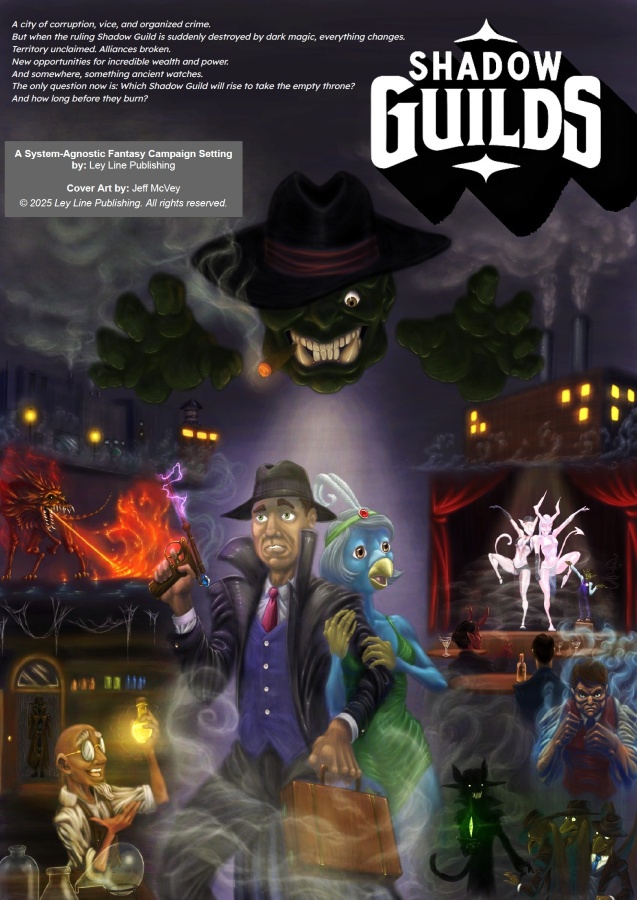
The leader of all the Shadow Guilds, the Ceta Consortium is gone, wiped out in a single night, without warning or witnesses. Their empire of control, secrecy, and soft-handed rule has vanished, leaving behind only rumors and blood. Now, the city of Lumina stands on the edge of something new... and something dangerous. Shadow Guilds is a system-agnostic tabletop campaign setting built for fantasy games that blur the line between ambition and morality. Set in a bustling metropolis of vice, corruption, and uneasy power, it invites players to step into the roles of underworld mafiosos, trying to make their mark—or just survive the fallout. Inside, you’ll find everything you need to run a campaign focused on gang politics, black-market enterprise, and the slow scramble toward power in a world that rewards the bold and punishes the careless. You’ll build a crew, carve out territory, and navigate a world where magic is outlawed, alliances are temporary, and opportunity lurks behind every closed door. This is not a story of chosen heroes or grand prophecies. It’s a story of clever rogues, ruthless enforcers, and ambitious criminals rising into the vacuum left by the old guard. The game leans into roleplay, style, and smart decision-making—but it doesn’t shy away from trouble when it finds you. Start small. Lie often. Watch your back. Shadow Guilds is a system-neutral campaign setting designed to drop into any fantasy world where criminal syndicates thrive in the shadows of power. Whether you're running a long-form campaign, a gritty one-shot, or threading a criminal conspiracy into your existing world, this guide provides the building blocks for a dangerous, decadent underworld full of secrets, turf wars, and moral gray areas. This setting assumes a single sprawling metropolis, where various criminal guilds operate openly or in secret. It leans into noir fantasy, urban intrigue, prohibition, and the uncomfortable alliances forged when justice fails.

Break in. Do the job. Survive the fallout. In a city so vast as Pindus-on-Isles, if you want to get ahead, you need to cozy up with someone powerful. And do something dangerous. When Hope the Fixer shows up at your door with a job from an anonymous employer, the pay is good enough. Are you? Seems there’s a thief holed up in a Wizard’s Egg, a stone laboratory suspended high on a tower. The anonymous employer wants the stolen goods trashed. It’s in Lightmill though. Those glittering skyscrapers are no place for basegels like you. Get your disguise together. Hope’s got the hippogriffs. It’s destruction time.
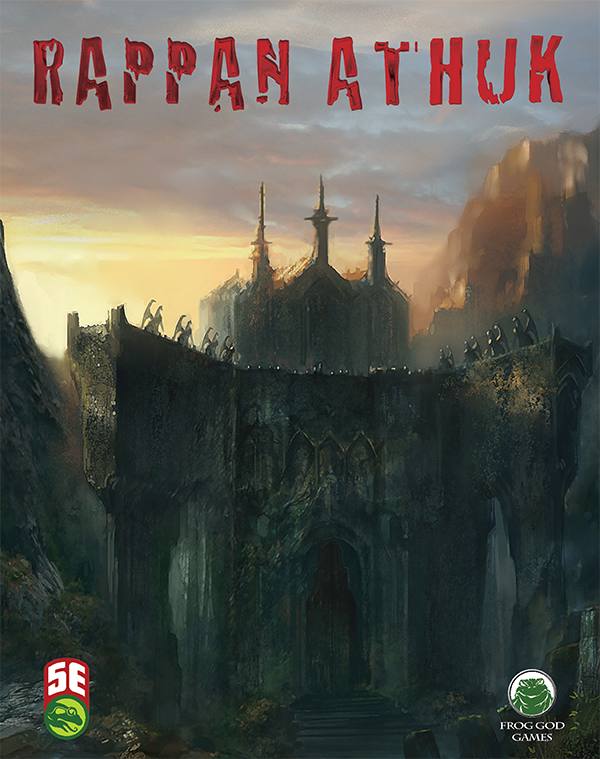
The Dungeon of Graves, is nothing more and nothing less than a good, old–fashioned, First Edition dungeon crawl updated for the 5th Edition Roleplaying Game. Very difficult, it should strike fear into the hearts of the most stalwart adventurers. It offers an abundance of traps, tricks, and monsters. We hope that you find this module as fun and exciting as those thousands of players who have ventured into (and not as often out of) the endless caverns and mazes of Rappan Athuk—The Dungeon of Graves. Rappan Athuk is a difficult dungeon. Even the upper dungeon levels should not be attempted by a party of less than six mid-level characters.
:strip_icc()/pic530586.jpg)
A scenario for a party of 4th-7th level adventurers You've earned quite a reputation as fearless adventurers, the sort who take on anything. But what happens when you come face-to-face with the challenge that bested the greatest adventurer in the whole Kingdom? Can you succeed where Feyr-Panniras failed? Can you find what has turned his friends against the Kingdom? And, more than anything, can you survive against the power of the New Gods?
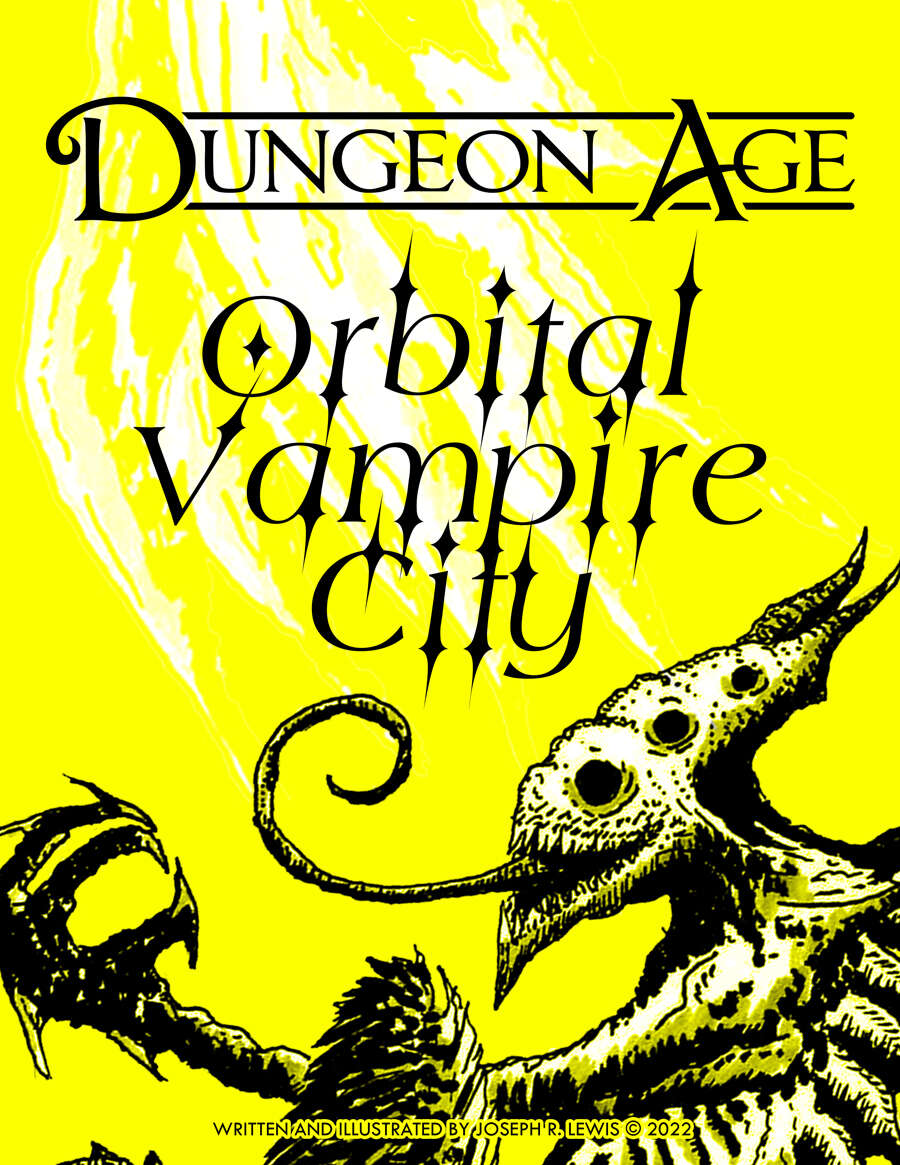
Far out in the void, an ancient city of vampires endures. Welcome to Araveshti, a city of a thousand towers floating safely in the shadow of the world, glittering with starlight, thrumming with ancient magics, and crawling with vicious immortals. Will you seek to destroy these bloodthirsty aristocrats? Or will you help them pursue their bizarre alchemical experiments in immortality? Or will you simply seek a way to escape their twisted and crumbling paradise? Within these ancient towers, adventurers will find vampire lords and servants, zealots and goliaths, as well as werewolves, mycotic zombies, victims of strange experimentation, fanatical holy knights, tragic vampire hunters in black, shipwrecked dreamers, castaway aliens, metal angels, eldritch horrors, star dragons, and (of course) the vampires' giant dragon-killing mecha suit... This is a dark sandbox. Players will explore a vast city of undead people and monsters in outer space, full of homages to classic horror and science fiction films and literature. ADVENTURE TYPE: Mid Level / Combat / Exploration / Dark Fantasy / Fantasy City / Gothic Horror DESIGN NOTES This adventure is intended for mid-level characters around Level 5-10 Players explore a large vampire city in space, encounter numerous NPCs and monsters, and engage with diverse factions to destroy, conquer, or escape from the city 40+ unique encounter locations, plus countless randomly generated locations 100+ original magic items 40+ original monsters One city map Estimated play time: 1-8 sessions (4-32 hours)

Run, play or splice up 66 pages of mayhem and weirdness in this Slavic mythic-inspired (with an acid fantasy-twist) mini-sandbox for Labyrinth Lord or the well-aged fantasy rpg of your druthers. Contains: • A 25-site pointcrawl of the otherwordly Slumbering Ursine Dunes region. Beyond the big ticket adventure sites you will find along the way a Polevik-haunted rye field, a Zardoz head-living hermit, bearling pilgrimage site, antediluvian beaver engineers and other assorted madness. • Two separate “dungeons”, the bio-mechanical, lost-in-time Golden Barge and the faction-contested Glittering Tower, with enough detail and portability to be slotted into an existing campaign. • The Chaos Index, a dynamic events system for modeling the mythic weirdness of the Dunes. Actions of the players in the sandbox will escalate or de-escalate the levels of events. • Four competing factions operating inside the Dunes, plus guidelines for their mutual interactions.
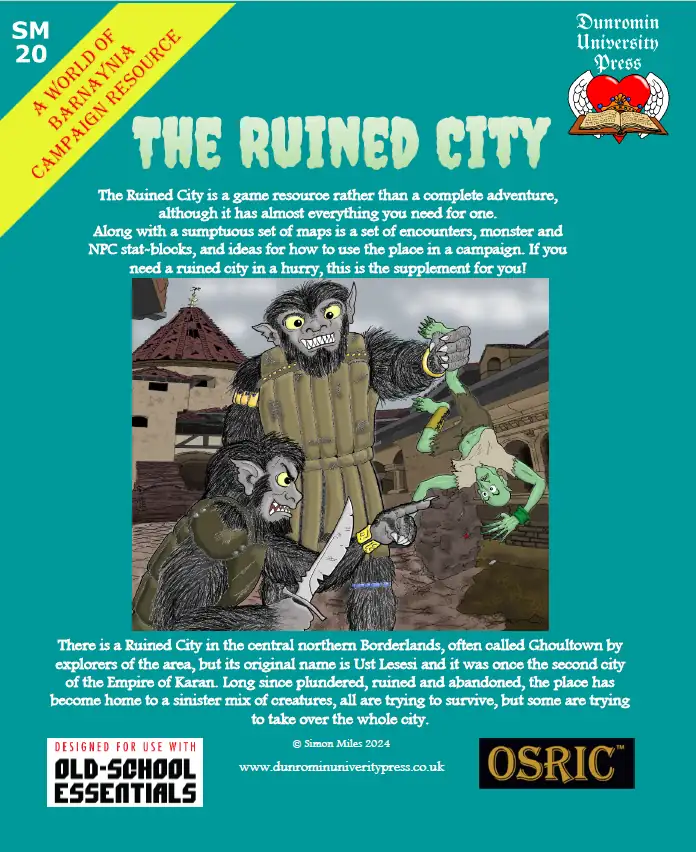
There is a Ruined City in the central northern Borderlands, often called Ghoultown by explorers of the area, but its original name is Ust Lesesi and it was once the second city of the Empire of Karan. Long since plundered, ruined and abandoned, the place has become home to a sinister mix of creatures, some are trading with each other, some are resting between skirmishes, all are schiming and all of them are trying to survive. This is a toy box for the GM - there are three settings in one - the Abandoned City, with stange creatures wandering the streets; the Monstrous community with several significant and detailed NPCs and their followers all trading, quarrelling and trying to get along with each other; and the city of the (un)dead - there's a whole army hidden in here, what are they being prepared for? The Ruined City is a 40-page game resource rather than a complete adventure, although it has almost everything you need for a simple hack or a more complex web of intrigue. Along with a sumptuous set of maps is a set of encounters, monster and NPC stat-blocks, and ideas for how to use the place in a campaign. If you need a ruined city in a hurry, this is the supplement for you! The Ruined City is designed for OSR but is also compatible with AD&D 1st and 2nd edition and pretty much any TTFRPG you fancy. The encounters are all pretty high level but most of the encounters will not be immediately hostile. There is scope in this setting for far more than simple hack and slash. These resources allow you to build a set of encounters as complex as you like. You can simply try and hack your way through, but there are some VERY nasty encounters in here. You could maybe set up your own base here, or just try and take over an existing group. Perhaps you want to start up a trade route, or maybe even start a Civil War! All of these possibilities, and many others, are catered for here. SM20 The Ruined City is released by Dunromin University Press. We are a very small publisher based in the UK and our aim is to produce VERY high quality products as the best value possible.
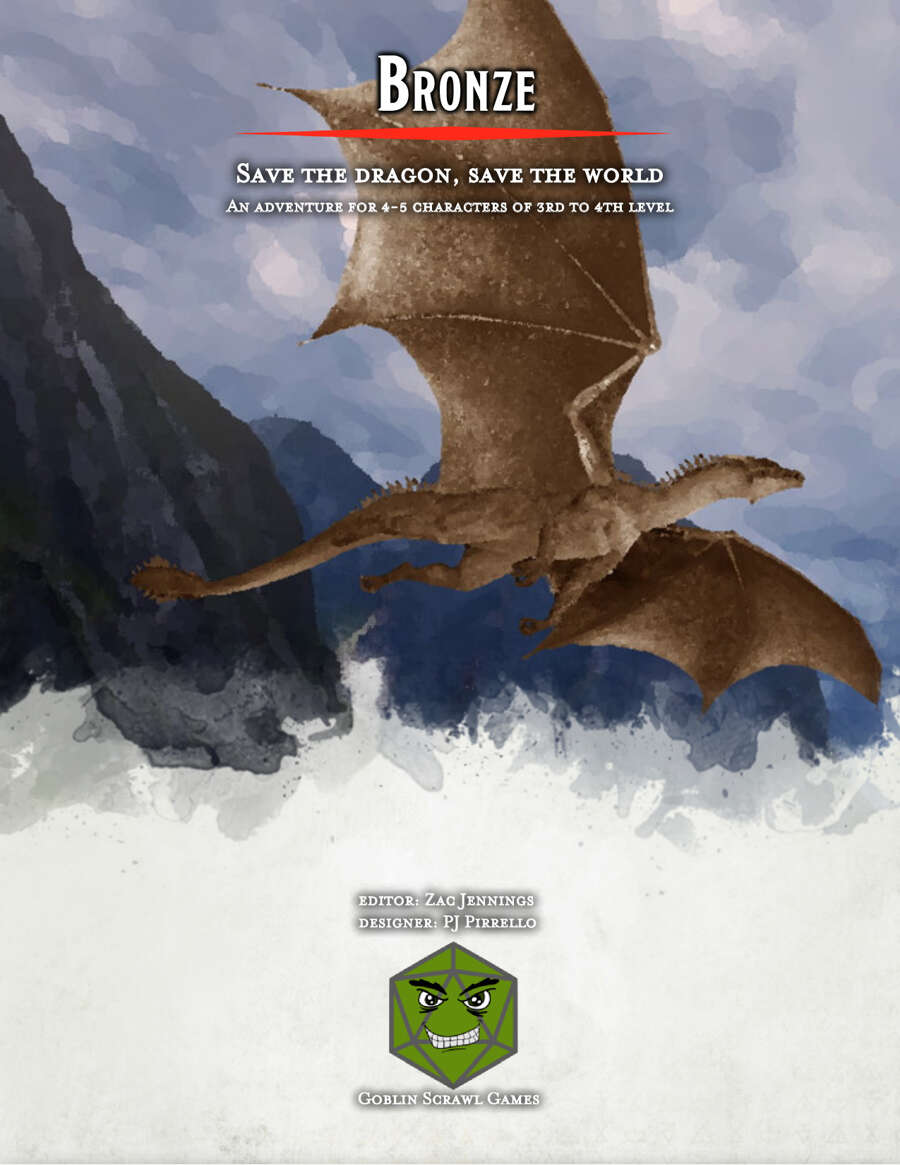
The idyllic town of Evershade is about to get a lot less peaceful. Nestled in a small valley near the border of two kingdoms, Evershade is a small but prosperous town. But ranchers have been finding their livestock slaughtered, with no idea what's behind it. What begins as a simple mission to scare off a predator, turns into a race across hills and mountains to prevent agents of evil from destroying a future force for good. Includes A adventure for 4-5 characters of 3rd to 4th level A regional map of the areas surrounding the town of Evershade Descriptions of the town of Evershade and several of the notable NPCs that live there A map of the dragon's lair on a cliff near the sea Stat blocks for all monsters Unnumbered map suitable for use in your favorite VTT Published by Goblin Scrawl Games

The Blood of a King The king is dead. All hail the king! The nomadic cattle-herding tribes of Shoma now meet at the Horns of Ngura to sacrifice gold and choose a new tribal king based on a series of ritual ordeals. Will you sneak into the temple of the Bull-God to steal its treasures, or will you participate as a champion in the Trials of Ngura? Savage Swords and Sinister Sorcery "The Trials of Ngura" is a stand-alone sword and sorcery adventure module, inspired by the pulp era tales of Robert E. Howard and Clark Ashton Smith. Venture in the footsteps of Conan the Cimmerian, Satampra Zeiros of Uzuldaroum, Imaro of Nyumbani, and other fabled thieves, reavers and slayers! Written for the Fifth Edition (5E) of the world's most popular roleplaying game, the adventure in this book can be easily adapted to any fantasy roleplaying game ruleset or edition.

The adventures in Dalentown continue in The Darkness Beneath Dalentown. Workers in the town’s sewers have stumbled upon the long abandoned halls of the dwarves that once settled beneath this region. What they’ve found is a haunted library. What they’ve woken is something far more sinister! The Darkness Beneath Dalentown features hordes of oozes, undead, and demons festering for years in an ancient dwarven mining stronghold. Now, they are slowly working their way to the surface, and the folk of Dalentown are in dire peril!
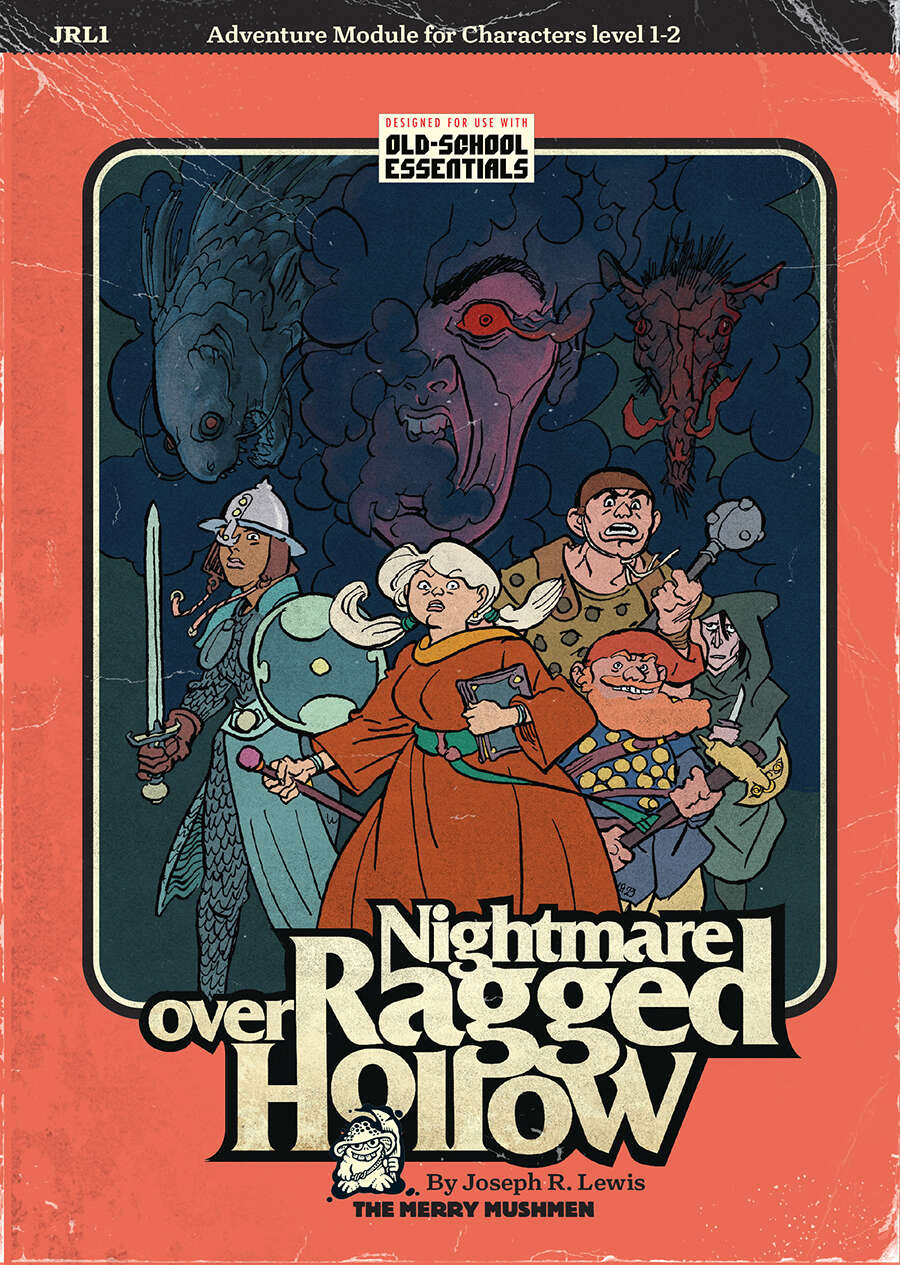
A new, expanded, OSR-ised, prettified edition of Joseph R. Lewis’ Ragged Hollow Nightmare which was rated among The Best by Tenfootpole. Joseph Lewis hit a perfect balance between the classics of dungeonverse fantasy and the whimsy of the folk tales we love so much (as testified by our Folklore Bestiary. we released last year), adding a dash of dreamworld strangeness and a pinch of body horror to spice up his brew. We did our best to respect his recipe when adding our extra material (about 30 pages of it). We worked with Joe and Li-An (the perfect artist to give life to spooky Ragged Hollow and its strange surroundings) to make the best module we could: a solid introduction to old-school gaming for both players and gamemasters. And for the veterans among us, it also makes an excellent, full-fledged campaign starter. Nightmare over Ragged Hollow is a sandbox adventure centred around a quaint town at the edge of the kingdom. But however quiet life in Ragged Hollow is, the town lies between places where you shouldn’t be traveling alone. Places like Gloam Wood (“A witch or two lurk there!”), the Bleak Mountains (“I’m told there are bugbears…”) and their infamous Mount Mourn (“Home, they say, to cursed Dwarven ruins”), not to forget the Wailing Hills (“Bandits on every road!”). There’s even a haunted house by the river (“That mad inventor riddled it with traps!”). But only when an impenetrable dome of golden light materialises around the Temple of Halcyon (“Hey, my kids go to school there!”) do things really get out of hand. Some selfless heroes (or, failing that, a bunch of greedy ne’er-do-wells) should really get involved. One town with three adventure mini-sites Three small dungeons One 50-room dungeon Three hexes with 16 detailed locations Two groups of potential allies or rivals Sixteen pre-generated characters One deadly countdown! Written for the Old-School Essentials (OSE) rule system

The Frozen Necromancer is a three-part adventure for Fifth Edition that takes player characters from levels 1 to 4. This adventure is the first in a storyline of four modules called The Demonplague that can be used as an entire campaign that takes characters from level 1 to 20. The entire adventure (or just pieces, characters, or encounters from The Frozen Necromancer) can be dropped into any fantasy setting with minimal changes
In ancient times, the area now known as the Dyrgalas Fens was home to a flourishing civilization of nature worshippers who wrested a living from the forest around them, built open-air temples, and generally did well. Over the centuries, a series of natural disasters (some say a series of foolish magical experiments) led to a rising water table and turned the forest into a vast swamp. As the water rose, most of the people left. Today, a few stalwart humans remain in the fens, living off the land through hunting, fishing, trapping, and even some agriculture. In addition to these honest folk, the Dyrgalas has some less savory residents, including both black and green dragons, trolls, hags, escaped criminals, and a host of lycanthropes. Most of these creatures prey on travelers foolish or unlucky enough to enter the fen, and sometimes raid both inside and outside the fen. This adventure, intended for characters of levels 6 to 8, deals with one group of raiders who make their lair in the Dyrgalas. A weretiger called Gavriil has formed a group of assorted lycanthropes into a band of cunning brigands. The lycanthropes favorite caper involves infiltrating a merchant caravan while posing as travelers, merchants, or swords for hire, then attacking it from within. Gavriil and his servants also take on kidnappings, murder for hire, and any other unsavory tasks that come their way.